

Quick answer
What you need to know
Discover the best AI tools for ecommerce in 2026 to automate operations, improve customer experience, and scale online sales efficiently.
What Are AI Tools for Ecommerce?
Why AI Matters for Ecommerce in 2026
Benefits of Using AI Tools in Ecommerce
Premium reader tools
Turn insight into action
The brief, before you dive in
A practical snapshot of what this guide will help you understand and apply.
Key takeaways
- What Are AI Tools for Ecommerce?: AI tools for ecommerce use technologies such as machine learning, natural language processing, predictive analytics, and generative AI to improve busi…
- Why AI Matters for Ecommerce in 2026: Many ecommerce businesses are reaching a point where manual processes can no longer support growth efficiently.
- Benefits of Using AI Tools in Ecommerce: Faster Product Content Creation Creating product descriptions, titles, specifications, category pages, and marketplace listings manually can be time-c…
- Common Challenges When Adopting AI: AI offers significant advantages, but implementation is not without challenges.
Running an ecommerce business in 2026 is more complex than ever. Sellers are managing products across multiple channels, competing for visibility in crowded marketplaces, responding to customer inquiries around the clock, and trying to maintain accurate product data while growing revenue.
The challenge is not a lack of opportunity. The challenge is maintaining efficient operations as the business scales.
This is why the best AI tools for ecommerce in 2026 have become essential for online retailers, brands, manufacturers, distributors, and marketplace sellers. AI is no longer limited to content generation. Today's ecommerce businesses are using AI to automate workflows, improve customer experiences, optimize inventory, enhance product discovery, and support better decision-making.
AI tools for ecommerce are software solutions that use artificial intelligence to automate tasks, analyze data, improve customer interactions, and increase operational efficiency across online sales channels.
The companies seeing the greatest success with AI are not replacing people. They are combining AI with experienced teams and structured processes to eliminate repetitive work and focus on growth.
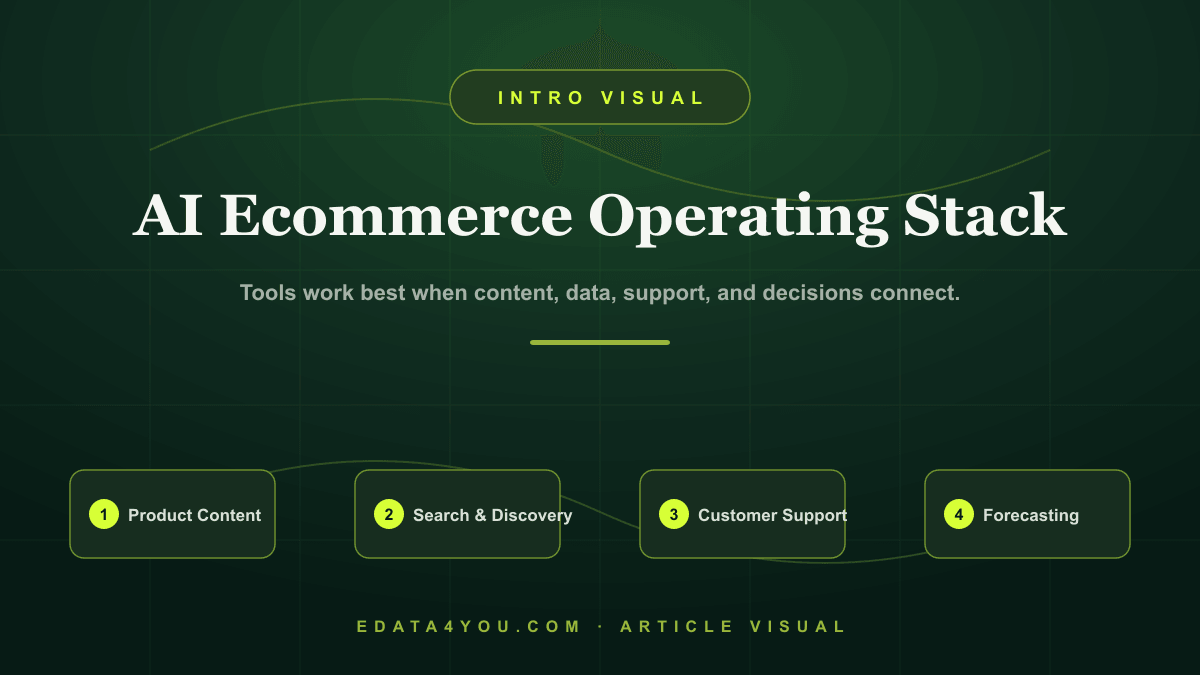
The strongest ecommerce AI stack usually covers three layers: customer experience, operational automation, and decision intelligence.
In this guide, we will explore the top AI tools for ecommerce in 2026, where they fit into your business, and how to choose the right solutions for your goals.
Need help applying this? Explore our Agentic Commerce Readiness.
What Are AI Tools for Ecommerce?
AI tools for ecommerce use technologies such as machine learning, natural language processing, predictive analytics, and generative AI to improve business operations.
These tools can support a wide range of ecommerce activities, including:
- Product content creation
- Customer support
- Inventory forecasting
- Product recommendations
- Email marketing
- Marketplace management
- Search optimization
- Data analysis
- Workflow automation
- Pricing optimization
Instead of manually performing repetitive tasks, businesses can use AI to accelerate workflows while maintaining consistency and accuracy.
For example, an ecommerce manager launching hundreds of new products can use AI to generate product descriptions, organize attributes, identify missing information, and create marketing content in a fraction of the time required through manual processes.
Why AI Matters for Ecommerce in 2026
Many ecommerce businesses are reaching a point where manual processes can no longer support growth efficiently.
As catalogs expand and sales channels multiply, teams often struggle with product data maintenance, customer support volume, marketplace compliance, inventory planning, content production, reporting, and analytics.
At the same time, customer expectations continue to rise. Customers expect fast responses, accurate product information, relevant search results, personalized shopping experiences, and consistent service across channels.
Another significant change is the rise of AI-powered search platforms such as ChatGPT, Gemini, Claude, Perplexity, and Google AI Overviews. Ecommerce brands must now optimize content not only for traditional search engines but also for AI-generated answers.
This shift makes AI both an operational tool and a competitive advantage.
Benefits of Using AI Tools in Ecommerce
Faster Product Content Creation
Creating product descriptions, titles, specifications, category pages, and marketplace listings manually can be time-consuming and resource-intensive. AI helps accelerate content production while maintaining consistency across large catalogs.
Benefits include faster product launches, improved catalog consistency, reduced manual workload, and easier expansion into new channels.
Improved Customer Support
Customer service teams often spend a substantial amount of time answering repetitive questions. AI-powered support tools can assist with shipping inquiries, order tracking, return requests, product questions, and store policies.
This allows support staff to focus on more complex customer issues.
Better Inventory Planning
Inventory challenges remain one of the biggest obstacles in ecommerce. AI forecasting tools help businesses predict demand, identify purchasing trends, reduce stockouts, and minimize excess inventory.
Better planning leads to improved cash flow and customer satisfaction.
Enhanced Personalization
Modern shoppers expect relevant recommendations. AI can analyze customer behavior and purchasing patterns to provide personalized product suggestions, dynamic merchandising, tailored promotions, and customized email campaigns.
Improved Operational Efficiency
AI automates many routine activities, including product categorization, attribute mapping, data enrichment, report generation, and workflow management. This allows teams to accomplish more without significantly increasing headcount.
Stronger Marketing Performance
AI supports marketing teams through ad copy generation, audience segmentation, campaign optimization, email automation, and SEO content creation. The result is more efficient marketing execution and better use of resources.
Common Challenges When Adopting AI
AI offers significant advantages, but implementation is not without challenges.
Poor Product Data
AI systems depend heavily on accurate information. Incomplete or inconsistent product data often leads to inaccurate outputs and additional manual corrections.
Tool Overload
Many businesses purchase multiple AI solutions that overlap in functionality. This creates unnecessary costs, workflow complexity, integration challenges, and user adoption issues.
Lack of Process Documentation
AI performs best when integrated into clearly defined workflows. Without documented processes, businesses often struggle to achieve consistent results.
Human Oversight Requirements
AI-generated content still requires review. Product specifications, technical details, pricing information, and compliance-related content should always be verified by experienced team members.
Integration Challenges
Not every AI tool integrates smoothly with existing ecommerce platforms and business systems. Businesses should evaluate compatibility before committing to a solution.
Best Practices for Using AI in Ecommerce
1. Identify Your Biggest Bottleneck First
Start by determining where your team spends the most time. Common areas include product content creation, customer support, marketplace management, inventory forecasting, and data management.
Solving the largest problem first typically delivers the fastest return.
2. Focus on Business Outcomes
Avoid adopting AI simply because it is popular. Instead, focus on measurable goals such as faster product launches, improved customer service, reduced manual workload, better data accuracy, and increased operational efficiency.
3. Keep Humans in the Loop
AI should assist decision-making rather than replace business expertise. Quality control remains essential.
4. Prioritize Data Quality
Accurate product information significantly improves AI performance. Before investing heavily in AI, ensure your catalog data is properly structured and maintained.
5. Choose Scalable Solutions
The best AI tools grow alongside your business. Consider future requirements when selecting software.
6. Measure Results Consistently
Track performance metrics such as time savings, customer response times, catalog accuracy, productivity improvements, and revenue-related outcomes.
The Best AI Tools for Ecommerce in 2026
Below are practical ecommerce AI tools to evaluate based on your business function, platform, and current bottleneck.
1. ChatGPT
Best for: product descriptions, SEO content, customer support drafts, product research, and workflow creation.
ChatGPT remains one of the most versatile AI ecommerce tools available to online businesses. Teams use it daily for product listing creation, blog writing, customer communication, marketplace optimization, and internal documentation.
Its main strengths are flexible applications, fast content generation, strong writing quality, and broad business utility. Always verify product-specific facts before publishing generated content.
2. Claude
Best for: long-form content, product catalog analysis, process documentation, and large-scale content review.
Claude is useful when ecommerce teams need to work with extensive information and maintain context across complex tasks. Its strengths include high-quality writing, document analysis, and reasoning across detailed operational material.
3. Google Gemini
Best for: research, analytics, Google Workspace users, and business productivity.
Gemini integrates naturally with Google's ecosystem and supports ecommerce workflows that depend on research, data interpretation, and team productivity.
4. Shopify Magic
Best for: Shopify merchants, product content generation, and store operations.
Shopify Magic is valuable because it is built into the Shopify environment. For merchants who already operate on Shopify, native AI assistance can reduce friction and speed up product content work.
5. Jasper
Best for: marketing teams, advertising copy, and brand content.
Jasper focuses heavily on marketing-related content creation. Its strengths include brand voice consistency, campaign workflows, and scalable marketing content production.
6. Klaviyo AI
Best for: email marketing, SMS marketing, customer retention, and lifecycle automation.
Klaviyo incorporates AI into customer communication and segmentation. Ecommerce teams can use it for predictive analytics, personalization, and marketing automation.
7. Algolia
Best for: site search, product discovery, and search-driven recommendations.
Poor search functionality often creates friction in the customer journey. Algolia helps online stores improve product discovery through fast, relevant AI-powered search experiences.
8. Nosto
Best for: personalization and product recommendations.
Nosto helps ecommerce businesses create personalized shopping experiences through behavioral targeting, dynamic recommendations, and customer segmentation.
9. Zendesk AI
Best for: customer support automation.
Zendesk AI supports service teams with ticket routing, automated responses, response suggestions, and service efficiency improvements.
10. Inventory Planner
Best for: inventory forecasting and purchasing decisions.
Inventory planning remains a major challenge for growing ecommerce businesses. Inventory Planner supports demand forecasting, purchasing decisions, and stock optimization.
11. Surfer SEO
Best for: ecommerce SEO and content optimization.
Surfer helps businesses create content aligned with search intent and ranking opportunities. It can support category pages, buying guides, blog content, and organic visibility planning.
12. Perplexity
Best for: competitive research and market analysis.
Perplexity provides fast research capabilities and source-backed information gathering. Ecommerce teams can use it to understand product categories, competitor positioning, and market trends.
13. Midjourney
Best for: marketing visuals, product concepts, and creative assets.
AI-generated imagery can support content and advertising workflows. Ecommerce teams should still review visual assets carefully for accuracy, brand fit, and usage rights.
14. Grammarly AI
Best for: editing, communication, and content review.
Grammarly improves clarity and consistency across product content, emails, customer responses, and internal documentation.
15. Notion AI
Best for: documentation, project management, and SOP creation.
Many ecommerce operations teams use Notion AI to streamline internal knowledge management, process documentation, and project planning.
Comparison Table: Best AI Tools by Ecommerce Function
| Business function | Recommended tools |
|---|---|
| Product content | ChatGPT, Claude |
| SEO content | ChatGPT, Claude, Surfer SEO |
| Customer support | Zendesk AI, ChatGPT |
| Email marketing | Klaviyo AI |
| Inventory management | Inventory Planner |
| Site search | Algolia |
| Personalization | Nosto |
| Research | Gemini, Perplexity |
| Team documentation | Notion AI |
| Visual content | Midjourney |
| Shopify operations | Shopify Magic |
Turn these recommendations into a working process with Agentic Commerce Readiness.
Industry Trends Shaping Ecommerce AI
AI Search Optimization
Businesses are increasingly optimizing content for AI-generated answers rather than relying solely on traditional rankings. This includes clearer product information, structured pages, answer-ready content, and stronger entity signals.
Hyper-Personalization
Customer experiences continue to become more individualized based on behavioral data, purchase history, browsing patterns, and intent signals.
AI-Assisted Catalog Management
Large product catalogs are increasingly managed through AI-supported workflows for categorization, attribute mapping, data enrichment, and content generation.
Multichannel Automation
Retailers are using AI to maintain consistency across Shopify, Amazon, Walmart, eBay, Etsy, and other sales channels.
Predictive Commerce
Forecasting customer behavior and demand patterns continues to become more sophisticated, helping teams plan inventory, merchandising, and promotions more effectively.
Real-World Ecommerce Scenarios
Scenario 1: Marketplace Expansion
A Shopify brand expands into Amazon and Walmart. AI assists with listing creation, product mapping, content adaptation, and attribute enrichment.
Result: faster expansion with fewer manual tasks.
Scenario 2: Large Product Catalog Management
A distributor manages thousands of products across multiple channels. AI supports categorization, product data enrichment, content generation, and catalog maintenance.
Result: improved consistency and reduced administrative effort.
Scenario 3: Customer Support Growth
Order volume increases significantly during peak seasons. AI helps answer routine inquiries, route tickets, and generate support responses.
Result: faster customer service without proportional increases in staffing.
Mistakes to Avoid
Avoid these common AI adoption mistakes:
- Using AI without clear objectives
- Ignoring product data quality
- Publishing AI content without review
- Purchasing too many overlapping tools
- Focusing only on marketing use cases
- Expecting AI to replace operational expertise
Industry Use Cases
AI-powered ecommerce solutions are useful across several business models:
- Ecommerce retail: improve product content, merchandising, and customer experiences.
- Manufacturing: manage technical specifications and large product catalogs.
- Wholesale distribution: maintain accurate product information across channels.
- SaaS companies: support content marketing and customer engagement.
- Consumer brands: scale marketing and personalization initiatives.
- Logistics providers: improve communication and operational forecasting.
How eData4You Can Help
Successfully implementing AI requires more than selecting software. Businesses also need clean data, efficient workflows, marketplace expertise, and operational support.
eData4You helps ecommerce businesses leverage AI through:
- eCommerce Management Services
- Marketplace Management Services
- Product Data Management Services
- SEO Services
- AI Search Optimization Services
- Data Entry and Processing Services
- Virtual Assistant Services
- Custom Software Development
Since 2008, eData4You has helped businesses improve efficiency, reduce operational overhead, and scale ecommerce operations through experienced remote teams and structured processes.
Whether you need support managing product data, optimizing marketplaces, improving SEO visibility, or implementing AI-assisted workflows, eData4You can serve as an extension of your team.
Frequently Asked Questions
What is the best AI tool for ecommerce in 2026?
The best AI tool depends on your goals. ChatGPT, Claude, Shopify Magic, Klaviyo AI, Algolia, and Zendesk AI are among the most widely adopted solutions.
Can AI create product descriptions?
Yes. AI can generate product descriptions quickly, but human review is recommended for accuracy and brand consistency.
Is AI useful for Amazon sellers?
Yes. AI can support listing optimization, content creation, customer service, and marketplace operations.
Can AI improve ecommerce SEO?
Yes. AI can assist with keyword research, content creation, optimization, and AI search visibility.
Does AI help with inventory management?
Yes. Forecasting tools can help businesses make more informed inventory decisions.
Are AI tools suitable for small businesses?
Yes. Many AI platforms offer scalable pricing and can provide significant productivity benefits for smaller teams.
Will AI replace ecommerce employees?
No. Most businesses use AI to enhance productivity rather than replace human expertise.
What is AI Search Optimization?
AI Search Optimization focuses on making content discoverable and quotable by AI-powered search engines and answer engines.
Which ecommerce platform offers built-in AI?
Shopify offers built-in AI capabilities through Shopify Magic.
How do I choose the right AI tool?
Start by identifying your largest operational challenge and selecting a tool that directly addresses that problem.
Conclusion
The best AI tools for ecommerce in 2026 are helping businesses automate repetitive work, improve customer experiences, manage larger catalogs, and operate more efficiently.
The most successful ecommerce companies are not adopting AI simply because it is popular. They are implementing it strategically to solve real operational challenges and create scalable systems for growth.
Whether your focus is content creation, customer support, inventory planning, personalization, or marketplace management, the right AI tools can help your business become more efficient and competitive.
When combined with strong processes and experienced operational support, AI becomes a practical business asset rather than just another technology trend.
Ready to Use AI to Grow Your Ecommerce Business?
The right AI tools can help your business save time, improve efficiency, enhance customer experiences, and scale operations more effectively. However, selecting the right tools, integrating them into your workflows, and maintaining accurate product data often requires expertise and ongoing management.
Whether you need help with ecommerce operations, marketplace management, product data optimization, AI-powered content creation, SEO, AI Search Optimization, or custom AI solutions, eData4You can provide the support and resources you need to achieve your goals.
With 17+ years of industry experience, 150+ projects delivered, 100+ clients served, and a team of 25+ specialists, eData4You works as an extension of your business, helping you implement practical solutions that improve efficiency and support long-term growth.
Contact eData4You today to identify the best AI tools for your ecommerce business, improve product data quality, optimize Shopify, Amazon, Walmart, and other marketplace operations, implement AI-powered workflows, improve organic visibility, and scale operations without the overhead of building large in-house teams.
Request a consultation and discover how eData4You can help your ecommerce business work smarter, operate more efficiently, and stay competitive in 2026 and beyond.
Let's build something great together
A dedicated team of ecommerce, design, and data specialists - ready to scale your business across every marketplace.
Recent Posts
Latest on Social
Grow your sales on Amazon, Walmart & more
Our marketplace specialists handle listings, SEO, catalog & ads - end to end.
Talk to an Expert
Amit Sharma
Founder & IT Head | Project Management & IT Strategy Expert

Leave a Comment