
Quick answer
Posting consistently isn't the same as marketing - the gap is strategy, distribution, and measuring what happens after someone sees your content.
If you're posting regularly and sales still aren't moving, the problem probably isn't your consistency. It's that you're posting without actually marketing.
A lot of businesses fall into this trap. Graphics go out, reels get uploaded, holidays get a promo post, the account stays active. On the surface, everything looks right. After months of effort, the results still feel disappointing.
Publishing content is only one part of marketing. Marketing starts earlier - with understanding who you're trying to reach and what they actually care about - and it continues after the post goes live, through distribution, trust, and a reason to come back. That gap between "posting" and "marketing" is where most of the wasted effort lives.
Posting Is Activity. Marketing Has a Purpose.
This is the same question a good performance marketing plan starts with. Before your next post, ask one question: what do I want this to accomplish? One post introduces your brand to new people. Another answers a common question. Another builds trust. Another drives someone who's been considering your product to finally buy. Those are different jobs - and treating every post the same is how content becomes generic.
Three patterns usually explain why social activity doesn't turn into sales:
Often there's no clear strategy behind it. Content goes out without a decided role in the buying journey. Someone watches a reel, likes it, moves on - that's not a failure on its own, but if there's never a next step, it won't move revenue.
Other times the business is just watching the wrong numbers. Follower counts feel rewarding because they're visible. A brand with 50,000 followers can still struggle to sell, while one with 5,000 relevant followers generates consistent revenue. The right question isn't "how many people saw this" - it's "did the right people see it, and did they do anything after."
Or the business is simply on the wrong channel. A B2B company usually gets stronger results from LinkedIn than Instagram; a visually-driven home décor brand usually does better on Instagram or Pinterest. Being active on the wrong platform creates the illusion of progress while quietly wasting time.
For your next planning session
Good guidance is worth keeping.
Save this guide and return when you’re ready to put it into practice.
The Internet Has Enough Content. The Challenge Is Being Worth Noticing.
AI has made producing captions, graphics and video faster than ever - which has also made everything start to look and sound the same. Generic advice, generic hooks, generic captions. A crowded feed where a lot is said and very little is remembered.
That's the difference between signal and noise. Noise is content any company in your industry could have made. Signal reflects something real: a genuine customer problem, a strong opinion, a mistake you actually see customers make, a real result, a comparison that helps someone decide. You don't need louder content - you need more specific content.
Your Best Ideas Should Carry the Content, Everything Else Should Support It
Think of content like music: some pieces carry the melody, others support it. Your biggest ideas - a detailed guide, a customer case study, original research, a real product comparison - should carry the melody. Everything else (short posts, a reel, a carousel, an email, an FAQ answer) gets built around that idea.
That reframes the daily question. Instead of "what should we post today" - which creates pressure to produce something, anything - ask "what useful idea do we want people to remember about us," then build the week's content around that one idea.
Content Alone Isn't the Strategy
Harvard Business School professor Bharat Anand's core argument in *The Content Trap* is that content becomes more valuable when it creates connection, rather than simply when it's well-made. A beautifully written article nobody shares or acts on has limited value. A product video that starts a real conversation with customers, or a genuine buyer review, can outperform an expensive brand campaign.
People don't experience brands only through content - they experience them through interaction. Marketing shouldn't only be a company speaking at customers; it should create room for customers to speak back.
More resources
Understand the terms.
Follow the changes.
Clear definitions and marketplace updates, with context you can use in your next decision.
Distribution Is What Gives Good Content a Chance
One of the most common failures in marketing: something genuinely useful gets made, gets posted once, and almost nobody sees it. The problem usually isn't the content - it's distribution.
A detailed buying guide can rank in Google search, become several social posts, get shortened into an email, have its strongest section turned into a video, retarget site visitors with an ad, and get sent by your sales team to customers asking similar questions. That's one piece of content doing real work across SEO, email, paid, and sales - very different from posting it once and moving on.
Customers Trust Customers Differently Than They Trust Brands
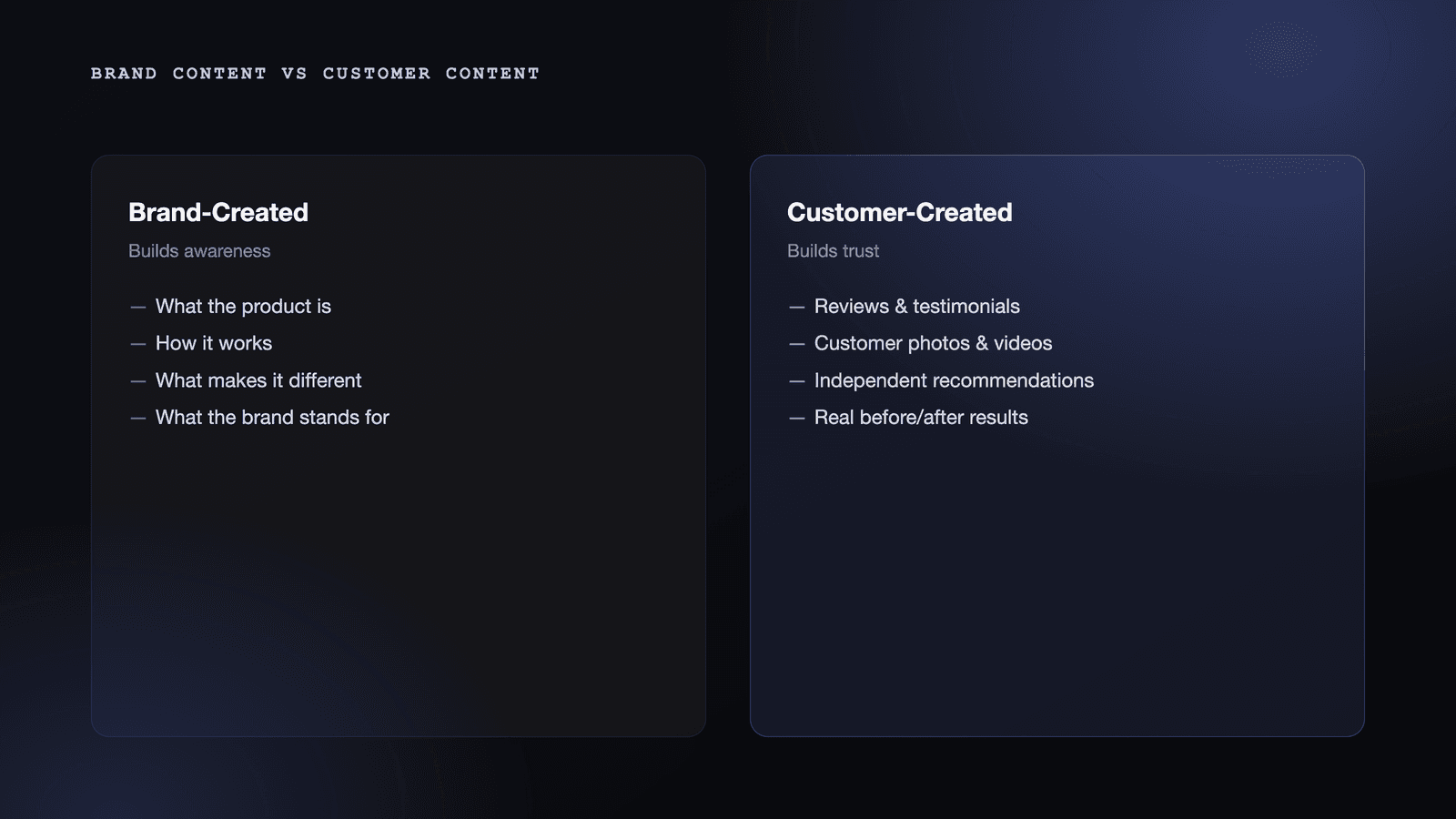
Brand-created content is genuinely useful for explaining what your product is, how it works, and what makes it different - that builds awareness. But trust gets much stronger when another customer confirms the message. When a company says its product is excellent, that's expected. When hundreds of customers independently say the same thing, it carries more weight - the customer has less obvious incentive to exaggerate.
That's why reviews, customer photos, testimonials, and demonstrations shouldn't be treated as something that just happens after a sale. Make it part of the system: ask for reviews, share customer photos, respond to comments, feature real customer projects, create a hashtag around specific uses. People contribute more when they can see someone is actually listening - a fashion brand encouraging outfit shares, a restaurant featuring customer food photos, a software company highlighting real customer workflows. The format changes by industry; the principle - people trust evidence from other people - doesn't.
Stop Letting Vanity Metrics Say Everything Is Fine
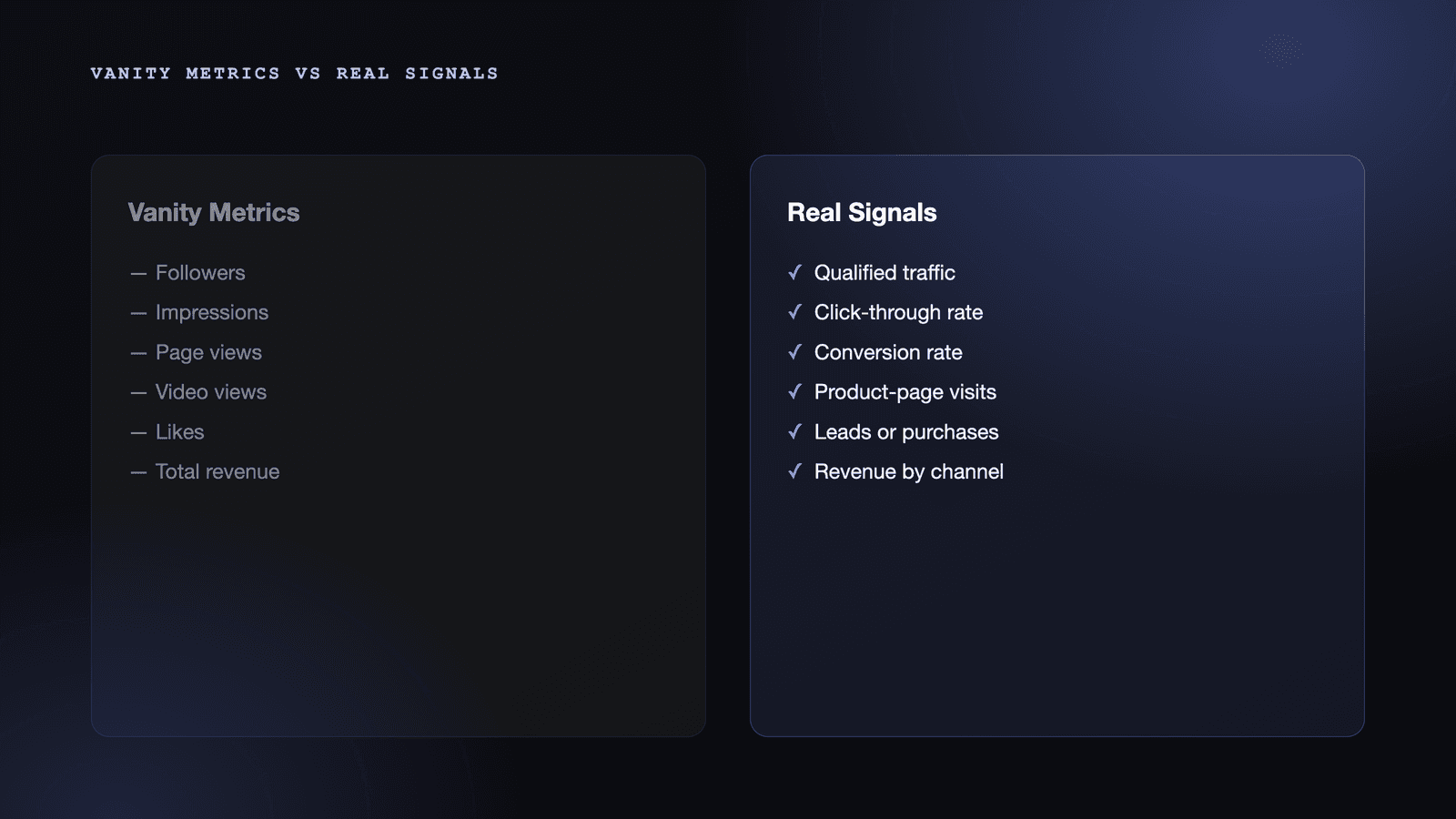
Marketing dashboards can make almost any campaign look successful: followers up, impressions up, views up. But those numbers don't tell you whether the business actually improved. A post reaching 100,000 people sounds impressive - but if almost none of them are potential customers, if nobody visited the site, if visitors landed and immediately left, the reach number was never the real measure.
The fix is asking a different question after every post: not "how many people saw this," but "what happened after they saw it." For social specifically, that means watching click-through rate, qualified sessions, email sign-ups, add-to-cart rate, conversion rate, and cost per acquisition - beyond followers and impressions. Those top-line numbers still provide context; the mistake is treating them as the final measure of success.
Your growth partner
Great work starts with a clear plan.
SEO, paid media and the creative that fuels them - one full-funnel strategy across every channel, run for return, not reach.
One accountable team, from scope to reporting.
Support for this article
Performance Marketing & Creative
- SEO ServicesTechnical SEO, content strategy and on-page optimization structured for how ecommerce actually ranks - measured by revenue, not vanity keyword positions.
- Google Ads ManagementSearch, Shopping, Performance Max, display and remarketing campaigns managed to a target ROAS, not a click count.
- Meta Ads ManagementFacebook, Instagram and Audience Network campaigns - audience targeting, creative and retargeting managed to a real return.
From first conversation to delivery
Start with the real bottleneck.
We review your listings, storefront, campaigns or workflows to identify what needs attention. Bring examples of the work you want to improve.
Know the scope before work starts.
We agree priorities, scope and timelines before execution. You know what the team will handle and how the work will be organised.
Keep one team accountable.
The team that scoped the work handles delivery. Responsibility stays clear as tasks move from planning into execution.
See what changed and what comes next.
Regular reporting connects the work to progress and results. Review what has been done and decide what should happen next.
To get started, share your platform, current workload and target timeline.
Use a Metric Tree to Connect Marketing to Revenue
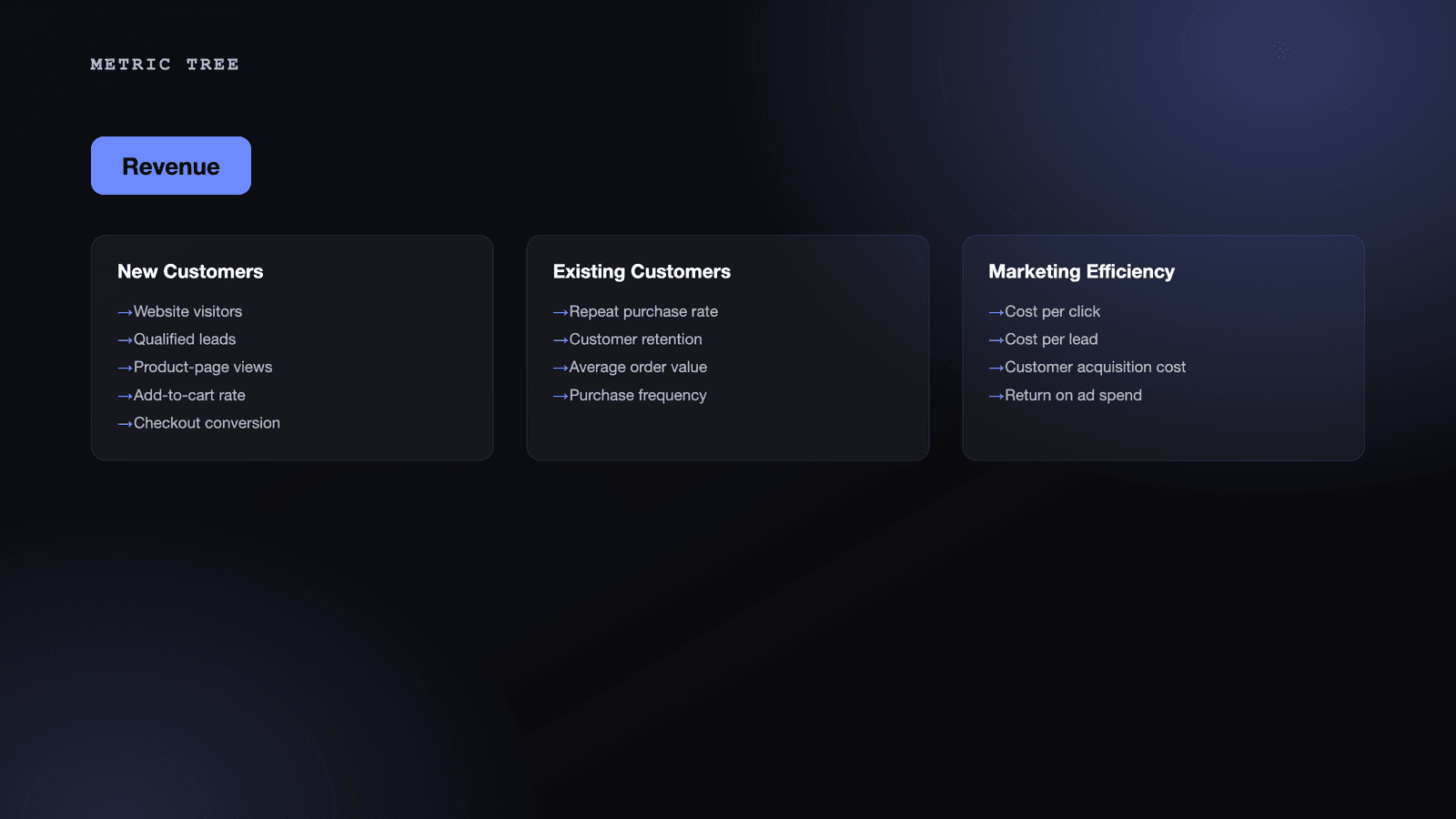
The clearest way to expose a weak metric is to ask what it actually drives. Start from an outcome that matters - usually revenue - and work backward:
Revenue - New customers → website visitors → qualified leads → product-page views → add-to-cart rate → checkout conversion → lead-to-customer rate - Existing customers → repeat purchase rate → retention → average order value → purchase frequency - Marketing efficiency → cost per click → cost per lead → customer acquisition cost → return on ad spend
Now place follower count on that tree. It contributes indirectly at best - more relevant followers can mean more reach, more reach can mean more qualified traffic, qualified traffic can mean more sales. But follower count alone guarantees none of it. If you can't explain how a metric feeds one of these branches, it probably shouldn't dominate your dashboard.
The Real Goal Is Not More Content
Marketing teams are under constant pressure to produce - another reel, another email, another campaign - and that pressure can turn marketing into a production line. But customers don't care how much content you made this month. They care whether something you made helped them: answered their question, made a decision easier, proved the product works, gave them a reason to trust you.
The companies that grow won't be the ones that publish the most. They'll be the ones that understand their customers well enough to build the right message, put it in the right place, back it with real evidence, and measure what actually happens next.
Before your next post goes live, ask who it's for, what they care about, and what you want them to understand or do after seeing it. And the sharper version of that question: if this content disappeared tomorrow, would anyone actually miss it? If the answer is no, making more of the same won't fix it - the fix is making the signal stronger. If you'd rather have a team build and run that metric tree for you, talk to us.

Reviewed by Amit Sharma, Founder & IT Head· Content reviewed Sep 2026
Explore eData4You
Find the right next step.
Check your fit, explore blog topics or find the service that supports your work.
Start with your industry, then check the platforms and technology that support your workload.
Blog topics
Choose a topic to explore recent guides on the work behind ecommerce.
Recent guides
Performance Marketing & Creative
Performance Marketing & Creative: 3 guides to explore.
Browse all articlesServices
Start with services relevant to this guide, or explore the rest of our services.




Comments
Leave a comment