On this page23 sectionsShowHide
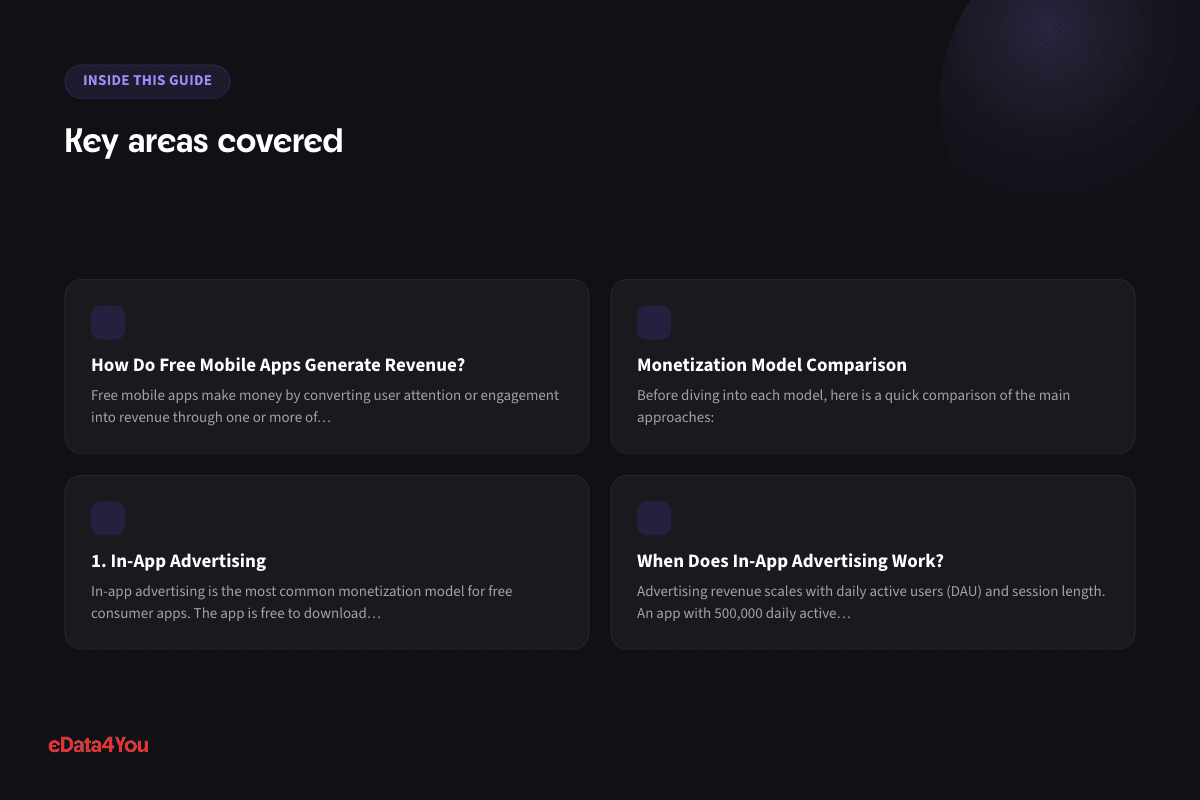
- How Do Free Mobile Apps Generate Revenue?
- Monetization Model Comparison
- 1. In-App Advertising
- When Does In-App Advertising Work?
- 2. In-App Purchases
- How IAPs Generate Revenue
- IAP Design Principles That Work
- 3. Subscriptions
- Why Subscriptions Are the Preferred Model in 2026
- When Do Subscriptions Work?
- 4. Freemium
- How to Design an Effective Freemium Model
- 5. Affiliate Revenue
- 6. Ecommerce Integration
- Choosing the Right Monetization Model
- App Monetization and eData4You
- Frequently Asked Questions
- Which monetization model makes the most money for a free app?
- How many users do I need before advertising becomes worthwhile?
- Why do annual subscriptions perform better than monthly ones?
- What's a good free-to-paid conversion rate for a freemium app?
- Can an app combine multiple monetization models?
- Conclusion
Key takeaways
- Free mobile apps make money by converting user attention or engagement into revenue through one or more of the following models: advertising, in-app purchases,…
- The most effective IAP structures offer clear value at accessible price points.
- An app that locks everything useful behind a paywall will not grow through organic word of mouth and will generate poor reviews.
- There's no single best model - it depends on app category and user behavior.
- There's no universal "best" way to monetize a free app - the right model follows from your app's category, your users' intent, and how much ongoing value the app…
How Do Free Mobile Apps Generate Revenue?
Free mobile apps make money by converting user attention or engagement into revenue through one or more of the following models: advertising, in-app purchases, subscriptions, freemium feature gating, affiliate commissions, or ecommerce. Most successful apps use a combination of two or three models rather than relying on a single revenue stream.
The global app economy generated over $430 billion in revenue in 2024, with free apps accounting for the vast majority of downloads. Understanding which monetization model fits your app type, user base, and growth stage is one of the most important decisions you will make during development.
Monetization Model Comparison
Before diving into each model, here is a quick comparison of the main approaches:
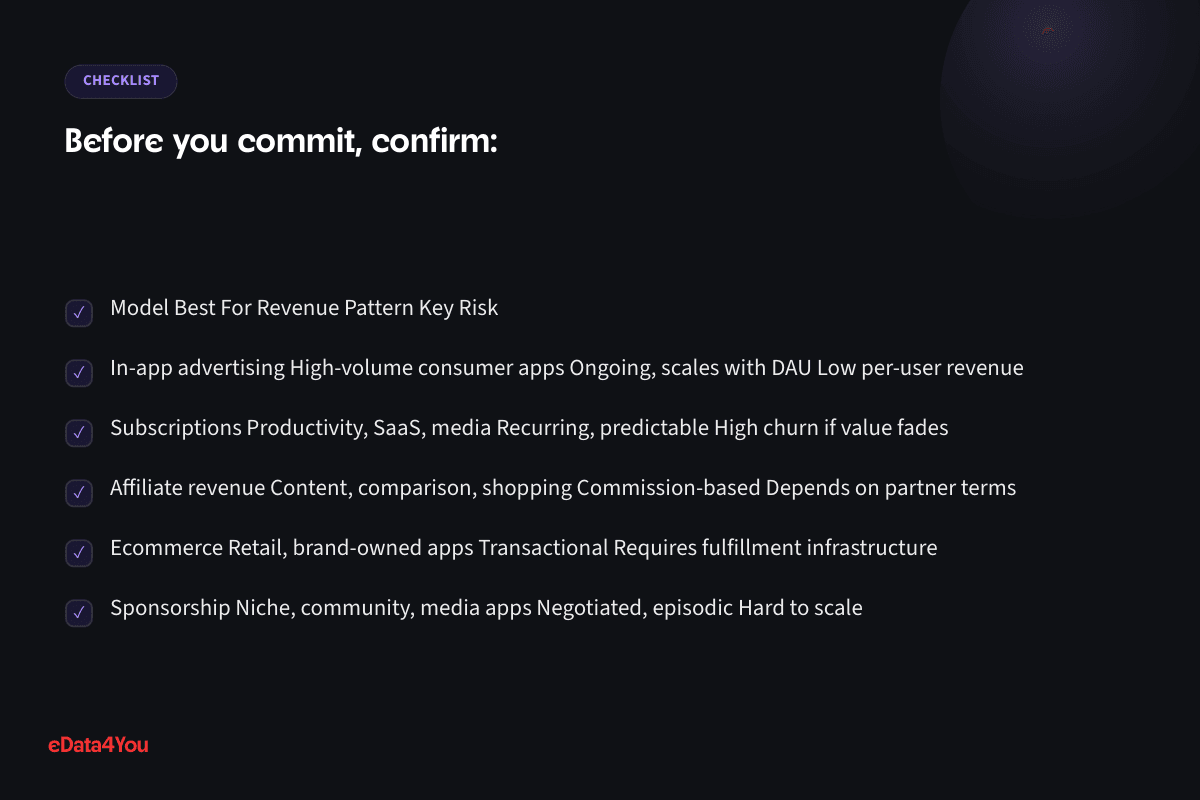
- Model Best For Revenue Pattern Key Risk
- In-app advertising High-volume consumer apps Ongoing, scales with DAU Low per-user revenue
- In-app purchases Gaming, content, utilities Transactional, variable Requires compelling upsells
- Subscriptions Productivity, SaaS, media Recurring, predictable High churn if value fades
Freemium B2B tools, productivity apps Scales with paid conversion Low conversion if free tier is too generous
Affiliate revenue Content, comparison, shopping Commission-based Depends on partner terms
Ecommerce Retail, brand-owned apps Transactional Requires fulfillment infrastructure
Sponsorship Niche, community, media apps Negotiated, episodic Hard to scale
01In-App Advertising
In-app advertising is the most common monetization model for free consumer apps. The app is free to download, and revenue is generated when users view or interact with ads served within the app.
Common ad formats include banner ads (low revenue, low disruption), interstitial ads (full-screen, higher CPM, shown between screens), rewarded video ads (users opt in to watch an ad in exchange for in-app currency or content), and native ads (formatted to match the app’s interface).
When Does In-App Advertising Work?
Advertising revenue scales with daily active users (DAU) and session length. An app with 500,000 daily active users spending 15 minutes per session generates meaningful ad revenue. An app with 5,000 users does not.
Ad revenue also depends on user geography and category. Finance, insurance, and B2B apps generate higher CPMs than entertainment or gaming apps. US and UK users generate significantly higher ad revenue than users in most other markets.
The main risk of over-relying on advertising is that it degrades user experience when ads are too frequent, too intrusive, or poorly targeted. High ad load increases churn and lowers session length, which reduces the revenue the ads were meant to generate.
For your next planning session
Good guidance is worth keeping.
Save this guide and return when you’re ready to put it into practice.
02In-App Purchases
In-app purchases (IAPs) allow users to buy virtual or digital goods within the app. These include virtual currency, additional lives in a game, digital content, premium features, or consumables that run out and must be repurchased.
How IAPs Generate Revenue
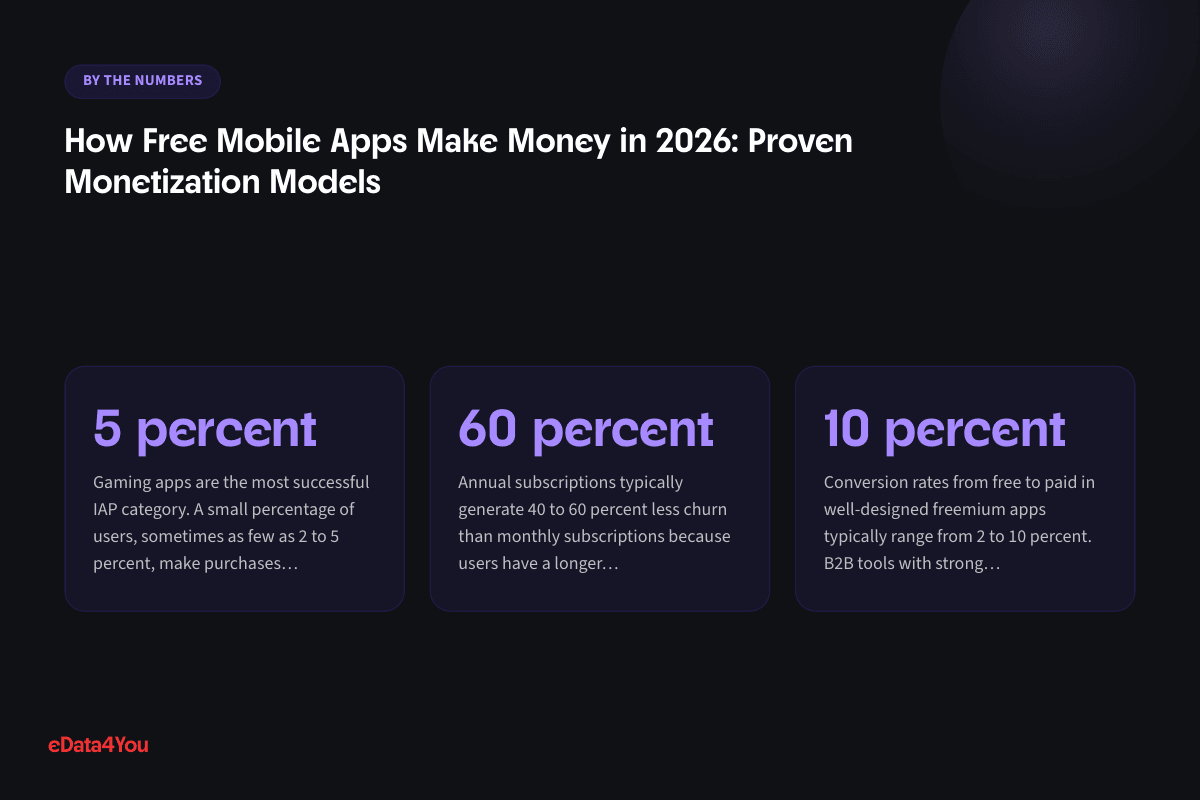
Gaming apps are the most successful IAP category. A small percentage of users, sometimes as few as 2 to 5 percent, make purchases that generate the majority of revenue. These high-value users are called “whales” in gaming terminology.
For non-gaming apps, IAPs work best when there is a clear, immediate benefit to the purchase: unlocking a level, removing a content limit, accessing a tool, or purchasing a digital asset.
IAP Design Principles That Work
The most effective IAP structures offer clear value at accessible price points. A $0.99 purchase that delivers an immediately satisfying result converts better than a $4.99 purchase for a vaguely described benefit. Price anchoring with bundles (three items for the price of two) consistently increases average transaction value.
03Subscriptions
Subscription monetization charges users a recurring fee (weekly, monthly, or annually) for continued access to the app or its premium features. This is the fastest-growing monetization model across both consumer and B2B apps.
Why Subscriptions Are the Preferred Model in 2026
Subscriptions generate predictable, recurring revenue, which makes the business easier to plan and more valuable to investors. They also create a sustainable relationship with users rather than a one-time transaction.
Apple and Google both support subscription billing directly through their platforms, handling the payment processing, renewal reminders, and cancellation management.
When Do Subscriptions Work?
Subscriptions work when the app delivers ongoing value that users cannot easily replicate elsewhere. Productivity tools, fitness apps, meditation apps, language learning platforms, and professional tools all demonstrate high subscription retention.
Apps where the value is one-time rather than ongoing, such as a wedding planning tool or a single-event ticketing app, are poor candidates for subscriptions.
Annual subscriptions typically generate 40 to 60 percent less churn than monthly subscriptions because users have a longer commitment window. Offering an annual option at a 20 to 40 percent discount is a standard strategy that improves retention significantly.
More resources
Understand the terms.
Follow the changes.
Clear definitions and marketplace updates, with context you can use in your next decision.
04Freemium
The freemium model offers a functional free version of the app and charges for premium features, higher usage limits, or advanced capabilities. The free tier acquires users at low cost, and a percentage of those users convert to paid plans.
How to Design an Effective Freemium Model
The free tier must be genuinely useful. An app that locks everything useful behind a paywall will not grow through organic word of mouth and will generate poor reviews. The goal is to let users experience the core value of the app before asking them to pay.
The paid tier must offer features that users encounter a clear need for as they use the product. Natural upgrade triggers such as hitting a usage limit, needing a feature for a specific task, or wanting to collaborate with a team member are the most effective conversion points.
Conversion rates from free to paid in well-designed freemium apps typically range from 2 to 10 percent. B2B tools with strong workflow fit tend toward the higher end.
05Affiliate Revenue
Apps that recommend products, services, or other apps can earn affiliate commissions when users follow a recommendation and complete a purchase. Finance apps recommending credit cards, travel apps recommending hotels, and health apps recommending supplements are common examples.
Affiliate revenue requires an audience that trusts the app’s recommendations and a volume of users large enough to generate meaningful commissions at the typical conversion rates of 0.5 to 3 percent.
06Ecommerce Integration
Brand-owned apps that sell physical or digital products earn revenue directly from sales. This is the primary model for retail brand apps, where the app serves as a mobile storefront.
Apps designed primarily for ecommerce must optimize the purchase flow for mobile: minimal steps to checkout, saved payment methods, fast loading product pages, and frictionless returns management. Conversion rates on poorly optimized mobile ecommerce are significantly lower than on desktop, which is why dedicated mobile development for ecommerce experiences directly affects revenue.
Choosing the Right Monetization Model
The best monetization model for your app depends on:
User base size and growth rate: Advertising requires large volume. Subscriptions can work with smaller but more engaged audiences.
App category: Gaming favors IAPs. Productivity favors subscriptions. Content favors advertising or subscriptions. Ecommerce favors direct sales.
Your growth partner
Great work starts with a clear plan.
Websites, storefronts, mobile apps and custom internal software - designed, built and maintained by one accountable team, whatever platform the work runs on.
One accountable team, from scope to reporting.
Support for this article
Software & Product Development
- Mobile App DevelopmentiOS, Android and cross-platform apps - designed, built, published and maintained by one team, from first release through every OS update after it.
- Web Application DevelopmentCustom web applications built for a specific workflow - internal tools, customer portals, dashboards - not squeezed into a generic SaaS template.
- Creative Content ProductionPhoto, video, design and listing creative produced as one pipeline - briefed, shot, edited and delivered in the exact formats every channel needs.
From first conversation to delivery
Start with the real bottleneck.
We review your listings, storefront, campaigns or workflows to identify what needs attention. Bring examples of the work you want to improve.
Know the scope before work starts.
We agree priorities, scope and timelines before execution. You know what the team will handle and how the work will be organised.
Keep one team accountable.
The team that scoped the work handles delivery. Responsibility stays clear as tasks move from planning into execution.
See what changed and what comes next.
Regular reporting connects the work to progress and results. Review what has been done and decide what should happen next.
To get started, share your platform, current workload and target timeline.
User intent: Are users coming to your app to accomplish something specific, or to explore and engage? Task-oriented users convert better on subscriptions and IAPs. Exploration-oriented users generate more ad revenue.
Monetization timing: Advertising can generate revenue from day one. Subscriptions and IAPs require user trust, which builds over time.
Most mature apps use two or three models together. A fitness app might use a freemium model with a subscription for premium features, offer in-app purchases for one-time content packs, and include affiliate links to fitness products. Combining models diversifies revenue and reduces dependence on any single stream.
App Monetization and eData4You
eData4You supports ecommerce brands and marketplace sellers with product data, catalog management, and marketplace operations that underpin the backend of retail and ecommerce apps. If your app's revenue depends on accurate, complete, and well-structured product data, our software and product development team can help with the data infrastructure that makes that possible. Request a free consultation to discuss your ecommerce operations.
Frequently Asked Questions
Which monetization model makes the most money for a free app?
There's no single best model - it depends on app category and user behavior. Gaming apps do best with in-app purchases, productivity tools do best with subscriptions, and high-volume consumer apps do best with advertising. Most mature apps combine two or three models rather than relying on one.
How many users do I need before advertising becomes worthwhile?
Ad revenue scales with daily active users and session length, so it works best at real volume - an app with 500,000 daily active users generates meaningful ad revenue, while one with 5,000 users typically doesn't, regardless of ad format.
Why do annual subscriptions perform better than monthly ones?
Annual subscriptions typically see 40-60% less churn than monthly plans because users commit to a longer window upfront. Offering an annual option at a 20-40% discount is a standard way to capture that retention benefit.
What's a good free-to-paid conversion rate for a freemium app?
Well-designed freemium apps typically convert 2-10% of free users to paid, with B2B tools that have strong workflow fit trending toward the higher end. The key is keeping the free tier genuinely useful rather than crippled.
Can an app combine multiple monetization models?
Yes, and most successful apps do. A fitness app, for example, might combine a freemium subscription model with one-time in-app purchases for content packs and affiliate links to related products - diversifying revenue instead of depending on one stream.
Conclusion
There's no universal "best" way to monetize a free app - the right model follows from your app's category, your users' intent, and how much ongoing value the app actually delivers. The apps that monetize well pick a primary model that fits naturally, then layer in a second or third stream once they understand their users well enough to do it without hurting the experience that got those users there in the first place.

Reviewed by Amit Sharma, Founder & IT Head· Content reviewed Sep 2026
Explore eData4You
Find the right next step.
Check your fit, explore blog topics or find the service that supports your work.
Start with your industry, then check the platforms and technology that support your workload.
Blog topics
Choose a topic to explore recent guides on the work behind ecommerce.
Recent guides
Software & Product Development
Software & Product Development: 3 guides to explore.
Services
Start with services relevant to this guide, or explore the rest of our services.




Comments
Leave a comment