
On this page22 sectionsShowHide
- Who This Guide Is For
- Why Performance Marketing Matters
- Start With a Performance Baseline
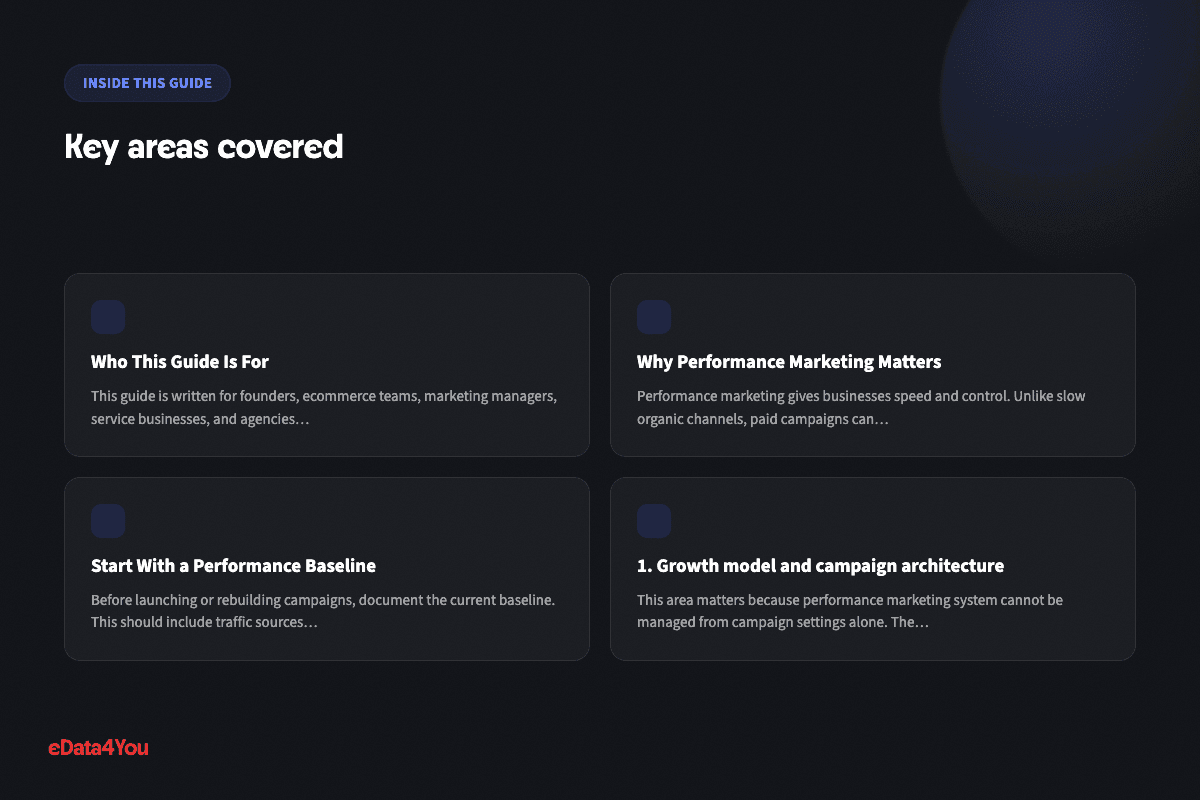
- 1. Growth model and campaign architecture
- 2. Offer, audience, and channel selection
- 3. Tracking, attribution, and reporting setup
- 4. Budget allocation and testing cadence
- 5. Optimization, scaling, and retention loops
- Performance Marketing Checklist
- Weekly Optimization Rhythm
- Ecommerce and AI Considerations
- Common Performance Marketing Mistakes
- Budget, Timeline, and Ownership
- 30-60-90 Day Performance Marketing Roadmap
- How eData4You Can Help
- Frequently Asked Questions
- What is performance marketing?
- What is the difference between performance marketing and digital marketing?
- Which channels are used in performance marketing?
- How do you know if performance marketing is profitable?
- Should small businesses use performance marketing?
- Final Thoughts
Performance marketing fails when campaigns are treated as isolated ads instead of a connected system of offer, audience, creative, landing page, tracking, budget, and reporting.
Performance marketing is the discipline of using paid and measurable channels to create growth that can be tracked, improved, and connected to business outcomes. It includes paid search, paid social, marketplace ads, retargeting, landing pages, conversion tracking, analytics, creative testing, budget control, and profitability review.
This guide explains how to manage performance marketing system as a practical growth system instead of a collection of disconnected campaigns.
Performance Guide Performance marketing works when offer, audience, creative, landing page, tracking, budget, and reporting are managed as one growth system.
Strategy Define the campaign role, audience intent, offer, channel mix, and success metric before spending. Tracking Use clean tracking, strong landing pages, and structured testing so optimization is based on evidence. Optimization Connect campaign performance with margin, CAC, ROAS, lead quality, retention, and business outcomes. 3 layers to align: offer, traffic, and conversion 7 checks before scaling any paid campaign 90 days to audit, test, and scale with control 1 Offer Clarify the value proposition, pricing, promise, proof, and conversion action. 2 Creative Test hooks, formats, proof, objections, and buyer angles with a clean naming system. 3 Tracking Validate events, pixels, UTM structure, CRM handoff, attribution, and dashboard logic. 4 Profit Review CAC, ROAS, margin, LTV, lead quality, and cash-flow impact before scaling.
Who This Guide Is For
This guide is written for founders, ecommerce teams, marketing managers, service businesses, and agencies that need paid growth to be measurable, profitable, and easier to manage. It is also useful for businesses planning to outsource paid marketing and teams that want a better brief before hiring an agency or performance marketing specialist.
The goal is not to chase every platform feature. The goal is to help you build a campaign system that is measurable, accountable, and connected to revenue quality.
Why Performance Marketing Matters
Performance marketing gives businesses speed and control. Unlike slow organic channels, paid campaigns can test demand, offers, audiences, product pages, lead magnets, and messaging quickly. But that speed creates risk when teams spend before the system is ready.
Paid growth is not only about traffic. It depends on what the traffic sees, how the offer is framed, how fast the page loads, whether the tracking is accurate, how the sales team handles leads, and whether the economics make sense after fees, refunds, returns, or sales effort.
Strong performance marketing connects acquisition with conversion and profitability. Weak performance marketing optimizes platform metrics while the business loses money.
Start With a Performance Baseline
Before launching or rebuilding campaigns, document the current baseline. This should include traffic sources, current spend, conversion events, landing pages, cost per acquisition, ROAS, lead quality, sales conversion, customer lifetime value, average order value, gross margin, and reporting gaps.
A baseline prevents guesswork. It also helps your team see whether the problem is traffic quality, creative, landing page conversion, tracking accuracy, sales follow-up, pricing, or retention.
For new campaigns, the baseline may be a forecast instead of historical data. Even then, write down assumptions so you can compare real performance against the expected model.
01Growth model and campaign architecture
This area matters because performance marketing system cannot be managed from campaign settings alone. The campaign only performs when the business goal, audience need, offer, creative, landing page, and measurement plan support each other.
For performance marketing system, review growth model and campaign architecture before increasing budget. Ask whether the campaign is solving the right business problem, reaching the right audience, and sending traffic to an experience that can convert.
Document the baseline before making changes. Record the current budget, audience, creative, landing page, conversion rate, tracking status, CAC, ROAS, lead quality, and next action. Without a baseline, every campaign review becomes opinion-based.
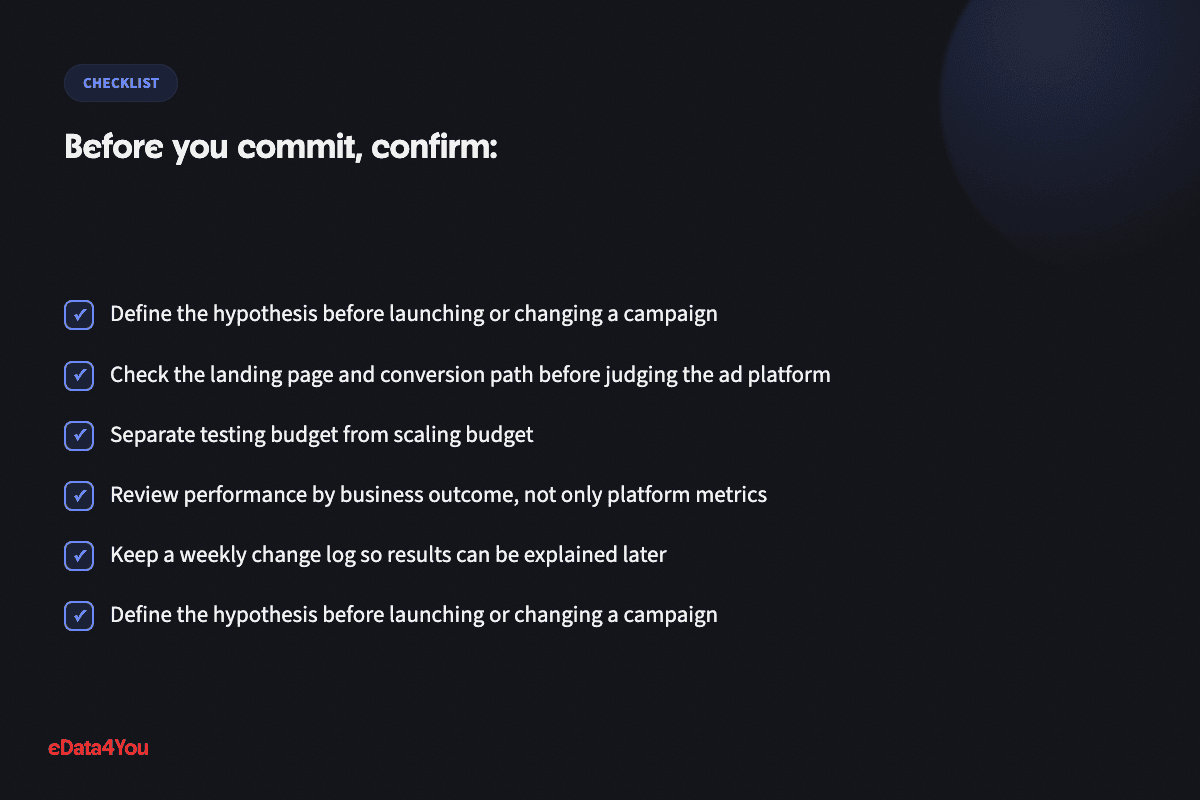
Define the hypothesis before launching or changing a campaign
Check the landing page and conversion path before judging the ad platform
Separate testing budget from scaling budget
Review performance by business outcome, not only platform metrics
Keep a weekly change log so results can be explained later
For your next planning session
Good guidance is worth keeping.
Save this guide and return when you’re ready to put it into practice.
02Offer, audience, and channel selection
When this part is weak, teams often misread performance. A campaign may look expensive because the landing page is weak, the offer is unclear, tracking is broken, or the audience is too broad.
For performance marketing system, review offer, audience, and channel selection before increasing budget. Ask whether the campaign is solving the right business problem, reaching the right audience, and sending traffic to an experience that can convert.
Document the baseline before making changes. Record the current budget, audience, creative, landing page, conversion rate, tracking status, CAC, ROAS, lead quality, and next action. Without a baseline, every campaign review becomes opinion-based.
Define the hypothesis before launching or changing a campaign
Check the landing page and conversion path before judging the ad platform
Separate testing budget from scaling budget
Review performance by business outcome, not only platform metrics
Keep a weekly change log so results can be explained later
03Tracking, attribution, and reporting setup
A strong process gives the team a clear standard for what to test, what to measure, and what decision will be made after the test. That prevents endless campaign changes without learning.
For performance marketing system, review tracking, attribution, and reporting setup before increasing budget. Ask whether the campaign is solving the right business problem, reaching the right audience, and sending traffic to an experience that can convert.
Document the baseline before making changes. Record the current budget, audience, creative, landing page, conversion rate, tracking status, CAC, ROAS, lead quality, and next action. Without a baseline, every campaign review becomes opinion-based.
Define the hypothesis before launching or changing a campaign
Check the landing page and conversion path before judging the ad platform
Separate testing budget from scaling budget
Review performance by business outcome, not only platform metrics
Keep a weekly change log so results can be explained later
04Budget allocation and testing cadence
For growth teams, this area should connect paid media with revenue quality. Traffic, clicks, leads, or purchases are not enough if margin, lead quality, repeat purchase, or sales conversion is poor.
For performance marketing system, review budget allocation and testing cadence before increasing budget. Ask whether the campaign is solving the right business problem, reaching the right audience, and sending traffic to an experience that can convert.
Document the baseline before making changes. Record the current budget, audience, creative, landing page, conversion rate, tracking status, CAC, ROAS, lead quality, and next action. Without a baseline, every campaign review becomes opinion-based.
Define the hypothesis before launching or changing a campaign
Check the landing page and conversion path before judging the ad platform
Separate testing budget from scaling budget
Review performance by business outcome, not only platform metrics
More resources
Understand the terms.
Follow the changes.
Clear definitions and marketplace updates, with context you can use in your next decision.
Keep a weekly change log so results can be explained later
05Optimization, scaling, and retention loops
The purpose is to make paid growth repeatable. A documented workflow makes it easier to delegate tasks, compare results, and scale the parts that actually work.
For performance marketing system, review optimization, scaling, and retention loops before increasing budget. Ask whether the campaign is solving the right business problem, reaching the right audience, and sending traffic to an experience that can convert.
Document the baseline before making changes. Record the current budget, audience, creative, landing page, conversion rate, tracking status, CAC, ROAS, lead quality, and next action. Without a baseline, every campaign review becomes opinion-based.
Define the hypothesis before launching or changing a campaign
Check the landing page and conversion path before judging the ad platform
Separate testing budget from scaling budget
Review performance by business outcome, not only platform metrics
Keep a weekly change log so results can be explained later
Performance Marketing Checklist
Use this checklist before scaling campaigns or approving more budget.
Area What to Check
Goal Is the campaign designed for awareness, leads, purchases, retargeting, retention, or pipeline?
Audience Is the targeting based on intent, behavior, customer data, or a clear hypothesis?
Offer Is the promise strong enough to earn action from the audience?
Creative Are hooks, formats, angles, proof, and objections being tested intentionally?
Landing Page Does the page match the ad, load quickly, build trust, and make the next step obvious?
Tracking Are pixels, events, UTMs, CRM fields, ecommerce events, and dashboards reliable?
Budget Is spend split between learning, scaling, retargeting, and retention?
Profit Are CAC, ROAS, margin, lead quality, refunds, returns, and LTV part of the decision?
Reporting Does the weekly report lead to specific actions?
This checklist should be reviewed before a launch, after major creative changes, and before increasing budget.
Explore related concepts
Related term
ROAS (Return on Ad Spend)
Definition of ROAS (Return on Ad Spend)
Revenue generated per dollar of ad spend - the inverse framing of ACOS, often preferred when talking to stakeholders.
Example in practice
An agency reports "a 5x ROAS this month" to a client instead of "20% ACOS," because it reads more directly as return on investment.
Weekly Optimization Rhythm
Performance marketing improves through rhythm. Daily checks should catch urgent problems such as broken landing pages, tracking issues, disapproved ads, spend spikes, or conversion drops.
Weekly reviews should look at campaign structure, search terms, creative performance, audience quality, landing page conversion, budget pacing, lead quality, ROAS, CAC, and profit impact. Monthly reviews should step back and decide whether the business needs new offers, new landing pages, new channels, new creative themes, or a different budget model.
Avoid changing everything at once. A clean testing rhythm isolates variables so the team can learn what caused the result.
Ecommerce and AI Considerations
For ecommerce businesses, performance marketing is tightly connected to product data, feed quality, inventory, page speed, reviews, pricing, AOV, repeat purchase, and return rate. A campaign may fail because the product page is weak, stock is unavailable, or shipping costs surprise buyers.
AI can help with creative ideation, keyword clustering, audience research, report summaries, product feed cleanup, landing page drafts, and ad variation generation. But AI should not replace human review for claims, compliance, brand tone, pricing, or conversion strategy.
The best use of AI is to speed up structured workflows. Keep your product data, campaign naming, UTM structure, CRM fields, and reporting clean so AI tools have reliable inputs.
Common Performance Marketing Mistakes
Scaling spend before tracking is reliable
Judging campaign performance without checking landing page quality
Optimizing for cheap leads that do not become customers
Ignoring margin, refunds, returns, and sales effort
Running creative tests without hypotheses
Mixing testing and scaling budgets
Reviewing platform metrics without blended business reporting
Letting campaigns run without weekly search term, placement, or creative review
Treating retargeting as a single audience instead of a sequence
Most paid marketing waste is preventable. The fix is not always a new platform. Often it is better tracking, better offers, better landing pages, cleaner creative testing, and stronger reporting.
Budget, Timeline, and Ownership
A practical performance marketing budget should include ad spend, creative production, landing page improvements, tracking setup, analytics, reporting, and management time. If the budget only covers media spend, the team may not have the assets needed to improve results.
Timeline depends on traffic volume and sales cycle. Ecommerce campaigns can often produce learning quickly if tracking and conversion volume are strong. B2B campaigns may need more time because lead quality, nurturing, and sales conversion take longer to measure.
Ownership should be clear. Decide who owns campaign setup, creative testing, landing page changes, analytics, CRM review, budget approvals, and weekly reporting. Paid growth becomes chaotic when every decision is split across teams with no shared dashboard.
30-60-90 Day Performance Marketing Roadmap
Timeline Focus Outcome
First 30
Your growth partner
Great work starts with a clear plan.
SEO, paid media and the creative that fuels them - one full-funnel strategy across every channel, run for return, not reach.
One accountable team, from scope to reporting.

Support for this article
Performance Marketing & Creative
- Meta Ads ManagementFacebook, Instagram and Audience Network campaigns - audience targeting, creative and retargeting managed to a real return.
- Social Media Marketing & Paid SocialOrganic content and posting strategy across the platforms your audience actually uses, coordinated with paid social rather than run separately.
- Amazon PPC & Marketplace AdvertisingSupport for Amazon Ads, Walmart Connect, campaign data checks, listing readiness and reporting.
From first conversation to delivery
Start with the real bottleneck.
We review your listings, storefront, campaigns or workflows to identify what needs attention. Bring examples of the work you want to improve.
Know the scope before work starts.
We agree priorities, scope and timelines before execution. You know what the team will handle and how the work will be organised.
Keep one team accountable.
The team that scoped the work handles delivery. Responsibility stays clear as tasks move from planning into execution.
See what changed and what comes next.
Regular reporting connects the work to progress and results. Review what has been done and decide what should happen next.
To get started, share your platform, current workload and target timeline.
Days
Audit tracking, campaigns, landing pages, offer, creative, budget, and reporting
Clear baseline and wasted-spend opportunities
Days 31-60 Fix tracking, improve landing pages, launch structured tests, clean audiences, and review creative
Better learning quality and stronger conversion path
Days 61-90 Scale winners, refresh creative, improve retention, adjust budget allocation, and build dashboards
Repeatable growth system with clearer profit signals
The roadmap should be adapted to your business model, but the sequence should remain the same: audit, fix, test, scale.
How eData4You Can Help
eData4You helps businesses with performance marketing support, paid campaign operations, landing page updates, ecommerce product data, feed cleanup, marketplace listing support, analytics assistance, content updates, conversion support, and reporting workflows.
Our team can support Google Ads, Meta Ads, marketplace ads, campaign QA, product feed work, landing page coordination, tracking checks, creative coordination, reporting, and ecommerce back-office operations that make paid marketing easier to manage.
If your campaigns need better tracking, cleaner product data, stronger landing pages, paid marketing support, or a practical growth operations team, contact eData4You to discuss the project.
Frequently Asked Questions
What is performance marketing?
Performance marketing is measurable paid marketing where campaigns are evaluated against specific outcomes such as leads, purchases, ROAS, CAC, pipeline, or revenue.
What is the difference between performance marketing and digital marketing?
Digital marketing includes many online activities, including SEO, content, email, branding, and social media. Performance marketing focuses on measurable campaigns and accountable outcomes.
Which channels are used in performance marketing?
Common channels include Google Ads, Meta Ads, LinkedIn Ads, marketplace ads, TikTok Ads, YouTube Ads, display ads, retargeting, affiliate programs, and paid search.
How do you know if performance marketing is profitable?
Profitability should be measured using CAC, ROAS, margin, conversion rate, lead quality, customer lifetime value, refunds, returns, and sales close rate where applicable.
Should small businesses use performance marketing?
Yes, but small businesses should start with clear tracking, focused offers, controlled budgets, and simple reporting before expanding into multiple channels.
Final Thoughts
Performance marketing goes beyond buying traffic — it's a system for learning what message, channel, audience, offer, and conversion path can create profitable growth.
Start with a baseline, fix tracking, improve the post-click experience, test with discipline, and scale only when the economics make sense. That is how paid marketing becomes a growth engine instead of a budget leak.

Reviewed by Amit Sharma, Founder & IT Head· Content reviewed Sep 2026
Explore eData4You
Find the right next step.
Check your fit, explore blog topics or find the service that supports your work.
Start with your industry, then check the platforms and technology that support your workload.
Blog topics
Choose a topic to explore recent guides on the work behind ecommerce.
Recent guides
Performance Marketing & Creative
Performance Marketing & Creative: 3 guides to explore.
Services
Start with services relevant to this guide, or explore the rest of our services.




Comments
Leave a comment