
On this page21 sectionsShowHide
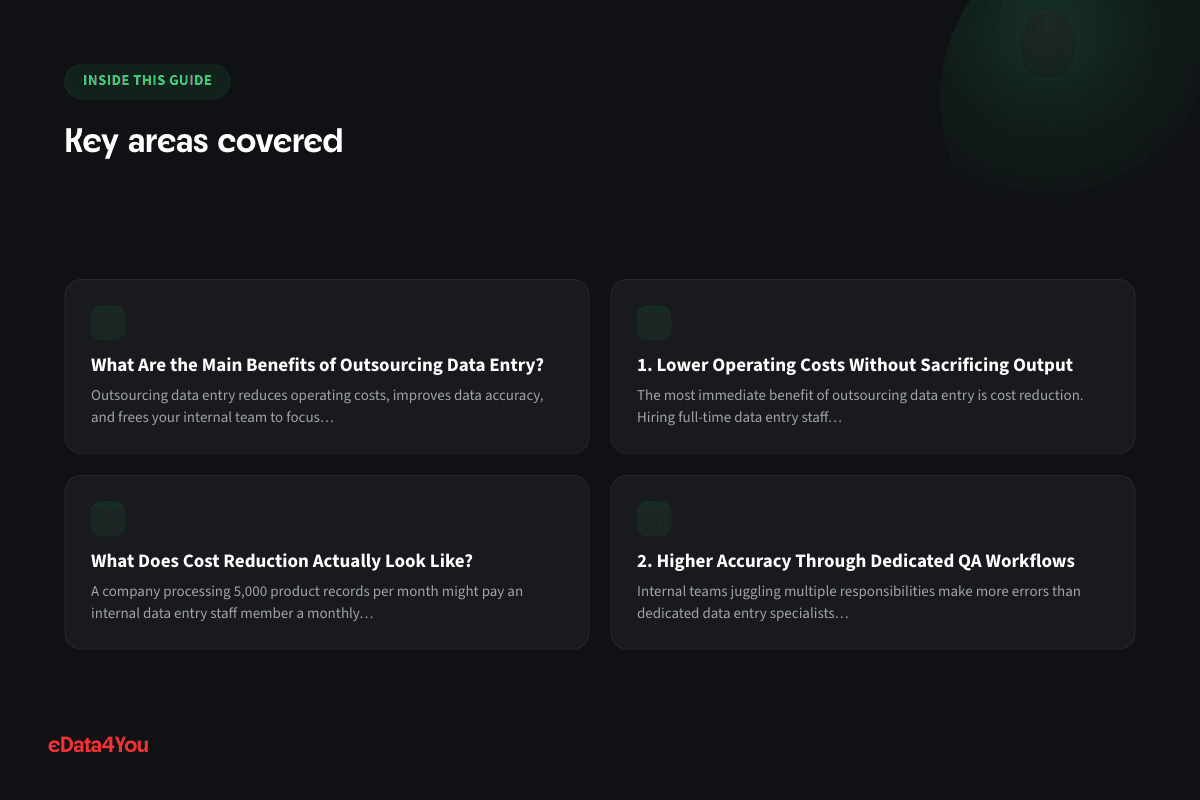
- What Are the Main Benefits of Outsourcing Data Entry?
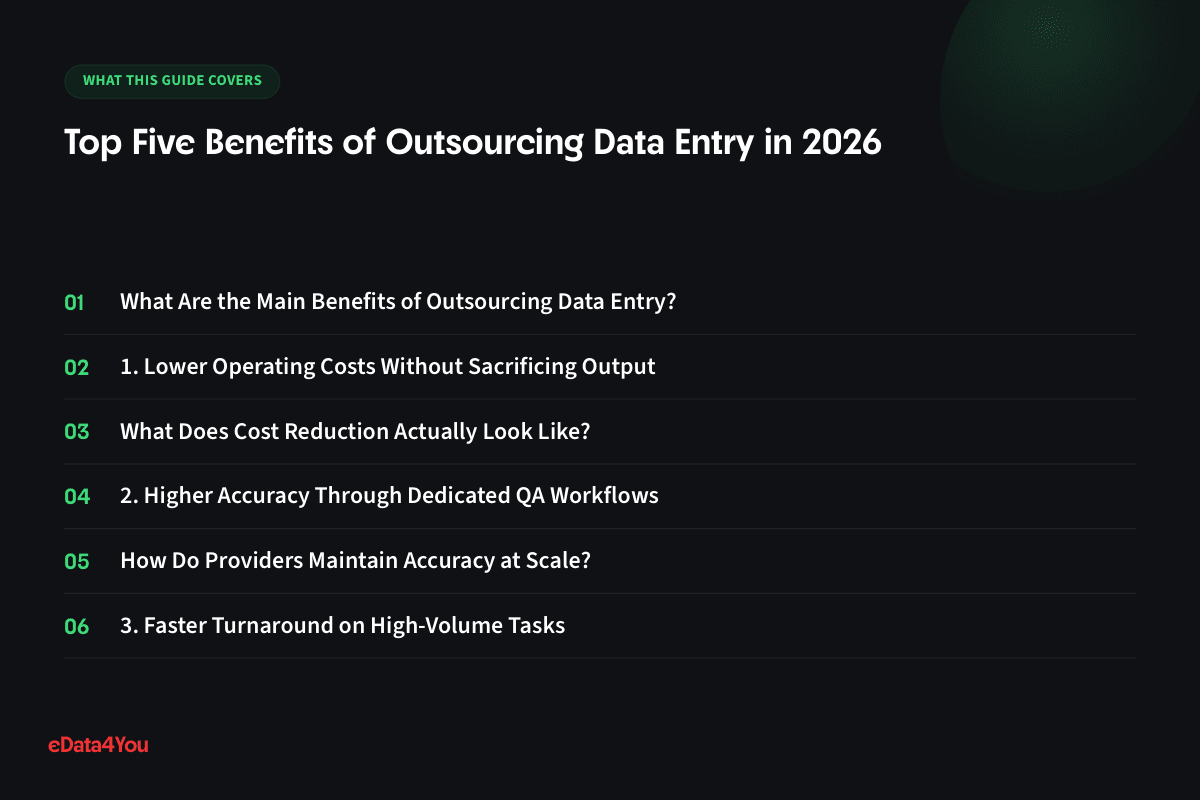
- 1. Lower Operating Costs Without Sacrificing Output
- What Does Cost Reduction Actually Look Like?
- 2. Higher Accuracy Through Dedicated QA Workflows
- How Do Providers Maintain Accuracy at Scale?
- 3. Faster Turnaround on High-Volume Tasks
- When Does Faster Turnaround Create Business Value?
- 4. Scalable Capacity Without Hiring Cycles
- How Does Scalable Outsourcing Work in Practice?
- 5. Your Team Focuses on Work That Grows Revenue
- What Tasks Open Up When Data Entry Is Outsourced?
- What Types of Data Entry Tasks Are Best Suited for Outsourcing?
- How to Get the Most Out of an Outsourced Data Entry Partnership
- Is Outsourcing Data Entry Right for Your Business?
- Frequently Asked Questions
- How much should I expect to save by outsourcing data entry?
- What accuracy rate can I expect from a professional data entry provider?
- How much data entry volume justifies outsourcing?
- Can outsourced providers handle sudden volume spikes, like a holiday catalog push?
- What data entry tasks should stay in-house rather than being outsourced?
- Conclusion
Key takeaways
- Outsourcing data entry reduces operating costs, improves data accuracy, and frees your internal team to focus on higher- value tasks.
- A small internal team has a fixed processing capacity.
- In ecommerce businesses, outsourcing catalog work typically frees product managers to focus on pricing strategy, supplier relationships, and new category development.
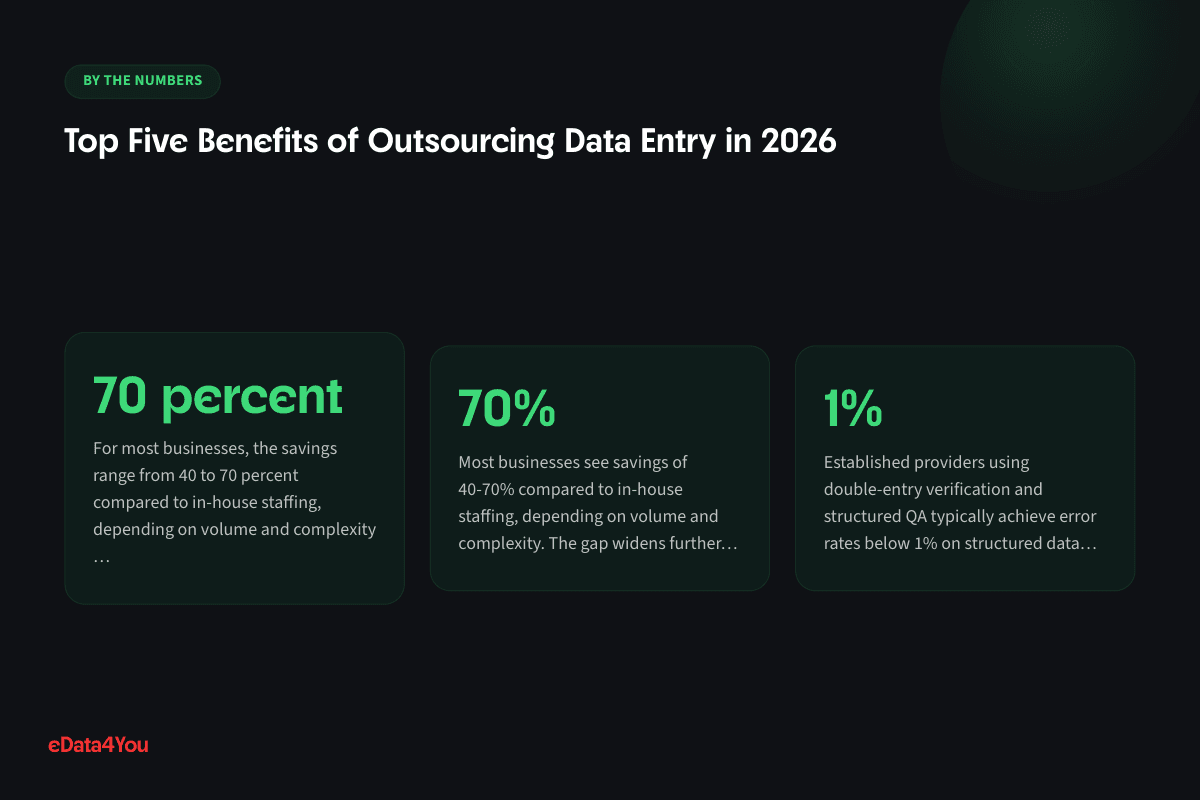
- Most businesses see savings of 40-70% compared to in-house staffing, depending on volume and complexity.
- The five benefits of outsourcing data entry - cost, accuracy, speed, scalability, and freed internal focus - aren't independent wins, they compound.
What Are the Main Benefits of Outsourcing Data Entry?
Outsourcing data entry reduces operating costs, improves data accuracy, and frees your internal team to focus on higher- value tasks. For most businesses, it is also the fastest way to scale data processing without hiring permanent staff.
Data entry is one of the most time-consuming back-office tasks in any operation. Product uploads, invoice processing, customer records, order management, and catalog updates all require consistent effort and attention to detail. When that work sits on your team’s plate, it competes with client work, sales, and growth projects.
This guide breaks down the five benefits that businesses consistently report after moving data entry to an outsourced provider.
01Lower Operating Costs Without Sacrificing Output
The most immediate benefit of outsourcing data entry is cost reduction. Hiring full-time data entry staff means paying salaries, benefits, office space, equipment, and training. An outsourced provider packages all of those costs into a predictable per-task or per-hour rate.
For most businesses, the savings range from 40 to 70 percent compared to in-house staffing, depending on volume and complexity. That gap is larger when you account for recruitment time and the cost of turnover.
What Does Cost Reduction Actually Look Like?
A company processing 5,000 product records per month might pay an internal data entry staff member a monthly salary plus overhead. An outsourced provider handling the same volume charges only for the work delivered. There is no idle time, no sick leave, and no benefits administration.

Offshore providers in India offer particularly competitive pricing for high-volume, structured work without compromising output quality when proper QA systems are in place.
For your next planning session
Good guidance is worth keeping.
Save this guide and return when you’re ready to put it into practice.
02Higher Accuracy Through Dedicated QA Workflows
Internal teams juggling multiple responsibilities make more errors than dedicated data entry specialists. Fatigue, context- switching, and lack of specialized training all contribute to mistakes that accumulate in your systems over time.
Professional data entry providers use double-entry verification, automated validation, and structured quality checks at every stage. Error rates at established providers typically fall below one percent for structured data tasks.
How Do Providers Maintain Accuracy at Scale?
Most providers use a combination of human review and software validation. Each record is entered twice by different operators and compared for mismatches. Exceptions are flagged and reviewed before delivery.
For ecommerce catalogs, accuracy checks cover product titles, attributes, pricing, category mapping, and image assignment. A single incorrect attribute can cause a product to disappear from search results or display incorrectly on a marketplace, which directly affects sales.
03Faster Turnaround on High-Volume Tasks
A small internal team has a fixed processing capacity. When volume spikes, such as during a catalog expansion, a seasonal product launch, or a marketplace migration, that team hits a wall.
Outsourced providers scale capacity on demand. A provider with a trained team of 50 operators can process in one day what a team of three would take two weeks to complete.
When Does Faster Turnaround Create Business Value?
Speed matters most when data delays block other parts of the business. If your development team cannot launch a new product category until the catalog is complete, or your sales team cannot quote accurately until the price list is updated, slow data entry has a direct revenue cost.
Explore related concepts
Related term
Attribute Mapping
Definition of Attribute Mapping
Matching a product's specifications to the exact fields a marketplace's category requires, so the listing doesn't get suppressed.
Example in practice
A supplier's spec sheet lists "fabric: 100% cotton," but the marketplace's field is labeled "material_type" with a fixed dropdown of accepted values - attribute mapping is matching one to the other correctly.
Outsourcing removes that bottleneck. Most providers offer 24 to 72 hour turnarounds on structured tasks, with rush options for time-sensitive projects.
04Scalable Capacity Without Hiring Cycles
Hiring for peak demand means carrying excess cost during slower periods. Outsourcing gives you capacity that scales up and down with your actual volume.
This is particularly valuable for ecommerce businesses with seasonal patterns. A retailer who needs 10,000 products entered before a holiday season and 500 per month the rest of the year cannot justify permanent staff for that peak.
How Does Scalable Outsourcing Work in Practice?
You agree on a base volume with your provider and communicate upcoming spikes in advance. Most providers can accommodate two to five times normal volume with a few days of notice. That flexibility removes the pressure to over-hire or to delay projects until internal capacity clears.
For growing businesses, scalability also means you are not limited by your team’s current size when pursuing new contracts, market expansions, or platform migrations.
05Your Team Focuses on Work That Grows Revenue
Data entry is necessary work, but it does not generate revenue on its own. When your internal team spends hours on data tasks, those are hours not spent on product strategy, client relationships, marketing, or business development.
Outsourcing moves the operational burden out of your core team’s day. The result is a shift in what your people are working on, beyond time saved alone.
Business Analyzer
Know your numbers before you scale.
Understand margin, ad return and storefront performance using your own business inputs. Explore what the report checks.
Report outline
ProfitabilityWhere does your revenue go?
- Fees and marginWhere each dollar of revenue goes, and what's left.
- Marketplace fee comparisonWhat your revenue would cost in selling fees on each platform.
- Profit leaksCosts running above healthy levels at the numbers you entered.
Have this ready
Start with your selling channels, monthly revenue, return rate and goal. Add product cost and monthly team cost for a fuller margin picture.
Report outline
AdvertisingWhat does your ad return need to cover?
- Break-even ad returnThe ad return you need just to break even, against what you're getting.
- Ad spend in your cost mixSee how monthly ad spend affects the margin left after your entered costs.
- Revenue relative to ad spendCompare monthly revenue with monthly ad spend alongside the break-even threshold.
Have this ready
Bring your business figures and monthly ad spend. Add product cost as a percentage of price to calculate break-even ad return.
Report outline
Store performanceHow does your storefront perform?
- Mobile speedA live scan checks how your store performs on mobile.
- Google SEO checksSee the SEO checks included in your store scan.
- Product markupCheck for structured product data on your store or product page.
Have this ready
Add a store or product page URL alongside your business figures. The store scan runs after you unlock the full report.
What Tasks Open Up When Data Entry Is Outsourced?
In ecommerce businesses, outsourcing catalog work typically frees product managers to focus on pricing strategy, supplier relationships, and new category development. In B2B companies, it frees operations teams to focus on process improvement and client delivery.
The compounding effect is significant. A team that recovers ten hours per week of focused work can take on an additional client, build new systems, or complete projects that have been stalled for months.
What Types of Data Entry Tasks Are Best Suited for Outsourcing?
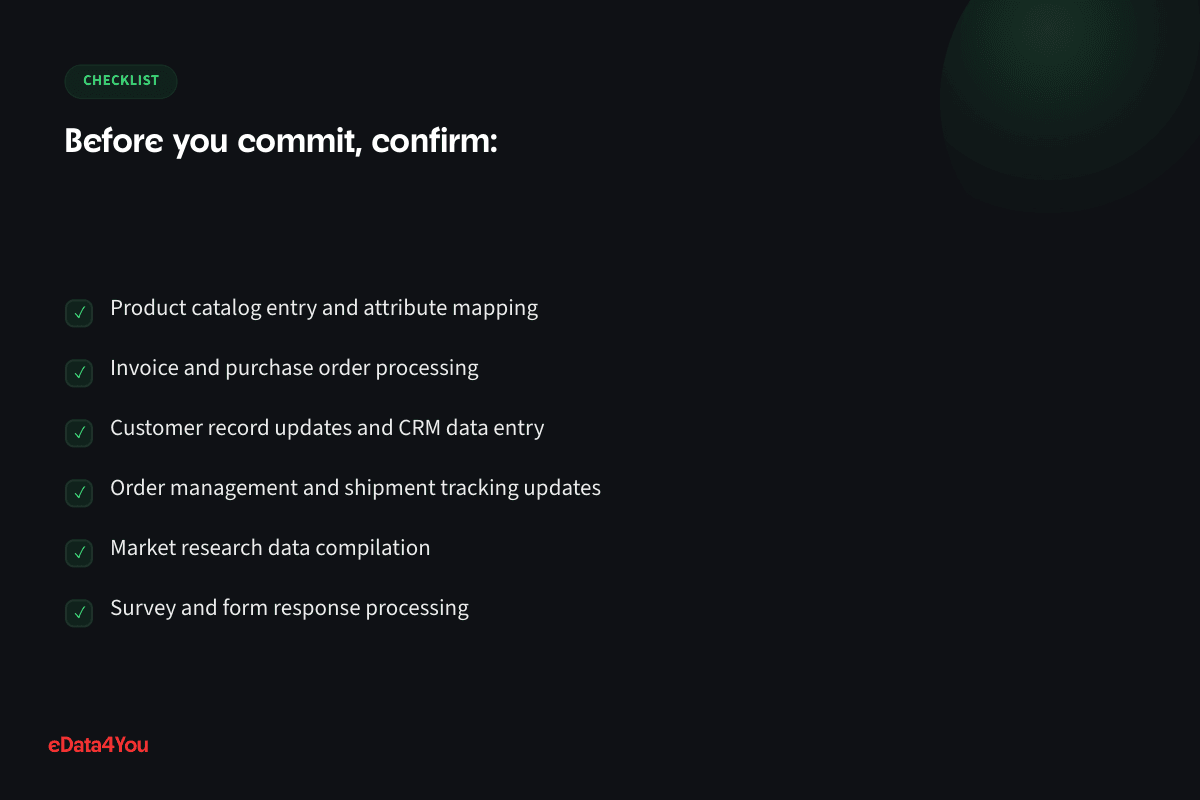
Not all data tasks are equal. The best candidates for outsourcing are tasks that are structured, repeatable, and clearly defined. These include:
- Product catalog entry and attribute mapping
- Invoice and purchase order processing
- Customer record updates and CRM data entry
- Order management and shipment tracking updates
Market research data compilation
Survey and form response processing
Image tagging and alt text entry
Tasks that require business judgment, real-time decision-making, or deep institutional knowledge are better kept in-house. Outsourcing works best when the process can be documented and handed off with clear instructions.
Your growth partner
Great work starts with a clear plan.
Clean, structured, compliant data - product, catalog and operational - across every system it needs to live in.
One accountable team, from scope to reporting.

Support for this article
Data Management
- Data Entry & Data Processing ServicesManual keying of forms, invoices, records and product data, with a dedicated remote team standing in for in-house data-entry work.
- Back-Office & Data Entry StaffDedicated capacity for the recurring data entry and back-office work that never stops, but rarely justifies a full-time hire on its own.
- Product Data EntrySKU creation, attribute population and bulk processing for catalogs ranging from hundreds to thousands of listings.
From first conversation to delivery
Start with the real bottleneck.
We review your listings, storefront, campaigns or workflows to identify what needs attention. Bring examples of the work you want to improve.
Know the scope before work starts.
We agree priorities, scope and timelines before execution. You know what the team will handle and how the work will be organised.
Keep one team accountable.
The team that scoped the work handles delivery. Responsibility stays clear as tasks move from planning into execution.
See what changed and what comes next.
Regular reporting connects the work to progress and results. Review what has been done and decide what should happen next.
To get started, share your platform, current workload and target timeline.
How to Get the Most Out of an Outsourced Data Entry Partnership
Outsourcing works best when you treat the provider as a process partner rather than merely a task executor. That means providing clear data templates, documenting your quality standards, and establishing a feedback loop for errors.
Start with a pilot batch to verify accuracy and turnaround before committing high-volume work. Build a process guide that covers your data format, naming conventions, category structure, and common edge cases. Review output regularly during the first few weeks to catch any misalignment early.
Providers who specialize in your industry, whether ecommerce, healthcare, finance, or logistics, will require less ramp-up time and deliver more consistent results.
Is Outsourcing Data Entry Right for Your Business?
Outsourcing data entry makes sense for any business where the volume of structured data tasks is large enough to create a consistent workload. If your team spends more than five hours per week on data entry, that work is almost certainly cheaper and faster to outsource.
The five benefits above, lower cost, higher accuracy, faster turnaround, scalable capacity, and freed internal focus, compound over time. Businesses that make the switch typically see the results within the first month.
eData4You provides data entry and catalog processing services for ecommerce brands, retailers, and marketplace sellers. Our teams handle product data, order records, and catalog updates with structured QA at every stage. Request a free consultation to discuss your data volume and turnaround requirements.
Frequently Asked Questions
How much should I expect to save by outsourcing data entry?
Most businesses see savings of 40-70% compared to in-house staffing, depending on volume and complexity. The gap widens further once you factor in recruitment time and turnover cost, which a per-task outsourced rate eliminates entirely.
Operations capacity
What could you hand off?
Adjust your workload and catalog size to explore a planning estimate of the time you could recover.
Time spent on your recurring operations tasks.
Number of products or variants in your catalog.
Estimated recoverable capacity
Per week
Per month
Monthly headline figures are rounded. This values time, rather than predicting a cash saving.
The assumptions behind the estimate
- Base recovery
- 60%of weekly operations time
- Catalog factor
- 1.00–1.40×1 + SKUs ÷ 2,000, capped at 1.40×
- Monthly conversion
- 4.33 weekstime valued at $35 per hour
Weekly hours × 60% × catalog factor × 4.33 = monthly capacity. Actual capacity depends on the work you can delegate.
What accuracy rate can I expect from a professional data entry provider?
Established providers using double-entry verification and structured QA typically achieve error rates below 1% on structured data tasks - meaningfully better than internal teams juggling data entry alongside other responsibilities.
How much data entry volume justifies outsourcing?
If your team spends more than five hours a week on data entry, that work is almost certainly cheaper and faster to hand off. Below that threshold, the setup overhead of an outsourcing relationship may not be worth it yet.
Can outsourced providers handle sudden volume spikes, like a holiday catalog push?
Yes, that's one of the main advantages. Most providers can accommodate two to five times normal volume with a few days' notice, which removes the pressure to over-hire internally for a seasonal peak that won't last.
What data entry tasks should stay in-house rather than being outsourced?
Anything requiring business judgment, real-time decision-making, or deep institutional knowledge - outsourcing works best on structured, repeatable, clearly documented tasks, not ones where the "right answer" depends on context only your team has.
Conclusion
The five benefits of outsourcing data entry - cost, accuracy, speed, scalability, and freed internal focus - aren't independent wins, they compound. A team that stops absorbing catalog work gets hours back for the work that actually grows revenue, and most businesses that make the switch see the combined effect within the first month.

Reviewed by Amit Sharma, Founder & IT Head· Content reviewed Sep 2026
Explore eData4You
Find the right next step.
Check your fit, explore blog topics or find the service that supports your work.
Start with your industry, then check the platforms and technology that support your workload.
Blog topics
Choose a topic to explore recent guides on the work behind ecommerce.
Recent guides
Data Management
Data Management: 3 guides to explore.
Services
Start with services relevant to this guide, or explore the rest of our services.




Comments
Leave a comment