

Quick answer
What you need to know
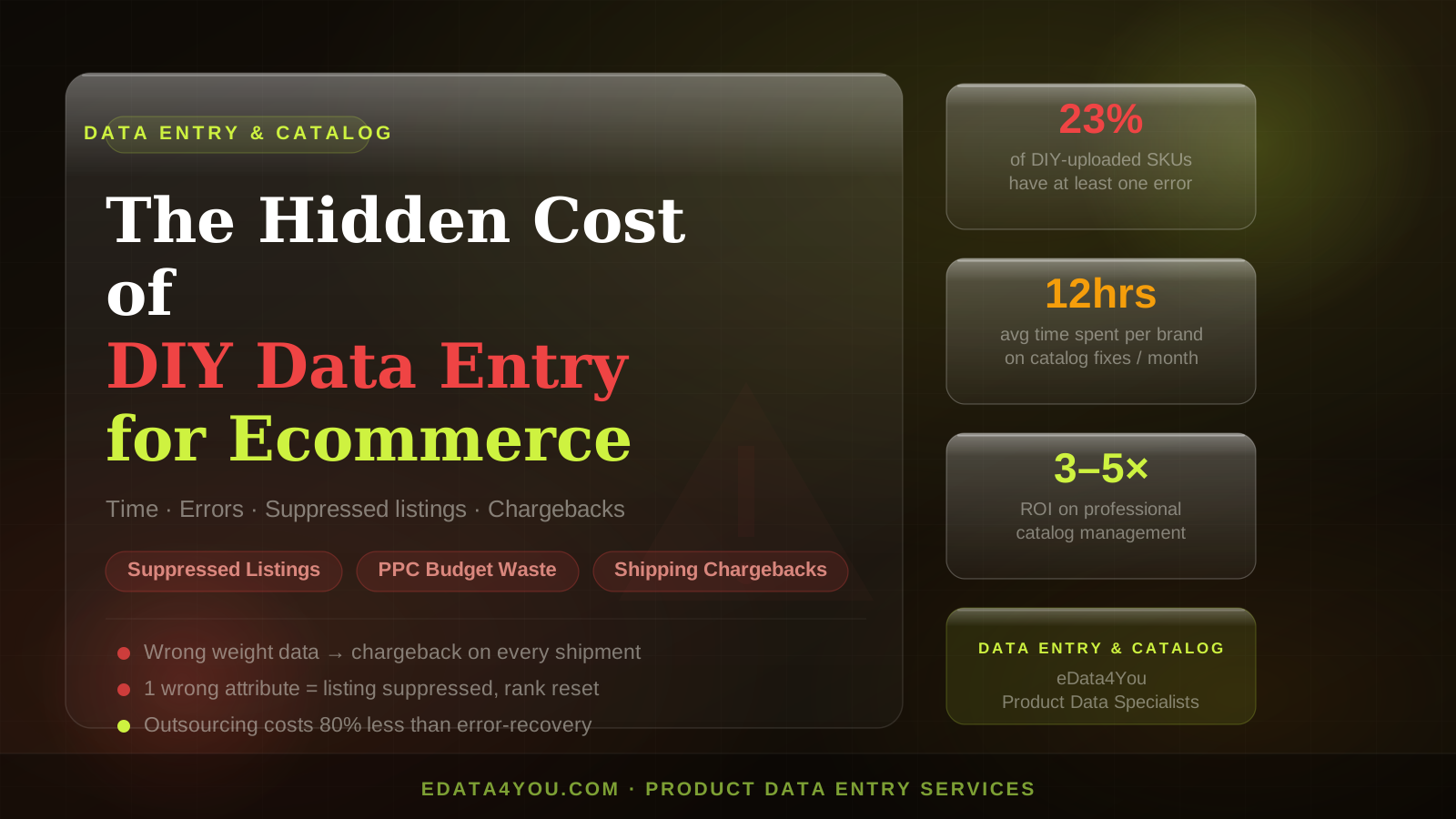
The real cost of in-house product data entry isn't the hours spent typing — it's the compounding errors that flow downstream into suppressed listings, shipping chargebacks, wasted ad spend, and returns that never should have happened.
Error 1: Wrong Weight and Dimension Data Causes Shipping Chargebacks
Error 2: Incorrect Attributes Cause Listing Suppression
Error 3: Poor Titles Waste PPC Ad Spend
Premium reader tools
Turn insight into action
The brief, before you dive in
A practical snapshot of what this guide will help you understand and apply.
Key takeaways
- Error 1: Wrong Weight and Dimension Data Causes Shipping Chargebacks: Amazon, Walmart, and most other major platforms use declared product weight and dimensions to calculate shipping costs, FBA storage fees, and carrier …
- Error 2: Incorrect Attributes Cause Listing Suppression: Amazon suppresses listings that fail attribute validation.
- Error 3: Poor Titles Waste PPC Ad Spend: Product titles are not just display text.
- Error 4: Wrong Variant Data Causes Returns: Variant setup errors are among the most expensive catalog mistakes because they generate returns directly.
When brands calculate what product data entry costs them, they usually count hours. Someone on the team spends X hours per week entering products, multiplied by their hourly rate. That number looks manageable. It is also almost entirely wrong as a measure of what data entry actually costs the business.
The real cost is not the input. It is what happens downstream when the input is wrong — and in ecommerce, incorrect product data creates errors that compound across systems, channels, and months. A wrong weight field at upload time can generate shipping chargebacks, FBA processing delays, and audit overhead that costs 10 to 50 times more to fix than it would have cost to get right the first time.
Need help applying this? Explore our Product Data Management.
Error 1: Wrong Weight and Dimension Data Causes Shipping Chargebacks
Amazon, Walmart, and most other major platforms use declared product weight and dimensions to calculate shipping costs, FBA storage fees, and carrier billing. If you declare a product as 0.5 kg when it actually weighs 0.8 kg, the discrepancy has financial consequences on every single unit shipped.
Amazon's FBA Reimbursement and Weight Verification system regularly audits physical products against catalog declarations. When the physical weight exceeds the declared weight, Amazon bills the brand retroactively for the difference across all units processed. On a SKU moving 500 units per month, a 0.3 kg understatement across 6 months before the error is caught is a meaningful chargeback — often ₹50,000 to ₹1,50,000 depending on the category weight tier.
Dimension errors cause related problems: products may be sorted into the wrong size tier (standard vs. oversize on Amazon), triggering a higher FBA fee per unit. They also cause inbound errors at fulfillment centers — a shipment labeled as standard-size that arrives oversized goes into FC exception handling, which delays processing by days and sometimes triggers partial rejection.
Error 2: Incorrect Attributes Cause Listing Suppression
Amazon suppresses listings that fail attribute validation. A suppressed listing generates zero impressions and zero sales. The product exists in the catalog, appears to be live in the backend, but is invisible to shoppers.
The most common suppression causes are catalog data problems, not account-level policy violations:
- Missing required bullet points for the category
- Incorrect or missing category-specific attributes (e.g., fabric type for apparel, wattage for electronics)
- Non-compliant main image (lifestyle image instead of product-on-white, text overlay on the image)
- Title exceeding character limits or containing prohibited terms
Walmart has similar attribute validation rules, and Shopify's channel integrations (Google Shopping, Meta Shops) also reject products with incomplete or malformed data. A brand managing 500 SKUs across three channels can have dozens of suppressed listings at any given time without realizing it, if there is no systematic QA process checking compliance after upload.
The recovery process for suppressed listings requires identifying each suppression reason, correcting the attribute, re-submitting, and waiting for the platform to re-index. On Amazon, re-indexing can take 24–72 hours. A SKU that is suppressed for two weeks loses ranking position, review recency signals, and sales velocity — all of which take additional time to rebuild.
Error 3: Poor Titles Waste PPC Ad Spend
Product titles are not just display text. On Amazon and Walmart, the title is one of the primary data points the search algorithm uses to index a product for keyword relevance. Sponsored ads (PPC) campaigns targeting keywords that aren't present in the title or backend attributes produce lower Quality Scores and higher effective cost-per-click.
A brand spending ₹8,00,000 per month on Amazon Sponsored Products with poorly structured titles is likely wasting 15–20% of that budget — ₹1,20,000 to ₹1,60,000 per month — on inflated CPCs and low-relevance impressions that don't convert. The campaign manager sees underperforming ASINs and increases bids to compensate, which compounds the waste.
High-quality title structure follows platform-specific formulas: Brand + Product Type + Key Feature + Size/Count/Variant for Amazon; slightly different for Walmart, which weights the first 75 characters most heavily for search display. Getting this right at the catalog level means PPC spend works harder without any change to bidding strategy.
Error 4: Wrong Variant Data Causes Returns
Variant setup errors are among the most expensive catalog mistakes because they generate returns directly. If a size L is mapped to the wrong variant ASIN, customers who order L receive M, leave a negative review, and initiate a return. The same applies to color mapping errors, bundle misconfigurations, and parent-child relationship mistakes.
Amazon's A-to-Z Guarantee and Walmart's return policy mean the brand bears the cost of the return shipping plus the lost unit if the item is not resellable. More importantly, each wrong-item return is a verified negative customer experience that shows up in seller feedback, product reviews, and returns rate metrics — all of which Amazon factors into seller performance scoring. A returns rate above 8–10% in categories like apparel or consumer electronics triggers performance warnings.
The downstream cost of a variant data error at upload time: return shipping cost + lost unit (if unsellable) + negative review impact on BSR + potential seller performance flag. All of it traces back to an incorrectly mapped attribute in a spreadsheet.
Turn these recommendations into a working process with Product Data Management.
Error 5: Catalog Inconsistency Across Channels Fragments Brand Signals
Most brands selling on Amazon, Walmart, and their own Shopify store use different catalog templates for each platform. When those templates aren't managed to a common product master, the same SKU ends up with different titles, different descriptions, and different attribute values across channels.
This creates several problems simultaneously. SEO signals are fragmented — Google indexes the product differently from each URL, and no single version accumulates enough signal strength to rank well organically. Price comparison engines (Google Shopping, PriceGrabber) surface inconsistent data that erodes consumer trust. Brand perception suffers when the same product looks different across touchpoints.
The fix is a product master — a single source of truth for all product data that feeds channel-specific templates. This is a catalog architecture decision, not just a data entry one, and it requires building the right structure before populating SKUs at scale.
The Accumulation Problem
Each individual error is manageable in isolation. The real damage is compounding. A wrong weight causes a shipping chargeback. The chargeback volume triggers a carrier audit. The audit surfaces dimension mismatches across 40 more SKUs. Fixing 40 SKUs requires a bulk edit, which requires someone to pull the original manufacturer specs, re-measure products, or request updated data sheets from suppliers. That process takes weeks.
Meanwhile, the listing for the original SKU may have been suppressed during the audit review, losing sales and rank for the duration. The original cost of the wrong weight field: perhaps 2 minutes of careless data entry. The downstream recovery cost: multiple staff hours over weeks, plus lost revenue, plus chargeback fees.
What High-Quality Product Data Entry Actually Looks Like
Done properly, product data entry is a structured workflow, not a typing task.
It starts with a category-specific template that maps manufacturer specifications to platform-required attributes — so the person entering data is never guessing what a field should contain. Titles are built to formula. Weight and dimensions are pulled from verified source data (product spec sheets, physical measurement), not estimated. Images are checked against platform compliance requirements before upload.
A second-person QA review layer catches errors before they reach the platform: attribute completeness check, image compliance check, title format validation, variant mapping verification. For high-volume catalogs, automated validation tools flag non-compliant fields before submission.
Standardized naming conventions — consistent brand name format, category taxonomy, variant labeling — ensure that when the same product appears across Amazon, Walmart, and Shopify, it is recognizably the same product to both platforms and consumers.
The Make-vs-Buy Calculation
In-house data entry at a junior executive level costs ₹30,000–50,000 per month in salary. Add benefits, payroll taxes, training time, and the management overhead of QA review (typically a senior team member spending 3–5 hours per week reviewing and correcting work), and the real cost is closer to ₹60,000–80,000 per month — not counting the cost of errors that get through.
Outsourced product data entry at per-SKU pricing, with QA built into the workflow, typically runs ₹15–40 per SKU depending on complexity and volume. For a brand uploading 200 SKUs per month, that is ₹3,000–8,000 — with error rates that are structurally lower because the process is standardized and reviewed by specialists who do this across dozens of platforms every day.
The math favors outsourcing at almost every volume level once you account for the full cost of in-house — including the downstream errors that most teams never attribute back to data quality.
Product data quality is not an operational detail. It is the foundation that every other channel function — PPC, SEO, fulfillment, returns management — builds on. Getting it right at the start costs a fraction of what it costs to fix later.
eData4You's product data entry service covers catalog setup, attribute mapping, QA review, and multi-channel consistency for brands selling on Amazon, Walmart, Shopify, Flipkart, and more — with per-SKU pricing and no long-term contract required.

Let's build something great together
A dedicated team of ecommerce, design, and data specialists - ready to scale your business across every marketplace.
Recent Posts
Latest on Social
Grow your sales on Amazon, Walmart & more
Our marketplace specialists handle listings, SEO, catalog & ads - end to end.
Talk to an Expert
Amit Sharma
Founder & IT Head | Project Management & IT Strategy Expert


Leave a Comment