Quick answer
What you need to know
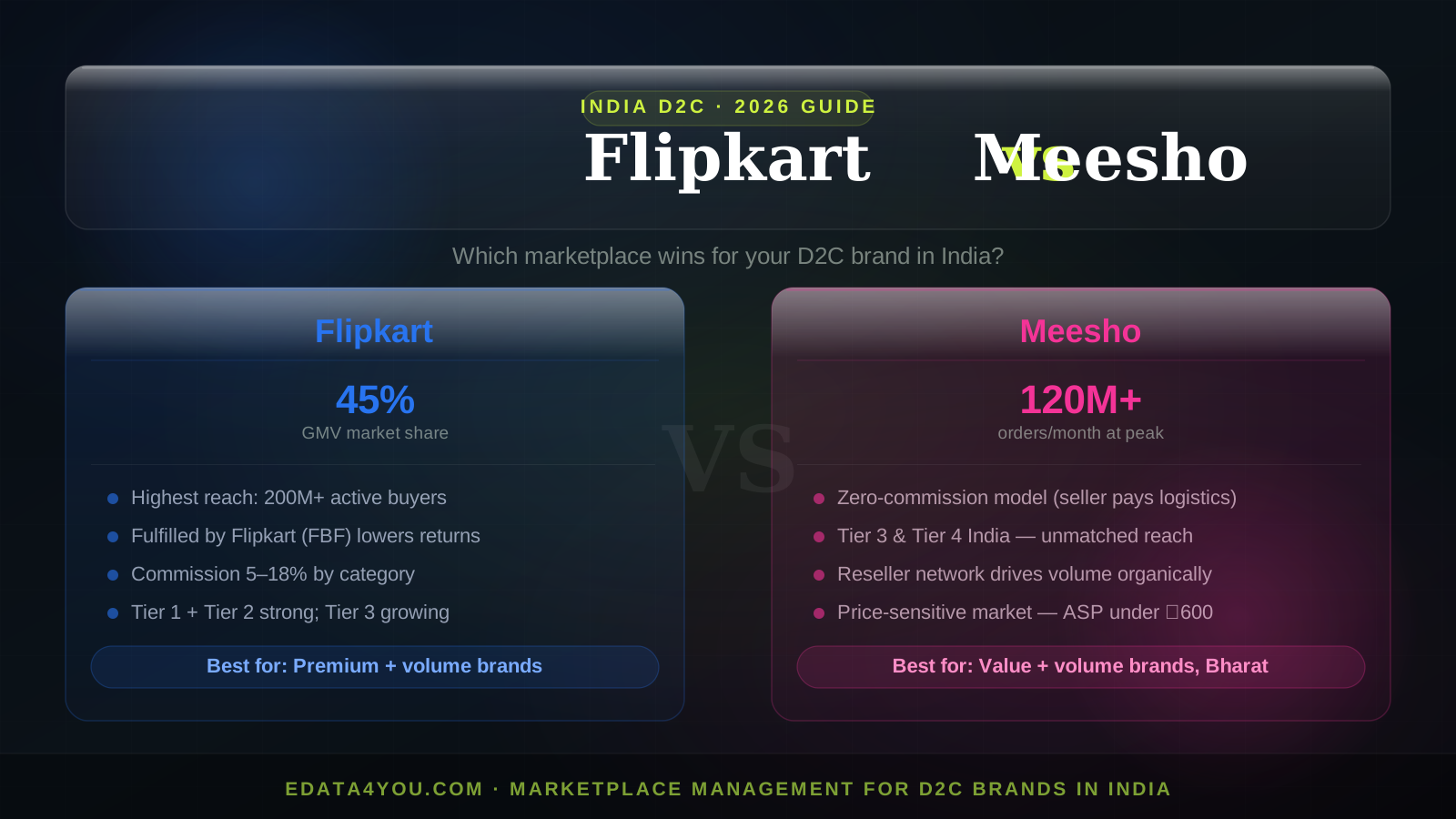
Flipkart and Meesho serve fundamentally different customers — and the margin structures, fulfillment requirements, and listing norms differ enough that what works on one often needs rethinking for the other.
Scale and Ownership: Where Each Platform Stands
Who Is Shopping on Each Platform
Commission Structures and Unit Economics
Premium reader tools
Turn insight into action
The brief, before you dive in
A practical snapshot of what this guide will help you understand and apply.
Key takeaways
- Scale and Ownership: Where Each Platform Stands: Flipkart is India's largest domestic e-commerce player by GMV, operating at approximately $23 billion in gross merchandise value.
- Who Is Shopping on Each Platform: Flipkart's core buyer is urban, skews male for electronics and appliances, and has enough income to consider purchases above ₹1,000 without significan…
- Commission Structures and Unit Economics: This is where the two platforms diverge most sharply, and where many sellers make planning errors.
- Fulfillment: FBF vs Meesho's Model: Flipkart Fulfillment (FBF) is the platform's equivalent of Amazon FBA — you send inventory to Flipkart's distribution centers and they handle pick, pa…
The question Indian D2C founders keep asking in 2026 is no longer "should we sell on marketplaces" but "which marketplaces, in what order, and how do we resource them." Flipkart and Meesho both reach hundreds of millions of Indian shoppers, but they reach almost entirely different ones — with different income levels, different price thresholds, and different expectations of what a product listing should look like. Getting this choice wrong doesn't just mean missed revenue; it means catalog investment, fulfillment infrastructure, and pricing strategy built for the wrong audience.
Need help applying this? Explore our Marketplace Management Services.
Scale and Ownership: Where Each Platform Stands
Flipkart is India's largest domestic e-commerce player by GMV, operating at approximately $23 billion in gross merchandise value. Walmart acquired Flipkart in 2018 and has continued investing in its logistics, payments (PhonePe), and grocery verticals. It's the default marketplace for mid-market and premium Indian consumers who are buying electronics, large appliances, branded fashion, and furniture online.
Meesho, by contrast, generated roughly $5 billion in GMV through 2025 but has been the fastest-growing marketplace in India by seller count and order volume. Its model is built around value buyers in tier-2, tier-3, and tier-4 towns — cities like Bhilwara, Siwan, and Nandurbar that Flipkart has historically under-served. Meesho also supports a large reseller ecosystem, where individual entrepreneurs buy products and resell them through WhatsApp and social media, though direct consumer purchases have grown substantially.
The practical implication: these are not substitute platforms. They are complements serving different ends of the market.
Who Is Shopping on Each Platform
Flipkart's core buyer is urban, skews male for electronics and appliances, and has enough income to consider purchases above ₹1,000 without significant friction. The platform's Big Billion Days event competes directly with Amazon Prime Day for the same urban Indian consumer who has both apps installed. Flipkart Plus (its loyalty program) attracts repeat buyers who have purchase histories showing brand preference.
Meesho's buyer is predominantly female, lives in smaller cities and semi-urban areas, and is shopping primarily for fashion, home décor, beauty, and daily-use products — almost always under ₹500. The Meesho shopper is extraordinarily price-sensitive. A 20% difference in price between two similar products on Meesho often determines the sale entirely, in a way that just isn't true on Flipkart.
This demographic reality shapes everything downstream: what you list, how you price it, what margin structure is viable, and how you write your catalog.
Commission Structures and Unit Economics
This is where the two platforms diverge most sharply, and where many sellers make planning errors.
Flipkart charges category commissions ranging from 5% to 25% of the selling price, plus a fixed fee per order (typically ₹20–₹50 depending on category), plus weight handling charges calculated by actual and volumetric weight. For a ₹800 fashion item, you might pay 18% commission (₹144) + ₹30 fixed fee + ₹35 weight handling = ₹209 in platform fees before returns. Margins need to support that cost structure plus your COGS and shipping to Flipkart's distribution centers.
Meesho has operated at 0% seller commission since its policy shift in 2022, which it maintained through 2025 and into 2026. Sellers do not pay a percentage of the sale price. However, Meesho charges shipping fees — typically ₹35–₹70 per order depending on weight and destination — and this is the primary cost to model. For a ₹299 item with ₹55 shipping, that's an 18% cost just for delivery. At low price points, this math is very tight, which is why Meesho works best for lightweight products with decent margins on COGS.
The 0% commission model makes Meesho appealing on paper, but the price compression it creates (because sellers who have lower commission burdens can undercut faster) means your realization per unit is often lower than Flipkart even before accounting for the higher return rates.
Fulfillment: FBF vs Meesho's Model
Flipkart Fulfillment (FBF) is the platform's equivalent of Amazon FBA — you send inventory to Flipkart's distribution centers and they handle pick, pack, and last-mile. FBF listings get a "Flipkart Assured" badge, which meaningfully improves conversion and typically provides priority ranking. The trade-off is that you need to maintain inventory at Flipkart's DCs, which requires working capital commitment and accurate demand forecasting.
Meesho operates a largely seller-fulfilled model with Meesho's own logistics network handling pickup. Sellers pack orders themselves and Meesho's delivery partners collect from the seller's location. This lowers the barrier to entry — you don't need to pre-position inventory anywhere — but it puts fulfillment execution risk back on the seller. Order processing time and packaging quality directly affect your seller rating, which affects visibility.
For sellers with manufacturing or warehouse operations in tier-2 cities, Meesho's pickup model can actually be advantageous — you don't need to ship inventory to a DC in a metro city first.
Turn these recommendations into a working process with Marketplace Management Services.
Listing Requirements and Catalog Standards
Flipkart's image specifications are strict: primary images require a white background, minimum resolution of 500×500 pixels, and the product must occupy at least 70% of the frame. Multiple angle shots are expected for electronics and apparel. Flipkart's attribute schema for each category is detailed — missing a required attribute like fabric composition or power wattage will suppress the listing.
Meesho is more lenient on image backgrounds and resolution thresholds, which is why its catalog quality varies widely. But don't mistake lenience for irrelevance — on Meesho, your main image and price are essentially all that drives a click. A poor image on Meesho kills conversion just as definitively as it does elsewhere, even if the platform doesn't reject it outright.
Both platforms require a valid GSTIN for seller registration. Meesho also requires a bank account linked to the GSTIN for payouts.
A point sellers consistently underestimate: titles, attributes, and image sets that work on Flipkart don't simply transfer to Meesho. Flipkart titles are longer and keyword-rich; Meesho shoppers respond to short, punchy titles that emphasize price value. The attribute schema differs by platform. Running both marketplaces is genuinely twice the catalog management effort.
Returns: The Hidden Margin Killer
Return rates on Meesho for fashion categories run 30–40%. This is not an anomaly — it reflects the buying behavior of a shopper who orders multiple sizes or variants and returns what doesn't fit, enabled by easy no-questions returns. If you're selling apparel on Meesho at ₹349 with a 35% return rate, your effective revenue per 100 orders is ₹22,685 (65 kept × ₹349), and your return logistics cost is non-trivial on top of that.
Flipkart return rates vary widely by category — electronics has low returns, fashion is moderate (15–25%), home décor is variable. Factor category-specific return rates into your Meesho margin model before launching; brands selling premium products on Meesho often find the returns volume alone makes the channel unviable.
Which Platform to Prioritise: A Practical Framework
Start with your average order value and brand recognition level.
If your product's natural price point is above ₹800 and you have some brand equity — even if only regional — Flipkart should be your first marketplace investment. The customer base is better matched to that price point, the platform's search and recommendation algorithms reward brand-level consistency, and FBF enables the kind of fast delivery experience that converts urban buyers.
If your products are lightweight, margin-positive below ₹500, and suited to a value-conscious buyer who may not know your brand name — fashion accessories, home utilities, beauty and personal care basics — Meesho is a high-volume channel worth developing in parallel or even first.
For most brands with product lines that span price points, the right answer is both platforms, sequenced: establish on Flipkart first to build sales history and reviews, then expand to Meesho for volume in markets you aren't reaching directly. The catalog work required to maintain both well is the main operational constraint.
The Operational Overhead of Running Both
Managing Flipkart and Meesho simultaneously is not just double the orders — it's double the catalog infrastructure. Separate image sets, separate title formats, separate attribute maps, separate pricing strategies, and separate inventory tracking if you're using FBF for Flipkart and seller-fulfilled for Meesho. Sellers who underestimate this overhead end up with outdated listings on one platform or the other, inconsistent pricing that triggers policy flags, and customer service backlogs that drag down seller ratings.
This is precisely the kind of multi-platform catalog management that makes sense to outsource once you've validated both channels. The variable cost of a managed catalog service is often lower than the opportunity cost of letting listings stagnate while your in-house team focuses on product and marketing.
If you're planning to launch or scale on Flipkart and need catalog, content, and listing management handled correctly from the start, eData4You's Flipkart product listing services cover everything from image preparation and attribute mapping to pricing strategy and ongoing catalog maintenance across both Flipkart and Meesho.
Let's build something great together
A dedicated team of ecommerce, design, and data specialists - ready to scale your business across every marketplace.
Recent Posts
Latest on Social
Grow your sales on Amazon, Walmart & more
Our marketplace specialists handle listings, SEO, catalog & ads - end to end.
Talk to an Expert
Amit Sharma
Founder & IT Head | Project Management & IT Strategy Expert
Leave a Comment