Quick answer
What you need to know
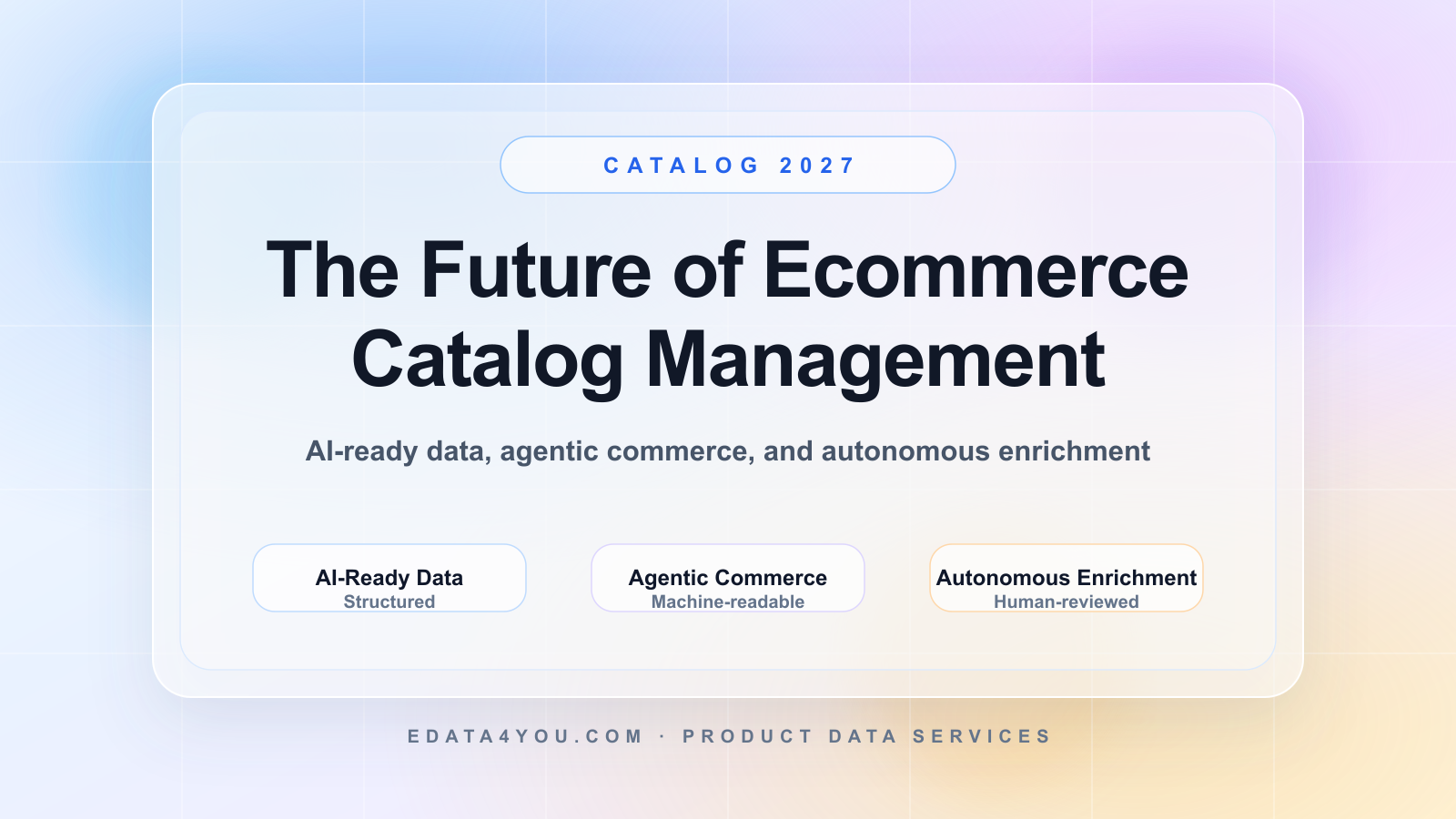
Ecommerce catalog management is shifting toward AI-ready data, agentic commerce, and autonomous enrichment. See the trends shaping 2027 and how to prepare.
Why Catalog Management Is Suddenly Strategic
Trend 1: Product Data Becomes AI-Ready or It Becomes Invisible
Trend 2: Agentic Commerce Turns Catalogs Into Sales Channels
Premium reader tools
Turn insight into action
The brief, before you dive in
A practical snapshot of what this guide will help you understand and apply.
Key takeaways
- Why Catalog Management Is Suddenly Strategic: The pressure is coming from the demand side.
- Trend 1: Product Data Becomes AI-Ready or It Becomes Invisible: The phrase to learn is AI-ready product data.
- Trend 2: Agentic Commerce Turns Catalogs Into Sales Channels: Agentic commerce is the practice of letting autonomous AI agents research, compare, and sometimes purchase products on a shopper's behalf.
- Trend 3: Enrichment Goes Autonomous With AI Agents: Manual enrichment has always been the bottleneck.
Primary keyword: ecommerce catalog management
For most of the last decade, ecommerce catalog management was treated as a back-office function. Teams uploaded products, fixed typos, swapped images, and kept prices current. The work was tedious, but the rules were relatively stable.
That stability is gone. Between AI-led discovery, autonomous enrichment, and a new class of buyers that are not human, product data has moved from a maintenance task to a growth lever. The catalogs that win in 2027 will not simply be the prettiest. They will be the most structured, the most consistent, and the easiest for machines to read.
This guide breaks down the trends reshaping ecommerce catalog management and what they mean for the roadmap you should be building now.
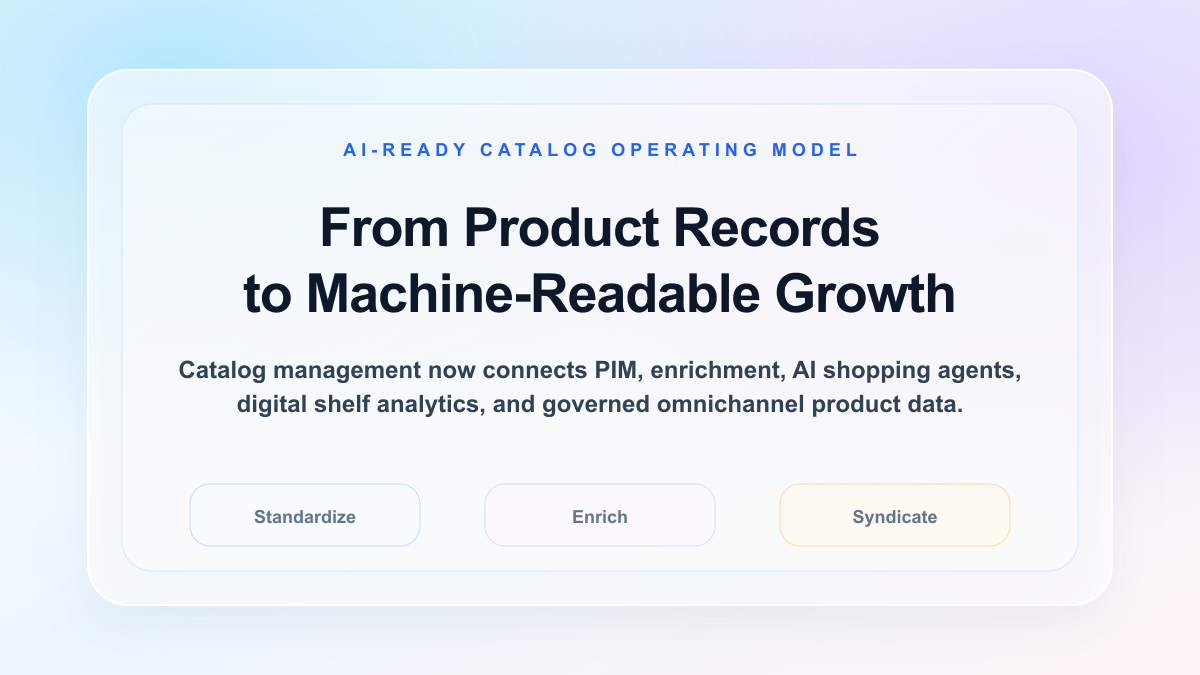
The next phase of catalog management is about making product information usable by shoppers, marketplaces, search systems, AI assistants, and autonomous shopping agents.
Need help applying this? Explore our Product Data Management.
Why Catalog Management Is Suddenly Strategic
The pressure is coming from the demand side. Shoppers no longer start every purchase on a search bar or a category page. A growing share begins inside an AI assistant that researches, compares, and shortlists products before a person ever sees a listing.
The directional signals are hard to ignore. Adobe Analytics reported an 805% year-over-year spike in AI-driven traffic to US retail websites on Black Friday 2025. ChatGPT crossed roughly 900 million weekly active users in early 2026 according to public reporting. McKinsey has forecast that agentic commerce could orchestrate up to about $1 trillion in US retail revenue by 2030, with a much larger global opportunity. Gartner-related reporting has also warned that many AI projects fail or are abandoned when the underlying data is not AI-ready.
The takeaway is simple: the quality of your product data now decides whether you are in the consideration set at all. If an AI agent cannot read your catalog cleanly, it cannot recommend you.
Trend 1: Product Data Becomes AI-Ready or It Becomes Invisible
The phrase to learn is AI-ready product data. It means data that is structured, standardized, relational, and governed, so an automated system can act on it without guessing.
In practice, AI-ready product data means:
- Structured. Specifications, dimensions, materials, certifications, compatibility rules, fitment data, and usage constraints exist as explicit attributes, not only inside description paragraphs.
- Standardized. The same attribute means the same thing across every category, supplier, marketplace, and region. Weight is not "lbs" in one place, "pounds" in another, and blank in a third.
- Relational. Variants, bundles, replacements, accessories, and cross-sells are connected, so an agent understands how products relate to each other.
- Governed. There is a source of truth, with validation rules that catch missing values, inconsistent formatting, duplicate attributes, and unsupported claims before publishing.
This is where many ecommerce AI initiatives will either succeed or stall. A brand can buy better AI tooling, but if its product data is fragmented, incomplete, and inconsistent, the output will still be unreliable. Catalog readiness becomes AI readiness.
Trend 2: Agentic Commerce Turns Catalogs Into Sales Channels
Agentic commerce is the practice of letting autonomous AI agents research, compare, and sometimes purchase products on a shopper's behalf. The shopper sets the intent, such as "find waterproof hiking boots under $150 that arrive by Friday," and the agent handles discovery and shortlisting.
This changes the job of catalog teams in several ways:
- Discovery runs through a curated shortlist an agent builds, not only a results page a shopper scrolls.
- A patchy or inconsistent listing may not make the shortlist at all.
- Direct merchant presence, structured feeds, and complete specifications begin to matter as much as marketplace ranking.
- Product information must answer intent-level questions, not just contain keywords.
Treating agentic commerce as a small feature is a mistake. It is closer to a new channel, and the entry ticket is a machine-readable catalog.
Trend 3: Enrichment Goes Autonomous With AI Agents
Manual enrichment has always been the bottleneck. Someone has to read a supplier sheet, fill missing fields, write copy, resize images, check retailer rules, and repeat the process across thousands of SKUs.
That work is moving toward AI enrichment agents. These systems can read images and spec sheets to suggest missing attributes, generate channel-ready descriptions, normalize units, identify inconsistent values, and check listings against marketplace rules continuously rather than in occasional batches.
The realistic 2027 model is hybrid. Autonomous enrichment handles volume and routine validation. People handle judgment calls, brand voice, edge cases, claims, compliance, and the quality bar that keeps AI from publishing confident mistakes at scale.
The brands that perform best will not simply automate more. They will design a clear human-and-AI workflow:
| Catalog task | Automation role | Human review role |
|---|---|---|
| Attribute extraction | Read supplier files, images, and existing records | Confirm category-specific meaning and edge cases |
| Description drafting | Generate first-pass copy by channel | Review claims, tone, accuracy, and differentiation |
| Rule validation | Flag missing fields, duplicate values, and marketplace conflicts | Decide exceptions and business priorities |
| Image checks | Detect size, background, angle, and missing views | Approve visual quality and brand fit |
| Ongoing optimization | Monitor gaps and performance signals | Prioritize updates based on revenue impact |
Trend 4: Discovery Optimization Moves From SEO to AEO and GEO
Search engine optimization is not going away, but it now shares the stage with Answer Engine Optimization (AEO) and Generative Engine Optimization (GEO). The goal shifts from ranking a page to becoming the source an AI system uses when answering a buying question.
For product catalogs, the practical moves include:
- Adding accurate product schema so engines can parse attributes cleanly.
- Writing product content that answers buying questions directly.
- Keeping specifications complete enough for comparison queries.
- Connecting category, collection, FAQ, and product content so AI systems understand context.
- Avoiding vague claims that sound persuasive to people but are weak for machine interpretation.
Catalog quality and discovery performance are now the same project. If your catalog is missing attributes, your SEO team cannot fully compensate with copy. If product data is inconsistent, your GEO strategy will be unstable.
Trend 5: Composable Commerce and Real-Time Syndication
The single-platform store is giving way to composable, headless, and multi-system architectures where the catalog feeds many front ends and channels at once. A modern Product Information Management (PIM) system often sits at the center, pulling data from ERP, supplier feeds, DAM systems, marketplaces, and internal teams.
Why this matters for 2027:
- Products can launch across web, marketplaces, feeds, and AI surfaces without manual re-entry.
- Real-time syndication reduces the lag that causes the classic "site says blue, warehouse says red" failure.
- Adding a new channel becomes a mapping and rules task, not a fresh catalog migration.
- Product information management becomes the operating layer between merchandising, operations, marketing, and AI discovery.
The trend rewards teams that treat product data as a central asset, not a per-channel chore.
Turn these recommendations into a working process with Product Data Management.
Trend 6: The Digital Shelf Feedback Loop
Catalogs used to be a one-way street. Data went out, and the job was considered complete. Digital shelf analytics closes the loop by sending performance signals back into the catalog.
This feedback loop helps teams see:
- Which attributes improve discoverability.
- Where listings fall below retailer requirements.
- How product content compares to competitors on the same shelf.
- Which missing details correlate with support questions or returns.
- Where images, titles, and descriptions underperform by channel.
In a 2027 operating model, product content is never "finished." It is continuously improved against live data.
Trend 7: Governance, Standardization, and Compliance Pressure
As catalogs feed more channels and more automated systems, governance stops being optional. Standardization rules, validation before publishing, and clear ownership of the source of truth protect both accuracy and compliance.
The growing risk is not just a messy catalog. It is an inconsistent claim or a missing required attribute propagating automatically across dozens of channels and AI surfaces in minutes. Strong governance is what keeps automation from amplifying small errors into large ones.
Catalog governance should define:
- Who owns each product field.
- Which fields are mandatory by category.
- Which values are controlled lists.
- Which claims require documentation.
- Which channels can override source data.
- Which updates require human approval.
Without governance, automation becomes a faster way to create confusion.
What This Means for Your 2027 Roadmap
The trends point to one conclusion. The center of gravity in ecommerce catalog management is moving from "publish products" to "maintain a clean, structured, machine-readable data foundation that performs everywhere."
Here is a practical way to prepare:
| Priority | What to do | Why it matters in 2027 |
|---|---|---|
| Audit data quality | Find missing attributes, inconsistent values, duplicate records, and orphaned variants | AI channels filter out incomplete listings |
| Standardize attributes | Apply naming, formatting, taxonomy, and unit rules across categories | Standardization is the base layer for automation |
| Add structured data | Implement schema, complete spec tables, and product comparison fields | Structured data drives AI citation and discovery |
| Centralize the source of truth | Consolidate product data into one governed system or workflow | Real-time syndication needs one clean origin |
| Plan the human and AI mix | Decide what to automate, what to validate, and what people must approve | Volume goes to automation; judgment stays with people |
You do not need to solve all of this in a single quarter. You do need a sequence, and clean data is the first link in every chain.
Where eData4You Fits
Most catalog work is steady, detailed, and operational. It rarely justifies a large new local hire, yet it is too important to leave half-done. That is the gap an outsourcing partner is built to close.
eData4You supports ecommerce catalog management as an extension of your team. That includes product data entry and catalog management, product data enrichment, catalog cleanup, multi-channel listing, image and content preparation, attribute standardization, and ongoing maintenance against changing platform and retailer rules.
The practical benefit is continuity. Routine catalog work moves off your team's plate and gets done on a predictable cadence, which frees your people to focus on strategy, merchandising, and the judgment calls automation should not make alone.
Frequently Asked Questions
What is ecommerce catalog management?
Ecommerce catalog management is the practice of keeping all product information accurate, consistent, and up to date across every channel where products appear. It covers attributes, descriptions, images, pricing, variants, inventory-related fields, and the rules that keep that data clean as it syndicates.
Why does catalog management matter more in 2027?
Catalog management matters more because more shoppers and AI agents discover products through structured product feeds rather than traditional browsing. If a catalog is incomplete or inconsistent, AI channels can filter it out of recommendations, so data quality directly affects visibility and sales.
What does AI-ready product data mean?
AI-ready product data is structured, standardized, relational, and governed, so automated systems can read and act on it without guessing. In practice, that means explicit attributes, consistent values, linked variants, and a validated source of truth.
Is AI replacing human catalog teams?
Not entirely. AI agents can handle high-volume enrichment and routine validation, while people manage brand voice, exceptions, category judgment, compliance, and quality control. The strongest model is hybrid.
What is agentic commerce, and how does it affect my catalog?
Agentic commerce lets AI agents research, compare, and sometimes buy products for a shopper. It affects your catalog because agents build shortlists from machine-readable product data, so listings that are not structured cleanly are less likely to be recommended.
How do I prepare my catalog for AI search?
Start with a data quality audit, standardize attributes across categories, complete specifications, and add structured data and schema. Centralizing product information in one governed workflow makes real-time syndication and ongoing optimization easier.
Can catalog management be outsourced effectively?
Yes. Catalog work is detailed and recurring, which makes it well suited to a process-driven remote partner. Outsourcing adds capacity for enrichment, standardization, cleanup, and maintenance without adding local headcount or office overhead.
Conclusion
Ecommerce catalog management has crossed a line. It is no longer a task you complete and forget. It is a living data foundation that decides whether AI assistants, marketplaces, search systems, and shoppers can find and trust your products.
The brands that prepare now by cleaning their data, standardizing attributes, and treating product information as a strategic asset will be easier for AI agents to recommend in 2027 and beyond. The brands that wait may quietly disappear from the shortlist.
If catalog quality is becoming a bottleneck, eData4You can help you build and maintain the structured, AI-ready product data this next phase of ecommerce demands. Request a free consultation to map out where to start.
Let's build something great together
A dedicated team of ecommerce, design, and data specialists - ready to scale your business across every marketplace.
Recent Posts
Latest on Social
Grow your sales on Amazon, Walmart & more
Our marketplace specialists handle listings, SEO, catalog & ads - end to end.
Talk to an Expert
Amit Sharma
Founder & IT Head | Project Management & IT Strategy Expert
Leave a Comment