
On this page25 sectionsShowHide
- What Is Catalog Processing in Data Entry Services?
- Why Ecommerce Catalogs Need More Than Basic Data Entry
- What Tasks Are Included in Catalog Processing?
- SKU Creation and Variant Setup
- Attribute Mapping and Specification Entry
- Product Description Writing and Optimization
- Image Coordination and Alt Text
- Category and Taxonomy Assignment
- Marketplace-Specific Upload and Compliance
- How Catalog Processing Supports Multichannel Selling
- What to Look for in a Catalog Processing Provider
- Experience With Your Platform
- Structured QA Process
- Ability to Handle Source Data in Multiple Formats
- Turnaround Commitments
- How Much Catalog Processing Costs
- Common Catalog Problems That Processing Services Solve
- Building a Catalog That Scales
- Frequently Asked Questions
- What's the difference between data entry and catalog processing?
- How long does it take to process a large catalog?
- Can catalog processing handle messy supplier data?
- Does catalog processing help with marketplace suppressions?
- Is catalog processing a one-time project or ongoing work?
- Conclusion
Key takeaways
- Catalog processing is the structured work of taking raw product information and converting it into clean, complete, channel-ready data.
- Images need to meet platform specifications for size, background, aspect ratio, and file format.
- Good catalog processors use a defined quality check at each stage: data completeness, format compliance, attribute accuracy, and channel readiness.
- Basic data entry copies information accurately from one place to another.
- Catalog processing is where product data quality actually gets decided - long before a listing ever goes live.
What Is Catalog Processing in Data Entry Services?
Catalog processing is the structured work of taking raw product information and converting it into clean, complete, channel-ready data. It covers SKU creation, attribute mapping, description writing, image coordination, and category assignment. Data entry services that include catalog processing handle all of these steps together rather than treating them as separate tasks.
For ecommerce businesses, catalog quality directly affects search visibility, conversion rates, and return volumes. A product with incomplete attributes, a vague description, or misaligned categories will underperform regardless of how good the product itself is.
This guide explains what catalog processing involves, which tasks are typically included, and how to assess whether a provider is equipped to handle the complexity of real ecommerce catalogs.
Why Ecommerce Catalogs Need More Than Basic Data Entry
Standard data entry involves copying information from one place to another with accuracy. Catalog processing requires that plus judgment, formatting standards, and channel-specific knowledge.
A product listing on Amazon has different requirements from the same product on Shopify, a wholesale portal, or a Google Shopping feed. Catalog processing services handle those differences rather than making your team manage them manually.
The consequences of poor catalog data compound over time. Incorrect attributes make products unsearchable. Missing images reduce conversion. Duplicate SKUs create fulfillment errors. These issues are far cheaper to prevent during the entry stage than to fix after thousands of records are live.
What Tasks Are Included in Catalog Processing?
A full catalog processing service covers the following areas:
SKU Creation and Variant Setup
Every product in your catalog needs a unique identifier. That identifier needs to follow a naming logic that scales as your catalog grows. Catalog processors set up SKU structures, handle parent-child relationships for variants such as size and color, and ensure each variant has the correct inventory and pricing data attached.
For your next planning session
Good guidance is worth keeping.
Save this guide and return when you’re ready to put it into practice.
Attribute Mapping and Specification Entry
Attributes are the structured fields that define a product: dimensions, weight, material, color, compatibility, certifications, and more. Each marketplace and platform uses different attribute schemas. Catalog processors map your source data to the required fields for each channel, flag missing values, and request supplier clarifications when data is incomplete.
Product Description Writing and Optimization
Descriptions need to communicate clearly to buyers and rank in search. Catalog processors write or clean up descriptions that answer the questions buyers actually ask, include the key terms that match search intent, and meet the character limits and formatting rules of each platform.
Poor descriptions are one of the most common causes of high return rates. When buyers receive something different from what the description implied, they send it back. Accurate, specific descriptions reduce that gap.
Image Coordination and Alt Text
Images need to meet platform specifications for size, background, aspect ratio, and file format. Catalog processors coordinate with photo editing teams, rename image files according to SKU, upload them to the correct product records, and add descriptive alt text for accessibility and SEO.
Category and Taxonomy Assignment
Correct category placement determines where your products appear in browse navigation and search filters. Misassigned categories reduce discoverability even when your content is strong. Catalog processors map products to the correct taxonomy on each platform based on product type, use case, and audience.
Marketplace-Specific Upload and Compliance
Each marketplace has its own data template, content policy, and upload process. Amazon, Walmart, eBay, Etsy, and Flipkart all use different schemas and have different rules for what is and is not permitted in product listings. Catalog processors handle those requirements, reduce listing errors, and resubmit flagged listings with the necessary corrections.
Explore related concepts
Related term
Attribute Mapping
Definition of Attribute Mapping
Matching a product's specifications to the exact fields a marketplace's category requires, so the listing doesn't get suppressed.
Example in practice
A supplier's spec sheet lists "fabric: 100% cotton," but the marketplace's field is labeled "material_type" with a fixed dropdown of accepted values - attribute mapping is matching one to the other correctly.
How Catalog Processing Supports Multichannel Selling
Selling across multiple channels with consistent product data is one of the harder operational challenges in ecommerce. Each channel wants data formatted differently, and maintaining accuracy across all of them manually creates a significant risk of inconsistency.
Catalog processing services work from a master data file, your source of truth for each product, and then format and distribute that data to each channel according to its specific requirements. When you update a price, a specification, or a description, that change flows through to each channel from the same source.
This approach reduces errors, saves significant time, and ensures that buyers see consistent information regardless of where they find you.
What to Look for in a Catalog Processing Provider
Not every data entry provider has the experience to handle complex catalog work. Here is what separates capable providers from basic ones.
Experience With Your Platform
A provider who has processed thousands of products on Amazon will understand the nuance of variation relationships, restricted category requirements, and content policy rules. Ask for examples of catalog work on the platforms you sell on.

Structured QA Process
Good catalog processors use a defined quality check at each stage: data completeness, format compliance, attribute accuracy, and channel readiness. Ask how errors are caught and what the remediation process looks like when issues are found.
Business Analyzer
Know your numbers before you scale.
Understand margin, ad return and storefront performance using your own business inputs. Explore what the report checks.
Report outline
ProfitabilityWhere does your revenue go?
- Fees and marginWhere each dollar of revenue goes, and what's left.
- Marketplace fee comparisonWhat your revenue would cost in selling fees on each platform.
- Profit leaksCosts running above healthy levels at the numbers you entered.
Have this ready
Start with your selling channels, monthly revenue, return rate and goal. Add product cost and monthly team cost for a fuller margin picture.
Report outline
AdvertisingWhat does your ad return need to cover?
- Break-even ad returnThe ad return you need just to break even, against what you're getting.
- Ad spend in your cost mixSee how monthly ad spend affects the margin left after your entered costs.
- Revenue relative to ad spendCompare monthly revenue with monthly ad spend alongside the break-even threshold.
Have this ready
Bring your business figures and monthly ad spend. Add product cost as a percentage of price to calculate break-even ad return.
Report outline
Store performanceHow does your storefront perform?
- Mobile speedA live scan checks how your store performs on mobile.
- Google SEO checksSee the SEO checks included in your store scan.
- Product markupCheck for structured product data on your store or product page.
Have this ready
Add a store or product page URL alongside your business figures. The store scan runs after you unlock the full report.
Ability to Handle Source Data in Multiple Formats
Supplier data arrives in spreadsheets, PDFs, image files, and sometimes only as physical samples or spec sheets. A capable provider can work from any of these inputs and produce clean, structured output.
Turnaround Commitments
Catalog projects often have launch deadlines. Confirm that the provider can commit to the turnaround you need and that they have the team size to absorb volume spikes without slipping timelines.
How Much Catalog Processing Costs
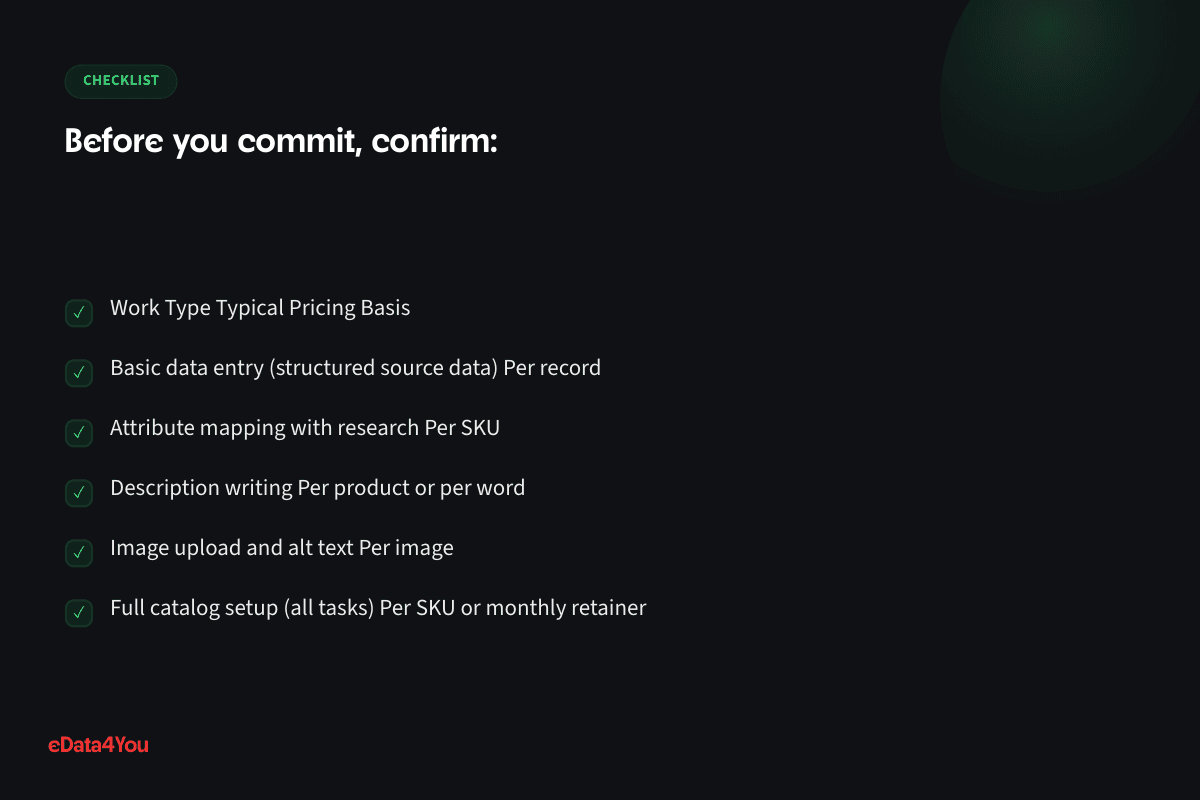
Pricing for catalog processing services varies based on the complexity of the data and the volume involved.
Work Type Typical Pricing Basis
Basic data entry (structured source data) Per record
Attribute mapping with research Per SKU
Description writing Per product or per word
Image upload and alt text Per image
Full catalog setup (all tasks) Per SKU or monthly retainer
Your growth partner
Great work starts with a clear plan.
Clean, structured, compliant data - product, catalog and operational - across every system it needs to live in.
One accountable team, from scope to reporting.

Support for this article
Data Management
- Product Data EntrySKU creation, attribute population and bulk processing for catalogs ranging from hundreds to thousands of listings.
- Data Entry & Data Processing ServicesManual keying of forms, invoices, records and product data, with a dedicated remote team standing in for in-house data-entry work.
- Catalog ManagementClean taxonomy, product grouping, catalog maintenance, attribute mapping and bulk data updates.
From first conversation to delivery
Start with the real bottleneck.
We review your listings, storefront, campaigns or workflows to identify what needs attention. Bring examples of the work you want to improve.
Know the scope before work starts.
We agree priorities, scope and timelines before execution. You know what the team will handle and how the work will be organised.
Keep one team accountable.
The team that scoped the work handles delivery. Responsibility stays clear as tasks move from planning into execution.
See what changed and what comes next.
Regular reporting connects the work to progress and results. Review what has been done and decide what should happen next.
To get started, share your platform, current workload and target timeline.
Offshore providers in India typically offer catalog processing at rates significantly below what comparable in-house work would cost. For high-volume catalogs, the savings can be substantial while the output quality remains competitive with domestic providers when you choose an experienced team.
Common Catalog Problems That Processing Services Solve
Businesses that come to catalog processing services often have the same set of recurring issues:
- Products buried in wrong categories with low or no search visibility
- Missing attributes that prevent products from appearing in filtered searches
- Descriptions that are copied directly from supplier sheets without buyer-friendly editing
- Image files that do not meet platform specifications and trigger suppressed listings
- Variants set up incorrectly, causing inventory tracking errors
Duplicate SKUs that create fulfillment confusion
Each of these problems has a direct cost, either in lost sales, returns, or time spent troubleshooting. Catalog processing services address them systematically rather than one at a time.
Building a Catalog That Scales
The work done at the catalog entry stage determines how easy or hard it is to manage your product data as the business grows. A catalog built on clean, consistent, well-structured data is easy to update, expand, and distribute. A catalog built on shortcuts and inconsistent formatting becomes increasingly difficult to manage at scale.
Catalog processing services are most valuable as ongoing operational support rather than a one-time project. Regular catalog maintenance, new product onboarding, seasonal content updates, and marketplace compliance checks all benefit from having a dedicated team who knows your data standards.
eData4You provides catalog processing and data entry services for ecommerce brands across Amazon, Shopify, Walmart, eBay, and other major platforms. Our teams handle the full scope of catalog work from SKU setup to marketplace upload. Request a free consultation to discuss your catalog size and channel requirements.
Operations capacity
What could you hand off?
Adjust your workload and catalog size to explore a planning estimate of the time you could recover.
Time spent on your recurring operations tasks.
Number of products or variants in your catalog.
Estimated recoverable capacity
Per week
Per month
Monthly headline figures are rounded. This values time, rather than predicting a cash saving.
The assumptions behind the estimate
- Base recovery
- 60%of weekly operations time
- Catalog factor
- 1.00–1.40×1 + SKUs ÷ 2,000, capped at 1.40×
- Monthly conversion
- 4.33 weekstime valued at $35 per hour
Weekly hours × 60% × catalog factor × 4.33 = monthly capacity. Actual capacity depends on the work you can delegate.
Frequently Asked Questions
What's the difference between data entry and catalog processing?
Basic data entry copies information accurately from one place to another. Catalog processing adds judgment on top of that - attribute mapping, channel-specific formatting, and taxonomy decisions that a straight copy-paste job doesn't require.
How long does it take to process a large catalog?
It depends on catalog size, source data quality, and how many channels the data needs to be formatted for. A provider with the team size to absorb volume should give you a specific turnaround commitment before the project starts, not an open-ended estimate.
Can catalog processing handle messy supplier data?
Yes, when the provider has the right experience. Supplier data often arrives as spreadsheets, PDFs, images, or spec sheets rather than clean structured files, and a capable catalog processor works from whatever format you have.
Does catalog processing help with marketplace suppressions?
Yes. Many suppressed listings trace back to missing attributes or non-compliant images, both of which are exactly what a structured catalog processing QA step is designed to catch before the listing goes live.
Is catalog processing a one-time project or ongoing work?
It works best as ongoing support. New product onboarding, seasonal updates, and marketplace compliance changes are recurring needs, and a team already familiar with your data standards handles them faster than starting fresh each time.
Conclusion
Catalog processing is where product data quality actually gets decided - long before a listing ever goes live. Getting SKU structure, attributes, descriptions, and taxonomy right at the entry stage is far cheaper than fixing thousands of live records later, and it's the difference between a catalog that scales cleanly and one that gets harder to manage with every new product added.

Reviewed by Amit Sharma, Founder & IT Head· Content reviewed Sep 2026
Explore eData4You
Find the right next step.
Check your fit, explore blog topics or find the service that supports your work.
Start with your industry, then check the platforms and technology that support your workload.
Blog topics
Choose a topic to explore recent guides on the work behind ecommerce.
Recent guides
Data Management
Data Management: 3 guides to explore.
Services
Start with services relevant to this guide, or explore the rest of our services.




Comments
Leave a comment