
On this page21 sectionsShowHide
- What Should You Evaluate Before Outsourcing Data Entry?
- 1. Accuracy Rate and Quality Control Process
- What a Strong QA Process Looks Like
- 2. Data Security and Confidentiality Practices
- Security Questions to Ask Every Provider
- 3. Experience With Your Type of Data
- 4. Turnaround Time and Reliability
- How to Test Turnaround Before Committing
- 5. Pricing Structure and What Is Included
- 6. Communication and Project Management
- 7. Scalability for Future Needs
- Red Flags to Avoid
- Running a Pilot Before Full Commitment
- Finding a Provider That Fits Your Requirements
- Frequently Asked Questions
- Is a 95% accuracy rate actually good for data entry?
- What's the fastest way to spot a provider that's not being straight with me?
- Why does a paid pilot matter more than a free sample?
- How do I make sure I'm not surprised by hidden costs later?
- Does a provider's current capacity guarantee they can handle my future growth?
- Conclusion
Key takeaways
- Before outsourcing data entry projects, evaluate the provider’s accuracy rates, QA process, data security practices, turnaround reliability, and experience with your…
- A provider who delivers accurate data two weeks late is not useful when your launch date is next week.
- Your data volume today may look very different in six months.
- Ask direct security and QA questions and watch for vague answers.
- The providers worth hiring are the ones who answer accuracy, security, and capacity questions with specifics rather than reassurance - a documented QA process, a signed…
What Should You Evaluate Before Outsourcing Data Entry?
Before outsourcing data entry projects, evaluate the provider’s accuracy rates, QA process, data security practices, turnaround reliability, and experience with your specific type of data. A provider who performs well on all five criteria is worth more than a cheaper option that fails on any one of them.
Outsourcing data entry to the wrong provider creates problems that cost more to fix than the original work cost to do. Inaccurate records, missed deadlines, and data security incidents all carry real business consequences. This guide covers the criteria that matter most when evaluating providers and the red flags that signal a poor fit.
01Accuracy Rate and Quality Control Process
Accuracy is the most important criterion for data entry work. A provider with a 95 percent accuracy rate sounds acceptable until you realize that means 1 in 20 records has an error. For a catalog of 10,000 products, that is 500 incorrect entries.
Ask every provider how they measure and guarantee accuracy. The answer should describe a specific QA process, not a vague commitment to quality.
What a Strong QA Process Looks Like
The best providers use double-entry verification: two operators enter the same data independently, and the system flags any mismatch for review. Others use automated validation to check data formats, required fields, and range constraints before delivery.
You should receive output with a stated accuracy guarantee, typically 99 percent or higher for structured data, and a clear remediation process for errors found after delivery. If a provider cannot describe their QA process in specific terms, treat that as a warning sign.
02Data Security and Confidentiality Practices
Data entry work often involves sensitive information: customer records, financial data, supplier pricing, unreleased product information, or proprietary catalog content. Before sharing any of that with a provider, understand exactly how they protect it.
For your next planning session
Good guidance is worth keeping.
Save this guide and return when you’re ready to put it into practice.
Security Questions to Ask Every Provider
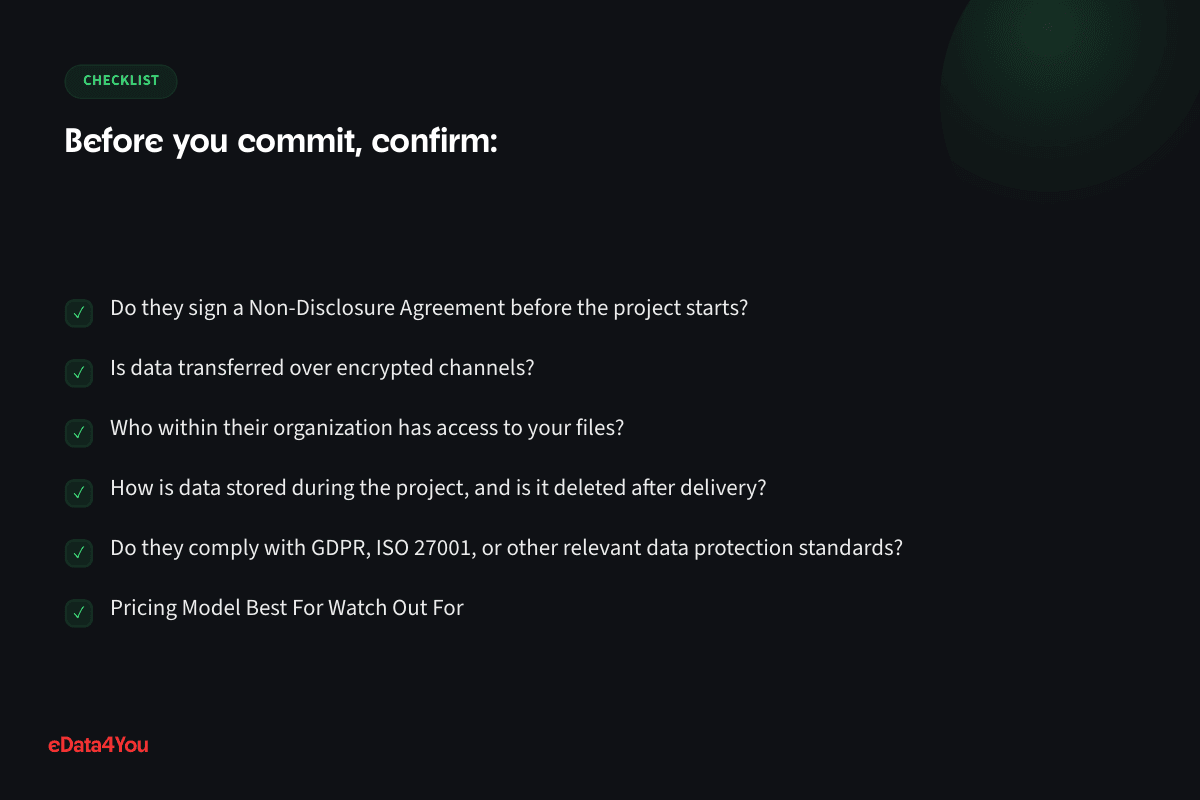
Do they sign a Non-Disclosure Agreement before the project starts?
Is data transferred over encrypted channels?
Who within their organization has access to your files?
How is data stored during the project, and is it deleted after delivery?
Do they comply with GDPR, ISO 27001, or other relevant data protection standards?
A provider who cannot answer these questions clearly is a risk. Reputable providers have documented security policies and will share them on request.
03Experience With Your Type of Data
Data entry is not a single skill. Processing product catalog data for ecommerce requires different knowledge than entering insurance claims, medical records, or legal documents. A provider experienced in one area may produce poor results in another.
Ask specifically about their experience with your data type. Request examples of similar work or client references in your industry. If a provider claims to handle all types of data equally well, ask for specific volume figures and error rates from clients in your category.
For ecommerce catalog work, look for experience with Amazon, Shopify, Walmart, or whichever platforms you sell on. Platform-specific knowledge significantly reduces errors and rework.
More resources
Understand the terms.
Follow the changes.
Clear definitions and marketplace updates, with context you can use in your next decision.
04Turnaround Time and Reliability
A provider who delivers accurate data two weeks late is not useful when your launch date is next week. Turnaround reliability matters as much as accuracy for time-sensitive projects.
How to Test Turnaround Before Committing
Ask for their standard turnaround on a project similar to yours. Then run a paid pilot batch, not a free sample, and measure whether they deliver on time. Free samples are often handled differently from paid work.
Check whether they have buffer capacity to handle volume spikes. If your monthly data entry volume doubles for a product launch, can they absorb that increase with the same turnaround? Get that answer in writing before it becomes urgent.
05Pricing Structure and What Is Included
Data entry pricing varies widely. Some providers charge per record, others per hour, and others by project. The right structure depends on your volume and task complexity.
Pricing Model Best For Watch Out For
Per record Structured, predictable tasks Hidden fees for complex records
Per hour Variable or research-heavy tasks Inflated time without output benchmarks
Per project Defined scope, one-time tasks Scope creep that increases cost
Business Analyzer
Know your numbers before you scale.
Understand margin, ad return and storefront performance using your own business inputs. Explore what the report checks.
Report outline
ProfitabilityWhere does your revenue go?
- Fees and marginWhere each dollar of revenue goes, and what's left.
- Marketplace fee comparisonWhat your revenue would cost in selling fees on each platform.
- Profit leaksCosts running above healthy levels at the numbers you entered.
Have this ready
Start with your selling channels, monthly revenue, return rate and goal. Add product cost and monthly team cost for a fuller margin picture.
Report outline
AdvertisingWhat does your ad return need to cover?
- Break-even ad returnThe ad return you need just to break even, against what you're getting.
- Ad spend in your cost mixSee how monthly ad spend affects the margin left after your entered costs.
- Revenue relative to ad spendCompare monthly revenue with monthly ad spend alongside the break-even threshold.
Have this ready
Bring your business figures and monthly ad spend. Add product cost as a percentage of price to calculate break-even ad return.
Report outline
Store performanceHow does your storefront perform?
- Mobile speedA live scan checks how your store performs on mobile.
- Google SEO checksSee the SEO checks included in your store scan.
- Product markupCheck for structured product data on your store or product page.
Have this ready
Add a store or product page URL alongside your business figures. The store scan runs after you unlock the full report.
Monthly retainer Ongoing steady-volume work Underutilized capacity in slow months
Always clarify what is included in the quoted rate. QA passes, revisions, secure file transfer, and project management are sometimes billed separately. Get a written scope of work before signing.
06Communication and Project Management
Poor communication is one of the most common complaints about outsourced data entry. Slow responses, unclear escalation paths, and no visibility into project status all create frustration and risk.
Evaluate communication before you start a project. How quickly do they respond to inquiries? Do they assign a single point of contact? What project management tools do they use? Can you see status updates in real time or only when you ask?
A provider who is responsive and transparent during the sales process is more likely to remain that way once the project is running.
07Scalability for Future Needs
Your data volume today may look very different in six months. If you are growing, entering new markets, or expanding your product catalog, your provider needs to scale with you.
Ask about their team size, their maximum monthly output, and how they handle requests that exceed their current capacity. A small provider who is efficient now may become a bottleneck when your volume grows.
Your growth partner
Great work starts with a clear plan.
Clean, structured, compliant data - product, catalog and operational - across every system it needs to live in.
One accountable team, from scope to reporting.

Support for this article
Data Management
- Data Entry & Data Processing ServicesManual keying of forms, invoices, records and product data, with a dedicated remote team standing in for in-house data-entry work.
- Product Data EntrySKU creation, attribute population and bulk processing for catalogs ranging from hundreds to thousands of listings.
- Catalog ManagementClean taxonomy, product grouping, catalog maintenance, attribute mapping and bulk data updates.
From first conversation to delivery
Start with the real bottleneck.
We review your listings, storefront, campaigns or workflows to identify what needs attention. Bring examples of the work you want to improve.
Know the scope before work starts.
We agree priorities, scope and timelines before execution. You know what the team will handle and how the work will be organised.
Keep one team accountable.
The team that scoped the work handles delivery. Responsibility stays clear as tasks move from planning into execution.
See what changed and what comes next.
Regular reporting connects the work to progress and results. Review what has been done and decide what should happen next.
To get started, share your platform, current workload and target timeline.
Red Flags to Avoid
Some providers look capable on the surface but show warning signs under scrutiny. Watch for:
- Unwillingness to sign an NDA before discussing your data
- No specific accuracy guarantee or QA process description
- Turnaround promises that seem too fast for the stated volume
- Pricing significantly lower than market rates without a clear explanation
- No client references willing to speak on their behalf
- Vague responses to direct security questions
Any one of these is worth pausing on. More than one is a signal to look elsewhere.
Running a Pilot Before Full Commitment
The most reliable way to evaluate a data entry provider is to run a paid pilot on a real sample of your work. Give them 100 to 500 records that represent your typical complexity, provide your standard instructions, and evaluate accuracy, formatting, turnaround, and communication.
A pilot tells you more than any sales conversation can. It shows how the provider performs under real conditions with real data, not a curated sample designed to impress.
If the pilot results are strong, scale up with confidence. If results are inconsistent, you have learned that without committing your full volume.
Finding a Provider That Fits Your Requirements
The right outsourced data entry provider for your business is one who matches your accuracy standards, works within your timelines, secures your data properly, and communicates clearly throughout the project.
eData4You provides data entry and catalog processing services for ecommerce businesses and B2B operations. Our QA process uses double-entry verification and structured review at every stage. We work with brands across Amazon, Shopify, Walmart, and other major platforms. Request a free consultation to discuss your project and receive a detailed proposal.
Operations capacity
What could you hand off?
Adjust your workload and catalog size to explore a planning estimate of the time you could recover.
Time spent on your recurring operations tasks.
Number of products or variants in your catalog.
Estimated recoverable capacity
Per week
Per month
Monthly headline figures are rounded. This values time, rather than predicting a cash saving.
The assumptions behind the estimate
- Base recovery
- 60%of weekly operations time
- Catalog factor
- 1.00–1.40×1 + SKUs ÷ 2,000, capped at 1.40×
- Monthly conversion
- 4.33 weekstime valued at $35 per hour
Weekly hours × 60% × catalog factor × 4.33 = monthly capacity. Actual capacity depends on the work you can delegate.
Frequently Asked Questions
Is a 95% accuracy rate actually good for data entry?
No, it sounds acceptable but means 1 in 20 records has an error - for a 10,000-product catalog, that's 500 incorrect entries. Look for a stated guarantee of 99% or higher for structured data work.
What's the fastest way to spot a provider that's not being straight with me?
Ask direct security and QA questions and watch for vague answers. Unwillingness to sign an NDA, no specific accuracy guarantee, or pricing significantly below market rate without explanation are all red flags worth pausing on individually - more than one should send you elsewhere.
Why does a paid pilot matter more than a free sample?
Free samples are often handled differently from paid work, since providers know it's being used to win the account. A paid pilot on 100-500 real records shows how they perform under normal working conditions, which is what you're actually buying.
How do I make sure I'm not surprised by hidden costs later?
Get a written scope of work before signing, and confirm explicitly whether QA passes, revisions, secure file transfer, and project management are included in the quoted rate or billed separately - these are the most common places pricing surprises hide.
Does a provider's current capacity guarantee they can handle my future growth?
No. A small provider who's efficient at your current volume can become a bottleneck once you scale. Ask about their maximum monthly output and how they handle requests that exceed current capacity before you need that answer urgently.
Conclusion
The providers worth hiring are the ones who answer accuracy, security, and capacity questions with specifics rather than reassurance - a documented QA process, a signed NDA, and a real paid pilot reveal more about fit than any sales conversation. Evaluating on all five criteria together, rather than defaulting to the cheapest quote, is what prevents a data entry decision from becoming a bigger problem than the one it was meant to solve.

Reviewed by Amit Sharma, Founder & IT Head· Content reviewed Sep 2026
Explore eData4You
Find the right next step.
Check your fit, explore blog topics or find the service that supports your work.
Start with your industry, then check the platforms and technology that support your workload.
Blog topics
Choose a topic to explore recent guides on the work behind ecommerce.
Recent guides
Data Management
Data Management: 3 guides to explore.
Services
Start with services relevant to this guide, or explore the rest of our services.




Comments
Leave a comment