
On this page20 sectionsShowHide
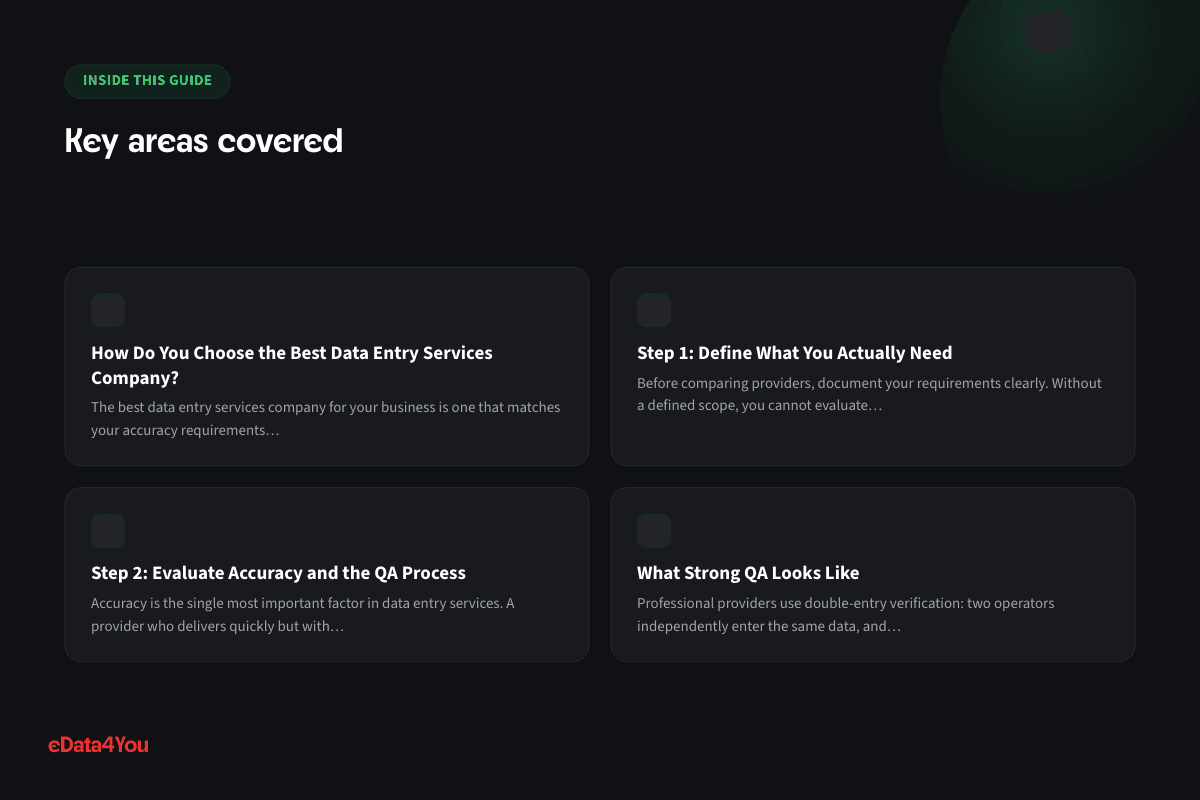
- How Do You Choose the Best Data Entry Services Company?
- Step 1: Define What You Actually Need
- Step 2: Evaluate Accuracy and the QA Process
- What Strong QA Looks Like
- Step 3: Assess Data Security Practices
- Security Criteria to Evaluate
- Step 4: Check Industry and Platform Experience
- Step 5: Test with a Paid Pilot Before Committing
- Step 6: Compare Pricing on a Like-for-Like Basis
- Common Pricing Models
- Step 7: Evaluate Communication and Responsiveness
- Questions to Ask Every Provider Before Signing
- Choosing a Provider for Long-Term Work
- Frequently Asked Questions
- What accuracy rate should I expect from a data entry provider?
- Why is a paid pilot better than a free sample for evaluating a provider?
- What security certifications should a data entry provider have?
- How should I compare pricing between providers who quote differently?
- What makes a data entry provider suitable for long-term, ongoing work?
- Conclusion
Key takeaways
- The best data entry services company for your business is one that matches your accuracy requirements, secures your data, delivers within your timelines, and has direct…
- Data entry work involves access to information you may not want shared: supplier pricing, customer records, unreleased product data, or sensitive business documents.
- Poor communication is one of the most common issues reported with outsourced data entry.
- Providers handle paid work under the same conditions as an ongoing contract, so a paid pilot reflects real performance.
- Choosing a data entry provider comes down to four things that actually predict long-term performance: accuracy standards you can verify, security practices you can…
How Do You Choose the Best Data Entry Services Company?
The best data entry services company for your business is one that matches your accuracy requirements, secures your data, delivers within your timelines, and has direct experience with your type of data. Evaluating providers on these four criteria before signing a contract saves significant time and cost compared to switching vendors after problems appear.
Data entry is not a commodity where the cheapest option always wins. Poor accuracy costs money in corrections. Slow turnaround delays your operations. Weak security exposes your business to risk. This guide gives you a step-by-step framework for finding a provider that performs well on the dimensions that matter.
Step 1Define What You Actually Need
Before comparing providers, document your requirements clearly. Without a defined scope, you cannot evaluate proposals accurately or hold vendors accountable to outcomes.
Your requirements document should cover:
- Data type: Product catalog, invoices, customer records, survey responses, financial data, or other
- Volume: Estimated monthly record count or hours of work
- Source format: Spreadsheets, PDFs, scanned documents, website data, images, or physical forms
- Output format: The exact fields, structure, and file format you need delivered
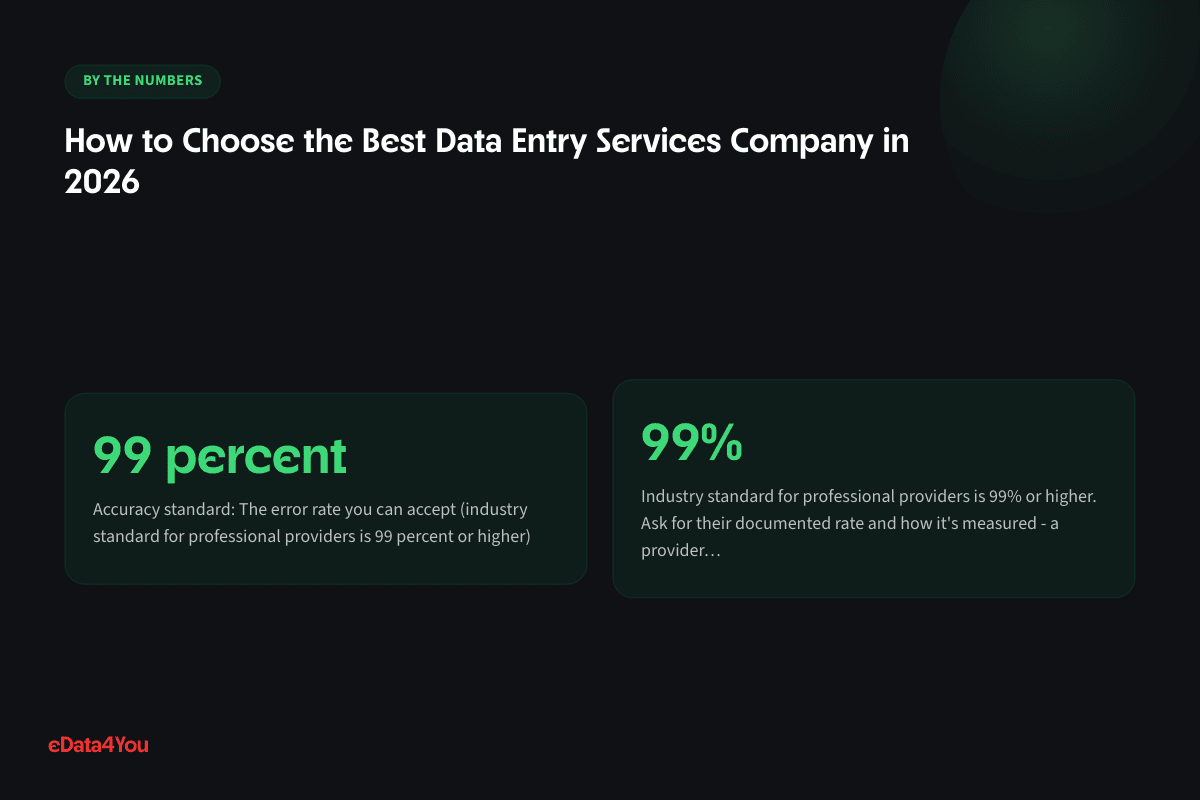
- Accuracy standard: The error rate you can accept (industry standard for professional providers is 99 percent or higher)
- Turnaround time: How quickly you need batches processed
Security requirements: NDA, data encryption, access restrictions, compliance standards
Providers who see a clear scope produce more accurate proposals. And you can compare those proposals fairly because they are all based on the same requirements.
Step 2Evaluate Accuracy and the QA Process
Accuracy is the single most important factor in data entry services. A provider who delivers quickly but with errors creates more work than they save.
Ask every provider you shortlist to explain their quality control process in specific terms. The answer should describe concrete steps, not vague assurances.
What Strong QA Looks Like
Professional providers use double-entry verification: two operators independently enter the same data, and automated comparison flags any mismatch. The flagged records go to a senior reviewer before delivery.
For your next planning session
Good guidance is worth keeping.
Save this guide and return when you’re ready to put it into practice.
Some providers layer in automated validation to check that values fall within expected ranges, required fields are populated, and formats are consistent. This catches systematic errors that manual review can miss.
Ask for their stated accuracy rate and for documentation of how it is measured. A provider who cannot show you their QA metrics does not have a reliable QA process.
Step 3Assess Data Security Practices
Data entry work involves access to information you may not want shared: supplier pricing, customer records, unreleased product data, or sensitive business documents. Security should be a non-negotiable part of your vendor evaluation.
Security Criteria to Evaluate
Criterion What to Ask
Confidentiality agreement Do they sign an NDA before project discussions?
Data transfer Is data moved over encrypted channels (SFTP, SSL)?
Access control Who within their team can access your files?
Storage How is data stored during and after the project?
Compliance Do they hold ISO 27001 or SOC 2 certification?
Deletion policy When is your data deleted after delivery?
Reputable providers have documented answers to all of these questions. If a provider is vague or resistant to discussing security specifics, that is a signal to look elsewhere.
More resources
Understand the terms.
Follow the changes.
Clear definitions and marketplace updates, with context you can use in your next decision.
Step 4Check Industry and Platform Experience
A provider who handles ecommerce catalog data for Amazon and Shopify has very different competencies from one who processes insurance claims or legal documents. Industry experience matters because it reduces errors, speeds up onboarding, and means the provider already understands the rules specific to your platforms.
Ask for client references or case studies in your industry. If they are reluctant to provide these, ask for aggregate performance data from similar clients instead.
For ecommerce, ask specifically about:
- Experience with the platforms you sell on (Amazon Seller Central, Shopify, Walmart Marketplace, eBay)
- Familiarity with category-specific listing requirements
- Ability to handle variation relationships, bundle SKUs, and multi-image uploads
- Experience with marketplace compliance and suppressed listing resolution
Step 5Test with a Paid Pilot Before Committing
The most reliable way to evaluate a provider is to run a real project with a real sample of your data. Paid pilots are more informative than free samples because providers handle paid work under the same conditions as ongoing contracts.
Structure your pilot to represent the typical complexity of your data. Include edge cases: records with missing fields, unusual formats, or ambiguous values. Provide the same instructions you would give for a full contract.
Evaluate the pilot results on:
- Accuracy rate against your stated standard
- Turnaround versus the committed timeline
Format and completeness of delivered output
Quality of communication during the project
Business Analyzer
Know your numbers before you scale.
Understand margin, ad return and storefront performance using your own business inputs. Explore what the report checks.
Report outline
ProfitabilityWhere does your revenue go?
- Fees and marginWhere each dollar of revenue goes, and what's left.
- Marketplace fee comparisonWhat your revenue would cost in selling fees on each platform.
- Profit leaksCosts running above healthy levels at the numbers you entered.
Have this ready
Start with your selling channels, monthly revenue, return rate and goal. Add product cost and monthly team cost for a fuller margin picture.
Report outline
AdvertisingWhat does your ad return need to cover?
- Break-even ad returnThe ad return you need just to break even, against what you're getting.
- Ad spend in your cost mixSee how monthly ad spend affects the margin left after your entered costs.
- Revenue relative to ad spendCompare monthly revenue with monthly ad spend alongside the break-even threshold.
Have this ready
Bring your business figures and monthly ad spend. Add product cost as a percentage of price to calculate break-even ad return.
Report outline
Store performanceHow does your storefront perform?
- Mobile speedA live scan checks how your store performs on mobile.
- Google SEO checksSee the SEO checks included in your store scan.
- Product markupCheck for structured product data on your store or product page.
Have this ready
Add a store or product page URL alongside your business figures. The store scan runs after you unlock the full report.
How errors in the pilot output were handled
If the pilot results are strong, you can scale up with confidence. If results are inconsistent, you have learned that before committing your full data volume.
Step 6Compare Pricing on a Like-for-Like Basis
Data entry pricing models vary. Some providers quote per record, others per hour, others per project. To compare proposals accurately, convert all quotes to the same basis: cost per processed record, estimated based on the volume and timeline in your scope.
Common Pricing Models
Model When It Works Risk
Per record Structured, predictable tasks High rates for complex records
Per hour Research-heavy or variable tasks Difficult to predict total cost
Per project Defined one-time scope Scope creep without clear boundaries
Monthly retainer Steady ongoing volume Underused capacity in slow months
Always confirm what is included in the quoted price. QA passes, secure file transfer, project management, and revisions are sometimes charged separately. Get a written scope of work before signing.
Step 7Evaluate Communication and Responsiveness
Poor communication is one of the most common issues reported with outsourced data entry. Providers who are slow to respond, unclear about project status, or hard to reach when problems arise create more friction than the outsourcing was meant to remove.
Evaluate communication during the sales process as an early indicator. How quickly do they respond to inquiries? Do they assign a dedicated account contact? Do they use project management tools that give you visibility into progress?
Your growth partner
Great work starts with a clear plan.
Clean, structured, compliant data - product, catalog and operational - across every system it needs to live in.
One accountable team, from scope to reporting.

Support for this article
Data Management
- Data Entry & Data Processing ServicesManual keying of forms, invoices, records and product data, with a dedicated remote team standing in for in-house data-entry work.
- Product Data EntrySKU creation, attribute population and bulk processing for catalogs ranging from hundreds to thousands of listings.
- Back-Office & Data Entry StaffDedicated capacity for the recurring data entry and back-office work that never stops, but rarely justifies a full-time hire on its own.
From first conversation to delivery
Start with the real bottleneck.
We review your listings, storefront, campaigns or workflows to identify what needs attention. Bring examples of the work you want to improve.
Know the scope before work starts.
We agree priorities, scope and timelines before execution. You know what the team will handle and how the work will be organised.
Keep one team accountable.
The team that scoped the work handles delivery. Responsibility stays clear as tasks move from planning into execution.
See what changed and what comes next.
Regular reporting connects the work to progress and results. Review what has been done and decide what should happen next.
To get started, share your platform, current workload and target timeline.
A provider who is responsive and specific during the evaluation phase is more likely to stay that way once you are a client.
Questions to Ask Every Provider Before Signing
Before finalizing any vendor, get clear answers to:
1. What is your documented accuracy rate, and how do you measure it?
2. What is your QA process for a project like mine?
3. What data security certifications or protocols do you have in place?
4. What is your realistic turnaround for my volume?
5. Who is my point of contact, and what is the escalation path if issues arise?
6. What happens if delivered output does not meet the agreed accuracy standard?
7. Can you share references from clients with similar data types?
Providers who give specific, direct answers to these questions are more trustworthy than those who respond with generalities or sales language.
Choosing a Provider for Long-Term Work
A data entry partner for ongoing work needs more than good one-time performance. They need to scale with your volume, adapt to your changing data requirements, and maintain quality over months and years.
Operations capacity
What could you hand off?
Adjust your workload and catalog size to explore a planning estimate of the time you could recover.
Time spent on your recurring operations tasks.
Number of products or variants in your catalog.
Estimated recoverable capacity
Per week
Per month
Monthly headline figures are rounded. This values time, rather than predicting a cash saving.
The assumptions behind the estimate
- Base recovery
- 60%of weekly operations time
- Catalog factor
- 1.00–1.40×1 + SKUs ÷ 2,000, capped at 1.40×
- Monthly conversion
- 4.33 weekstime valued at $35 per hour
Weekly hours × 60% × catalog factor × 4.33 = monthly capacity. Actual capacity depends on the work you can delegate.
Ask about their team size, their capacity ceiling, and their process for onboarding new data types or platforms. The right long-term provider is one you can hand off new work to without rebuilding the process from scratch every time.
eData4You provides data entry and catalog processing services for ecommerce businesses, retailers, and B2B operations. Our teams have experience across Amazon, Shopify, Walmart, eBay, and other major platforms. We use structured QA at every stage and commit to accuracy rates of 99 percent or higher on structured tasks. Request a free consultation to discuss your data requirements and receive a tailored proposal.
Frequently Asked Questions
What accuracy rate should I expect from a data entry provider?
Industry standard for professional providers is 99% or higher. Ask for their documented rate and how it's measured - a provider who can't produce that data likely doesn't have a reliable QA process to back the claim.
Why is a paid pilot better than a free sample for evaluating a provider?
Providers handle paid work under the same conditions as an ongoing contract, so a paid pilot reflects real performance. A free sample often gets extra attention precisely because it's a sales pitch, which can mask how the provider performs at normal working pace.
What security certifications should a data entry provider have?
Look for ISO 27001 or SOC 2 certification, along with clear answers on encrypted data transfer, access control, and a defined deletion policy. A provider who is vague about security specifics is a signal to look elsewhere.
How should I compare pricing between providers who quote differently?
Convert every quote to the same basis - cost per processed record - using your actual volume and timeline. Also confirm what's included, since QA passes, secure file transfer, and revisions are sometimes billed separately from the base rate.
What makes a data entry provider suitable for long-term, ongoing work?
Team size, capacity ceiling, and their process for onboarding new data types matter more for long-term partnerships than one-time pilot performance. The right provider scales with your volume without you having to rebuild the process each time.
Conclusion
Choosing a data entry provider comes down to four things that actually predict long-term performance: accuracy standards you can verify, security practices you can audit, platform experience relevant to your business, and communication that stays reliable once you're a paying client rather than a prospect. A structured evaluation - built around a real, paid pilot - catches problems before they become your problem at full volume.

Reviewed by Amit Sharma, Founder & IT Head· Content reviewed Sep 2026
Explore eData4You
Find the right next step.
Check your fit, explore blog topics or find the service that supports your work.
Start with your industry, then check the platforms and technology that support your workload.
Blog topics
Choose a topic to explore recent guides on the work behind ecommerce.
Recent guides
Data Management
Data Management: 3 guides to explore.
Services
Start with services relevant to this guide, or explore the rest of our services.




Comments
Leave a comment