
On this page22 sectionsShowHide
- Who This Guide Is For
- Why Marketplace Management Matters
- Start With a Marketplace Operating Baseline
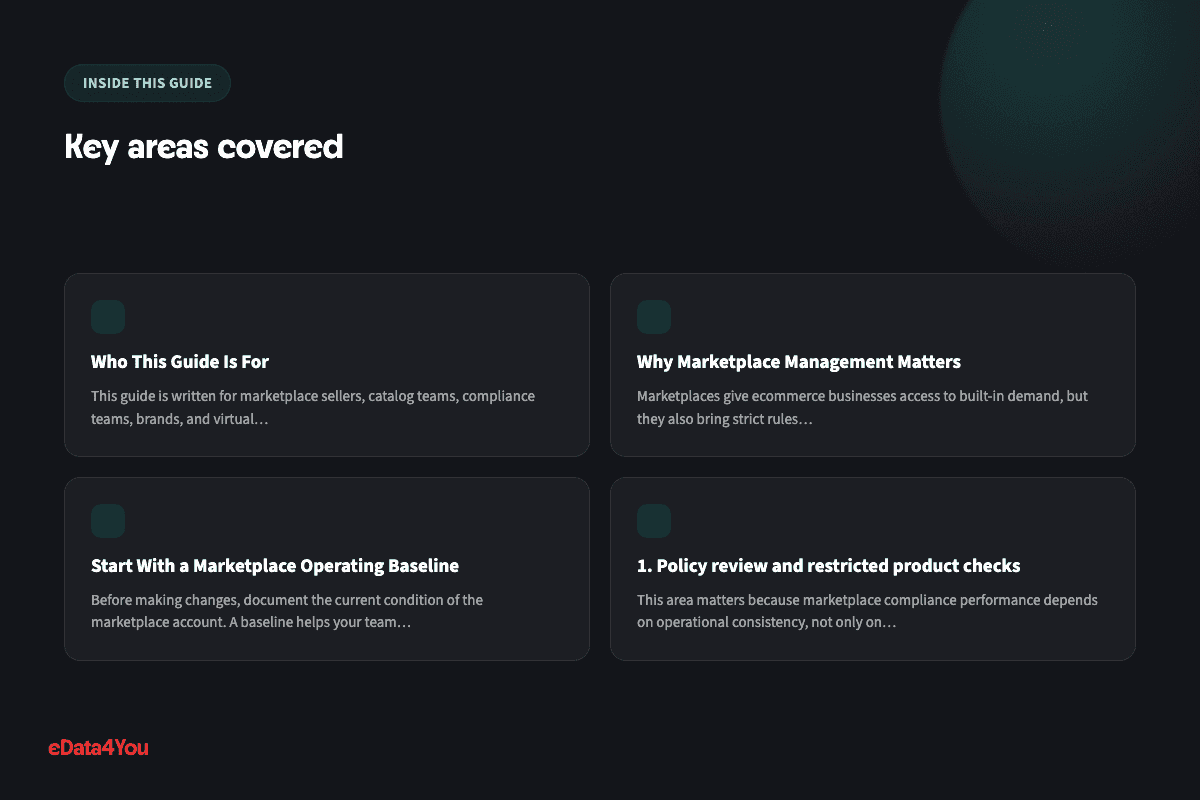
- 1. Policy review and restricted product checks
- 2. Claims, images, and product documentation
- 3. Category compliance and attribute accuracy
- 4. Suppression, warning, and violation workflow
- 5. Compliance audit and approval process
- Marketplace Management Checklist
- Daily, Weekly, and Monthly Marketplace Tasks
- Ecommerce and AI Considerations
- Common Marketplace Management Mistakes
- Budget, Timeline, and Ownership
- 30-60-90 Day Marketplace Roadmap
- How eData4You Can Help
- Frequently Asked Questions
- What is marketplace management?
- Why do marketplace sellers need management support?
- Can marketplace management be outsourced?
- What should be checked every week?
- How do marketplaces decide product visibility?
- Final Thoughts
Compliance problems often appear after listings are live: restricted claims, missing documents, inaccurate attributes, image issues, category rules, safety requirements, and marketplace policy changes.
Marketplace management is the work of keeping product listings, inventory, pricing, fulfillment, customer service, advertising, compliance, and reporting aligned across one or many online marketplaces. It is not only a listing task. It is an operating system for ecommerce growth.
This guide explains how to manage marketplace compliance in a practical way so your team can reduce errors, protect seller metrics, improve product visibility, and make better decisions every week.
Compliance Guide A marketplace management system should connect catalog quality, inventory, pricing, advertising, orders, account health, and reporting into one operating rhythm.
Catalog Build accurate listings with strong titles, images, attributes, variations, compliance data, and marketplace SEO. Operations Keep inventory, orders, shipping, returns, messages, and account health under daily control. Growth Use ads, pricing, analytics, reviews, and expansion planning to grow without losing margin. 5 areas to manage: listings, stock, orders, ads, and account health 7 checks before scaling any marketplace channel 90 days to stabilize operations and improve marketplace growth 1 Listings Optimize product data so shoppers and marketplace algorithms understand the offer. 2 Inventory Protect availability, fulfillment speed, and channel allocation before stock issues hurt metrics. 3 Service Handle orders, messages, returns, and account health before small issues become penalties. 4 Reporting Review profit, ads, conversion, search visibility, and operational exceptions every week.
Who This Guide Is For
This guide is written for marketplace sellers, catalog teams, compliance teams, brands, and virtual assistants responsible for preventing listing violations and seller account risk. It also fits brands weighing whether to outsource policy monitoring, listing audits, or violation response, and teams that want a firmer process before compliance risk scales with more listings.
Nobody needs to memorize every marketplace policy to benefit here — the goal is spotting which listing and account practices create violation risk, where enforcement actions usually originate, and what a compliance-minded workflow looks like.
Why Marketplace Management Matters
Marketplaces give ecommerce businesses access to built-in demand, but they also bring strict rules, competition, operational pressure, and platform-specific ranking systems. A product can be excellent and still fail if the listing is incomplete, the price is uncompetitive, inventory is unstable, shipping is slow, or customer messages are missed.
Most marketplace problems begin as small operational gaps. A missing attribute causes listing suppression. A late shipment hurts seller metrics. A weak title reduces search visibility. A poor image lowers conversion. A stock sync issue creates cancellations. A policy warning becomes an account health risk because nobody responded in time.
Good marketplace management prevents these gaps from becoming revenue problems. It creates a repeatable rhythm for catalog work, order checks, customer service, advertising review, inventory control, and reporting.
Start With a Marketplace Operating Baseline
Before making changes, document the current condition of the marketplace account. A baseline helps your team see what is working, what is risky, and what needs attention first.
Your baseline should include active SKUs, suppressed listings, top sellers, low performers, inventory status, fulfillment settings, return rate, order defect indicators, advertising spend, account health warnings, customer message response time, pricing issues, and current marketplace reports.
This baseline does not need to be complicated. A clear spreadsheet or dashboard is enough if it is reviewed consistently and updated after major changes.
01Policy review and restricted product checks
This area matters because marketplace compliance performance depends on operational consistency, not only on having products listed.
For marketplace compliance, review policy review and restricted product checks with both marketplace rules and buyer expectations in mind. Marketplaces reward listings and sellers that are complete, accurate, available, competitively positioned, and reliable after the order is placed.
Create a simple operating record for this area. It should show what was reviewed, what changed, what error remains, what owner is responsible, and when the next check is due. This makes marketplace management easier to delegate and easier to improve.
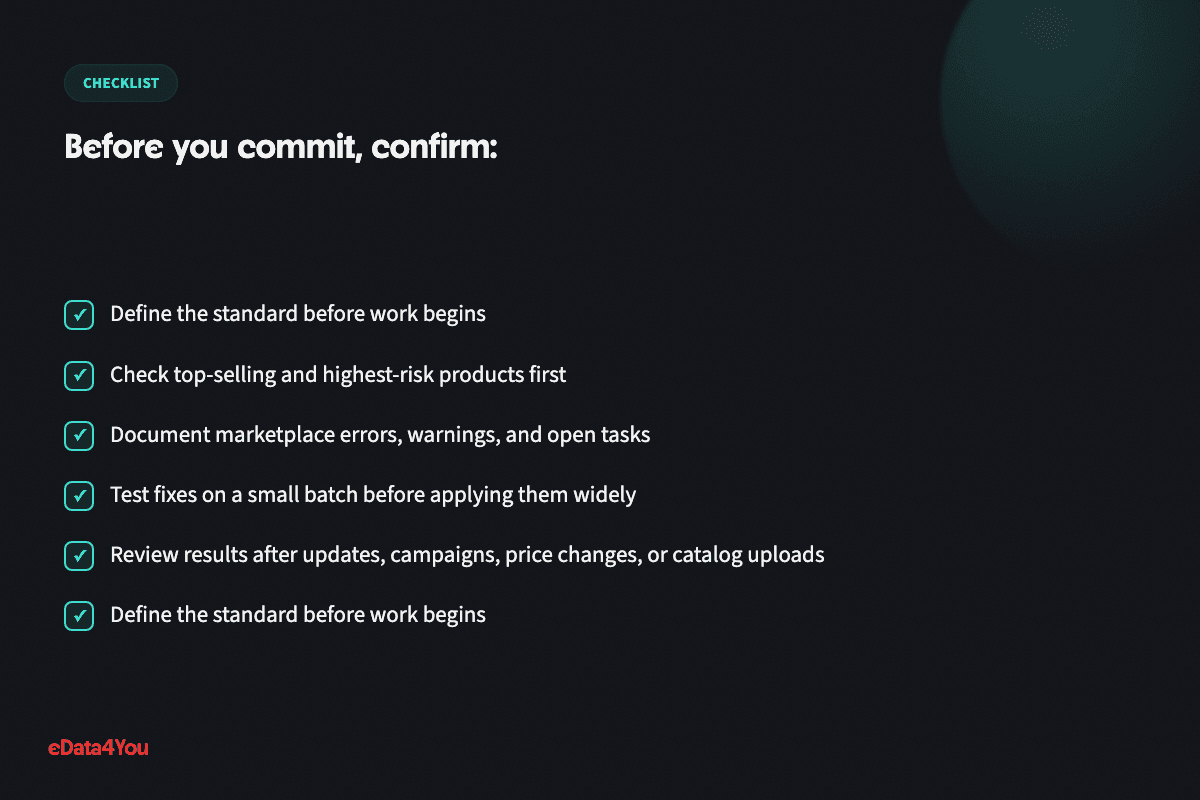
Define the standard before work begins
Check top-selling and highest-risk products first
For your next planning session
Good guidance is worth keeping.
Save this guide and return when you’re ready to put it into practice.
Document marketplace errors, warnings, and open tasks
Test fixes on a small batch before applying them widely
Review results after updates, campaigns, price changes, or catalog uploads
02Claims, images, and product documentation
When this area is weak, sellers often see avoidable errors: suppressed listings, stock problems, late orders, wasted ad spend, lower visibility, or account health warnings.
For marketplace compliance, review claims, images, and product documentation with both marketplace rules and buyer expectations in mind. Marketplaces reward listings and sellers that are complete, accurate, available, competitively positioned, and reliable after the order is placed.
Create a simple operating record for this area. It should show what was reviewed, what changed, what error remains, what owner is responsible, and when the next check is due. This makes marketplace management easier to delegate and easier to improve.
Define the standard before work begins
Check top-selling and highest-risk products first
Document marketplace errors, warnings, and open tasks
Test fixes on a small batch before applying them widely
Review results after updates, campaigns, price changes, or catalog uploads
03Category compliance and attribute accuracy
A strong process gives the team a clear standard for what to check, how often to check it, and when to escalate an issue before it affects customers.
For marketplace compliance, review category compliance and attribute accuracy with both marketplace rules and buyer expectations in mind. Marketplaces reward listings and sellers that are complete, accurate, available, competitively positioned, and reliable after the order is placed.
Create a simple operating record for this area. It should show what was reviewed, what changed, what error remains, what owner is responsible, and when the next check is due. This makes marketplace management easier to delegate and easier to improve.
Define the standard before work begins
Check top-selling and highest-risk products first
Document marketplace errors, warnings, and open tasks
Test fixes on a small batch before applying them widely
Explore related concepts
Related term
ASIN
Definition of ASIN
Amazon Standard Identification Number - the unique code Amazon assigns to every product listing on its catalog.
Example in practice
A seller launching a private-label phone case gets one ASIN when the listing goes live; every size or color variation gets its own child ASIN under the same parent.
Review results after updates, campaigns, price changes, or catalog uploads
04Suppression, warning, and violation workflow
Marketplace teams should document the baseline, assign an owner, and connect this work to measurable outcomes such as revenue, conversion, margin, defect rate, or response time.
For marketplace compliance, review suppression, warning, and violation workflow with both marketplace rules and buyer expectations in mind. Marketplaces reward listings and sellers that are complete, accurate, available, competitively positioned, and reliable after the order is placed.
Create a simple operating record for this area. It should show what was reviewed, what changed, what error remains, what owner is responsible, and when the next check is due. This makes marketplace management easier to delegate and easier to improve.
Define the standard before work begins
Check top-selling and highest-risk products first
Document marketplace errors, warnings, and open tasks
Test fixes on a small batch before applying them widely
Review results after updates, campaigns, price changes, or catalog uploads
05Compliance audit and approval process
The goal is not to create extra admin work. The goal is to make marketplace growth repeatable instead of dependent on memory, urgency, or last-minute fixes.
For marketplace compliance, review compliance audit and approval process with both marketplace rules and buyer expectations in mind. Marketplaces reward listings and sellers that are complete, accurate, available, competitively positioned, and reliable after the order is placed.
Create a simple operating record for this area. It should show what was reviewed, what changed, what error remains, what owner is responsible, and when the next check is due. This makes marketplace management easier to delegate and easier to improve.
Define the standard before work begins
Check top-selling and highest-risk products first
Document marketplace errors, warnings, and open tasks
Test fixes on a small batch before applying them widely
Review results after updates, campaigns, price changes, or catalog uploads
Marketplace Management Checklist
Use this checklist before launching a new marketplace, cleaning up an existing account, or assigning work to an internal or outsourced team.
Business Analyzer
Know your numbers before you scale.
Understand margin, ad return and storefront performance using your own business inputs. Explore what the report checks.
Report outline
ProfitabilityWhere does your revenue go?
- Fees and marginWhere each dollar of revenue goes, and what's left.
- Marketplace fee comparisonWhat your revenue would cost in selling fees on each platform.
- Profit leaksCosts running above healthy levels at the numbers you entered.
Have this ready
Start with your selling channels, monthly revenue, return rate and goal. Add product cost and monthly team cost for a fuller margin picture.
Report outline
AdvertisingWhat does your ad return need to cover?
- Break-even ad returnThe ad return you need just to break even, against what you're getting.
- Ad spend in your cost mixSee how monthly ad spend affects the margin left after your entered costs.
- Revenue relative to ad spendCompare monthly revenue with monthly ad spend alongside the break-even threshold.
Have this ready
Bring your business figures and monthly ad spend. Add product cost as a percentage of price to calculate break-even ad return.
Report outline
Store performanceHow does your storefront perform?
- Mobile speedA live scan checks how your store performs on mobile.
- Google SEO checksSee the SEO checks included in your store scan.
- Product markupCheck for structured product data on your store or product page.
Have this ready
Add a store or product page URL alongside your business figures. The store scan runs after you unlock the full report.
Area What to Check
Product Listings Titles, images, descriptions, bullets, attributes, variations, category mapping, and compliance fields
Marketplace SEO Keyword placement, search filters, backend fields where available, reviews, conversion signals, and content freshness
Inventory Available stock, safety stock, channel allocation, sync frequency, stockout alerts, and oversell prevention
Pricing Marketplace fees, shipping cost, ad cost, returns, minimum margin, competitor pricing, coupons, and repricing rules
Orders Order routing, fulfillment speed, tracking uploads, cancellation reasons, late shipment risk, and exceptions
Customer Service Buyer messages, response time, return requests, refunds, disputes, review issues, and escalation rules
Account Health Policy warnings, listing violations, seller metrics, documentation requests, and suspension risk
Advertising Campaign structure, search terms, bids, budgets, ACOS, ROAS, profit impact, and listing readiness
Reporting Weekly sales, profit, traffic, conversion, inventory, ad performance, and operational issues
The checklist should have owners. If nobody owns inventory, messages, listing errors, ads, and account health, the marketplace account will eventually become reactive.
Daily, Weekly, and Monthly Marketplace Tasks
Daily tasks should protect selling ability. Review new orders, failed orders, customer messages, return requests, account health alerts, suppressed listings, out-of-stock warnings, and urgent pricing issues.
Weekly tasks should improve performance. Review top sellers, low conversion listings, ad spend, search term data, inventory movement, listing quality, returns, customer complaints, and competitor changes.
Monthly tasks should strengthen the system. Audit catalog quality, update old listings, review fees and profitability, clean discontinued products, check policy changes, evaluate marketplace expansion opportunities, and update SOPs.
This rhythm keeps marketplace work organized. It also makes outsourcing easier because repeated tasks can be documented, assigned, reviewed, and improved.
Ecommerce and AI Considerations
Marketplace management increasingly depends on clean data and fast analysis. AI tools can help with listing drafts, keyword clustering, review analysis, support templates, ad insights, and product data cleanup. But AI is only useful when the source data is accurate.
If product attributes are inconsistent, images are mislabeled, policies are unclear, or marketplace reports are not reviewed, AI can create more errors instead of solving them. Human review is still required for claims, compliance, pricing, customer messages, and marketplace policy-sensitive content.
For 2026 marketplace operations, build AI readiness by keeping product data structured, support reasons tagged, ad reports organized, listing errors documented, and performance metrics reviewed on a fixed schedule.

Your growth partner
Great work starts with a clear plan.
End-to-end operation of your marketplace storefronts - listings, ads, fulfillment and compliance.
One accountable team, from scope to reporting.

Support for this article
Marketplace Management
- Marketplace Account ManagementDay-to-day account handling, marketplace updates, issue tracking and operational coordination.
- Amazon Account Health ManagementListing issue resolution, policy checks, error monitoring and account-health support across channels.
- Brand Protection & Listing Hijack MonitoringDaily monitoring for unauthorized sellers, counterfeit listings, hijacked content and MAP violations, with documented evidence ready for escalation.
From first conversation to delivery
Start with the real bottleneck.
We review your listings, storefront, campaigns or workflows to identify what needs attention. Bring examples of the work you want to improve.
Know the scope before work starts.
We agree priorities, scope and timelines before execution. You know what the team will handle and how the work will be organised.
Keep one team accountable.
The team that scoped the work handles delivery. Responsibility stays clear as tasks move from planning into execution.
See what changed and what comes next.
Regular reporting connects the work to progress and results. Review what has been done and decide what should happen next.
To get started, share your platform, current workload and target timeline.
Common Marketplace Management Mistakes
Copying the same product content across every marketplace without adapting it
Running ads before listings are complete and conversion-ready
Managing pricing without knowing true margin after fees, shipping, ads, and returns
Ignoring account health warnings until they become urgent
Letting inventory sync problems create cancellations and stockouts
Treating customer service as separate from listing and fulfillment quality
Expanding to more marketplaces before the current channel is stable
Reviewing revenue without reviewing profit and operational cost
Giving virtual assistants access without SOPs, QA, and escalation rules
Most of these mistakes are avoidable. A clear management process fixes them, not more effort by itself.
Budget, Timeline, and Ownership
Marketplace management cost depends on catalog size, channel count, order volume, advertising activity, support load, and complexity. A small seller may need part-time support. A larger multi-channel brand may need separate owners for catalog, inventory, ads, customer service, and reporting.
Timeline also depends on account condition. A clean account with a small catalog can be improved quickly. A large account with suppressed listings, broken variations, poor images, stock sync issues, and unclear pricing may need a phased cleanup plan.
Ownership should be defined before work begins. Decide who manages listing updates, inventory checks, pricing, ads, returns, customer messages, account health, reporting, and marketplace policy review.
30-60-90 Day Marketplace Roadmap
Timeline Focus Outcome
First 30
Days
Audit listings, account health, inventory, pricing, orders, ads, and reports Clear baseline and prioritized issue list
Days 31-60 Fix high-impact listings, clean product data, stabilize stock, improve support process, and review campaigns
Operations capacity
What could you hand off?
Adjust your workload and catalog size to explore a planning estimate of the time you could recover.
Time spent on your recurring operations tasks.
Number of products or variants in your catalog.
Estimated recoverable capacity
Per week
Per month
Monthly headline figures are rounded. This values time, rather than predicting a cash saving.
The assumptions behind the estimate
- Base recovery
- 60%of weekly operations time
- Catalog factor
- 1.00–1.40×1 + SKUs ÷ 2,000, capped at 1.40×
- Monthly conversion
- 4.33 weekstime valued at $35 per hour
Weekly hours × 60% × catalog factor × 4.33 = monthly capacity. Actual capacity depends on the work you can delegate.
Fewer errors and stronger operating control
Days 61-90 Expand optimization, improve reporting, test growth campaigns, document SOPs, and review channel expansion
Repeatable marketplace management system
This roadmap works for single-marketplace sellers and multi-channel teams. The details change by platform, but the sequence stays the same: audit first, stabilize second, scale third.
How eData4You Can Help
eData4You helps ecommerce businesses manage marketplace operations across product listings, catalog cleanup, marketplace SEO, product data entry, image coordination, inventory support, order processing, customer support, advertising assistance, account health monitoring, reporting, and virtual assistant workflows.
Our team can support Amazon, Walmart, eBay, Etsy, Target Plus, Wayfair, Shopify marketplace workflows, product upload projects, listing optimization, marketplace feed management, data cleanup, and ongoing seller account support.
If your marketplace account needs listing cleanup, catalog management, order support, customer service, reporting, feed management, or a dedicated marketplace management team, contact eData4You to discuss the project.
Frequently Asked Questions
What is marketplace management?
Marketplace management is the ongoing process of managing listings, inventory, pricing, orders, customer service, advertising, account health, compliance, and reporting on ecommerce marketplaces.
Why do marketplace sellers need management support?
Sellers need management support because marketplace growth creates repeated operational work. Without a system, errors in listings, stock, pricing, fulfillment, and customer service can reduce sales and damage account health.
Can marketplace management be outsourced?
Yes. Many sellers outsource listing updates, catalog cleanup, product uploads, customer messages, order checks, reporting, and account monitoring while keeping strategic decisions internal.
What should be checked every week?
Weekly checks should include listing errors, suppressed products, inventory status, ad performance, customer messages, returns, account health, pricing issues, and sales or profit trends.
How do marketplaces decide product visibility?
Each marketplace has its own ranking system, but common factors include listing relevance, attributes, price, availability, shipping speed, reviews, conversion rate, seller performance, and advertising activity.
Final Thoughts
Marketplace growth depends on more than uploading products. It requires clean catalog data, stable inventory, competitive pricing, strong customer service, careful compliance, useful reporting, and a team that knows what to check every day.
Start with a baseline, fix the highest-risk issues, document repeatable workflows, and improve based on marketplace data. That is how marketplace management becomes a growth system instead of a daily firefight.

Reviewed by Amit Sharma, Founder & IT Head· Content reviewed Sep 2026
Explore eData4You
Find the right next step.
Check your fit, explore blog topics or find the service that supports your work.
Start with your industry, then check the platforms and technology that support your workload.
Blog topics
Choose a topic to explore recent guides on the work behind ecommerce.
Recent guides
Marketplace Management
Marketplace Management: 3 guides to explore.
Services
Start with services relevant to this guide, or explore the rest of our services.




Comments
Leave a comment