

On this page21 sectionsShowHide
- What Makes Customer Support Services Excellent?
- Why Response Time Is the Foundation of Good Support
- What Response Time Standards Should You Target?
- Building a Knowledge Base That Reduces Ticket Volume
- What to Include in an Ecommerce Knowledge Base
- What Agent Training Must Cover
- Core Training Areas for Ecommerce Support Agents
- Setting Up Omnichannel Support Without Creating Chaos
- Quality Assurance for Customer Support
- How to Build a Support QA Process
- When to Outsource Customer Support Services
- What to Evaluate in a Support Outsourcing Provider
- Common Support Problems That Kill Retention
- Building Customer Support That Scales
- Frequently Asked Questions
- What response time should ecommerce support actually aim for?
- Does a knowledge base really reduce support volume?
- How much of my support tickets should I be reviewing for QA?
- When does it make sense to outsource customer support instead of hiring in-house?
- What's the biggest hidden cost of poor customer support?
- Conclusion
Key takeaways
- Excellent customer support services resolve issues quickly, communicate clearly, and give buyers confidence that problems will be fixed without friction.
- Product knowledge: Agents need to understand what you sell, how products work, common compatibility questions, and how to identify which product a buyer purchased from…
- Outsourcing customer support makes sense when internal teams cannot keep pace with volume, when coverage hours need to extend beyond what in-house staffing can sustain,…
- A well-structured knowledge base covering order tracking, returns, and product details answers questions before they become tickets - but only if it's reviewed…
- Hiring unusually talented agents matters less than the systems behind them: documented policies, structured training, a unified helpdesk, and a real QA review cycle.
What Makes Customer Support Services Excellent?
Excellent customer support services resolve issues quickly, communicate clearly, and give buyers confidence that problems will be fixed without friction. For ecommerce businesses, support quality directly affects repeat purchase rates, review scores, and return volumes.
Most buyers do not complain to the business when they have a poor support experience. They leave a negative review, file a chargeback, or simply never order again. The cost of poor customer support is largely invisible in the short term and very expensive over time.
This guide covers the operational components of high-quality customer support, from response time standards and agent training to QA processes and the decision of whether to build in-house or outsource.
Why Response Time Is the Foundation of Good Support
Response time is the single factor buyers cite most often when evaluating support quality. A buyer who receives a response within two hours has a very different experience from one who waits two days, even if the resolution in both cases is identical.
What Response Time Standards Should You Target?
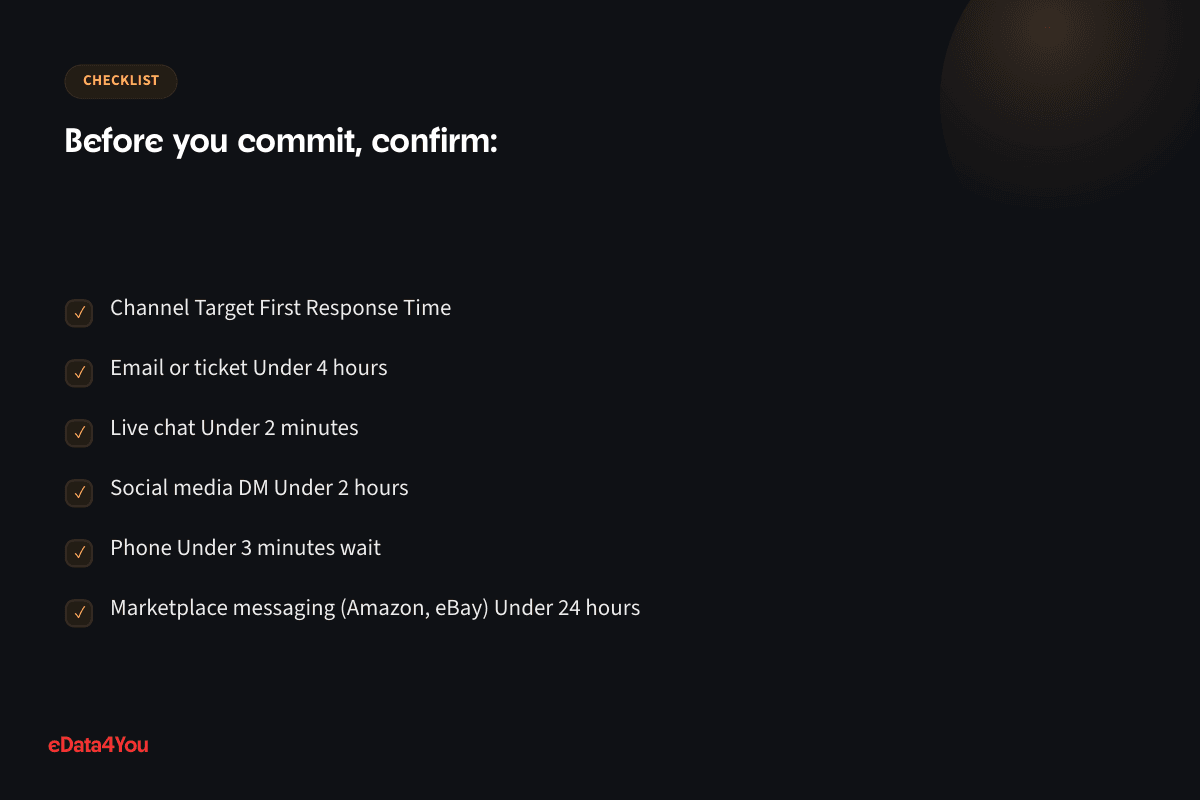
For ecommerce support, these benchmarks represent competitive standards in 2026:
- Channel Target First Response Time
- Email or ticket Under 4 hours
- Live chat Under 2 minutes
- Social media DM Under 2 hours
Phone Under 3 minutes wait
Marketplace messaging (Amazon, eBay) Under 24 hours
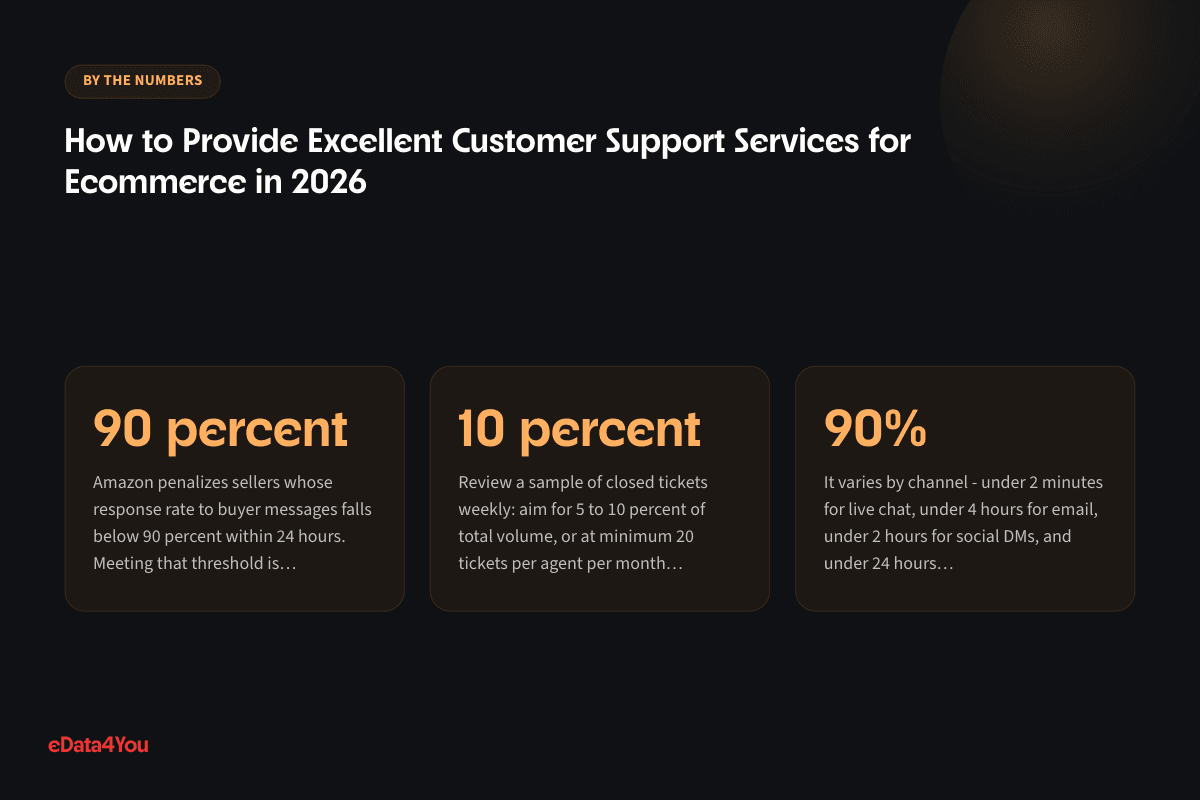
Amazon penalizes sellers whose response rate to buyer messages falls below 90 percent within 24 hours. Meeting that threshold is a baseline requirement, not a standard to aspire to.
Building a Knowledge Base That Reduces Ticket Volume
The most efficient way to handle support is to answer questions before they become tickets. A well-structured knowledge base covering common questions, order processes, return policies, and product details reduces incoming volume significantly.
What to Include in an Ecommerce Knowledge Base
Order tracking and delivery timeframes
For your next planning session
Good guidance is worth keeping.
Save this guide and return when you’re ready to put it into practice.
Return and refund policy with step-by-step instructions
Product size guides, compatibility charts, and care instructions
Payment methods accepted and how to update payment information
How to contact support and what response times to expect
Common troubleshooting steps for product issues
Knowledge base content should be written in plain language, organized by category, and reviewed quarterly to ensure it reflects current policies and products. Outdated knowledge base content creates more confusion than no knowledge base at all.
What Agent Training Must Cover
Support agents who lack product knowledge and policy clarity give inconsistent responses. Inconsistent responses frustrate buyers and create additional tickets as buyers follow up to get a straight answer.
Core Training Areas for Ecommerce Support Agents
Product knowledge: Agents need to understand what you sell, how products work, common compatibility questions, and how to identify which product a buyer purchased from an order reference.
Policy knowledge: Return windows, refund processing times, exchange procedures, and escalation paths for damaged or missing orders should all be documented and tested during training.
Tone and communication standards: Define how agents should open and close conversations, how to handle frustrated buyers, and what language is off-limits. Written standards reduce variation across agents significantly.
Escalation protocol: Agents need to know immediately when to escalate an issue to a senior team member or a manager, and how to communicate that escalation to the buyer without creating additional frustration.
Platform tools: Agents should be trained on the ticketing system, order management platform, and any marketplace portals they use before handling live tickets.
More resources
Understand the terms.
Follow the changes.
Clear definitions and marketplace updates, with context you can use in your next decision.
Setting Up Omnichannel Support Without Creating Chaos
Buyers contact support through email, live chat, social media, marketplace messaging, and sometimes phone. Managing these channels separately creates gaps where tickets fall through and buyers have to repeat themselves.
A unified helpdesk platform brings all channels into a single queue. Agents see the full conversation history regardless of which channel the buyer used, which eliminates the frustration of repeated explanations. Popular platforms for ecommerce support operations include Zendesk, Freshdesk, Gorgias (which connects directly to Shopify), and Re:amaze.
Channel coverage does not need to mean 24-hour availability on every platform from day one. Start with the channels your buyers use most, cover those well, and add capacity as volume grows.
Quality Assurance for Customer Support
Support quality degrades without a structured review process. Agents develop shortcuts, tone slips, and response accuracy drops, especially on high-volume days.
How to Build a Support QA Process
Review a sample of closed tickets weekly: aim for 5 to 10 percent of total volume, or at minimum 20 tickets per agent per month. Score each ticket on:
- Response accuracy (was the information given correct?)
- Response clarity (would a first-time buyer understand it?)
Policy adherence (did the agent follow procedures correctly?)
Tone (was the response appropriate for the situation?)
Resolution (was the issue actually resolved, or was it closed prematurely?)
Share individual feedback with agents in a structured review session, not in front of the team. Track scores over time to identify whether training gaps are improving or persisting.
When to Outsource Customer Support Services
Outsourcing customer support makes sense when internal teams cannot keep pace with volume, when coverage hours need to extend beyond what in-house staffing can sustain, or when the cost of building internal capacity outweighs the cost of an external provider.
Explore related concepts
Related term
First Response Time
Definition of First Response Time
How long it takes a support team to send an initial reply to a new customer inquiry.
Example in practice
A customer emails about a damaged item at 9 a.m. and gets an automated but personalized reply within 10 minutes confirming a human will follow up with a solution.
What to Evaluate in a Support Outsourcing Provider
Before selecting a provider, assess:
- Experience with your platform (Shopify, Amazon, eBay, or other)
- Language capability matching your customer base
Staffing flexibility for volume spikes
Technology compatibility with your existing helpdesk
QA process and how they report performance metrics
References from ecommerce clients with similar volumes
A pilot period of 30 to 60 days before full commitment allows you to assess accuracy, tone, and ticket resolution quality under real conditions.
Common Support Problems That Kill Retention
Slow first responses that leave buyers anxious about their order
Agents giving different answers to the same question on different days
Ticket closures without confirming the issue was resolved
Automated replies that do not answer the actual question
Refund or return processes that require too many steps to complete
No follow-up on escalated issues, leaving buyers with no update
Each of these erodes buyer confidence. The buyers who have bad support experiences and never come back are the ones you never hear from, which makes the problem easy to underestimate.
Your growth partner
Great work starts with a clear plan.
Dedicated offshore staff - trained on your systems, accountable to your SLAs.
One accountable team, from scope to reporting.
Support for this article
Remote Teams & Virtual Assistants
- Customer Support & Live Chat TeamsDedicated reps across email, chat and marketplace messages, so response times hold even when volume spikes.
- Returns, Refunds & Chargeback ManagementReturn authorization, refund processing, dispute handling and return-rate tracking across every marketplace you sell on.
- Dedicated Virtual AssistantsA dedicated ecommerce VA handling inbox, listings and day-to-day admin - trained on your systems, not generic tasks.
From first conversation to delivery
Start with the real bottleneck.
We review your listings, storefront, campaigns or workflows to identify what needs attention. Bring examples of the work you want to improve.
Know the scope before work starts.
We agree priorities, scope and timelines before execution. You know what the team will handle and how the work will be organised.
Keep one team accountable.
The team that scoped the work handles delivery. Responsibility stays clear as tasks move from planning into execution.
See what changed and what comes next.
Regular reporting connects the work to progress and results. Review what has been done and decide what should happen next.
To get started, share your platform, current workload and target timeline.
Building Customer Support That Scales
The businesses that consistently receive strong reviews and maintain high marketplace seller ratings do not have unusually talented support agents. They have clear processes, documented policies, structured training, and regular QA review.
Support at scale requires investment in systems and process, beyond headcount alone. The right helpdesk platform, a complete knowledge base, documented escalation paths, and a regular quality review cycle are the components that make support reliable as volume grows.
eData4You provides customer support outsourcing for ecommerce businesses on Amazon, Shopify, eBay, and other platforms. Our teams handle ticket management, buyer communication, returns coordination, and marketplace messaging with structured QA at every stage. Request a free consultation to discuss your support volume and coverage requirements.
Frequently Asked Questions
What response time should ecommerce support actually aim for?
It varies by channel - under 2 minutes for live chat, under 4 hours for email, under 2 hours for social DMs, and under 24 hours for marketplace messaging. On Amazon specifically, falling below a 90% response rate within 24 hours risks a performance penalty, beyond a slower buyer experience alone.
Does a knowledge base really reduce support volume?
Yes, meaningfully. A well-structured knowledge base covering order tracking, returns, and product details answers questions before they become tickets - but only if it's reviewed quarterly, since outdated content creates more confusion than having none at all.
How much of my support tickets should I be reviewing for QA?
Aim for 5-10% of total ticket volume, or at minimum 20 tickets per agent per month. Without a regular review cycle, response accuracy and tone consistency degrade quietly, especially on high-volume days.
When does it make sense to outsource customer support instead of hiring in-house?
When internal capacity can't keep pace with volume, when you need coverage hours beyond what in-house staffing can sustain, or when the cost of building that capacity internally exceeds what an experienced external provider charges.
What's the biggest hidden cost of poor customer support?
Buyers who don't complain - they just leave a negative review, file a chargeback, or never order again. The businesses lost to poor support are largely invisible in the short term, which is exactly why the cost gets underestimated.
Conclusion
Hiring unusually talented agents matters less than the systems behind them: documented policies, structured training, a unified helpdesk, and a real QA review cycle. Businesses that invest in that infrastructure are the ones whose support scales cleanly as order volume grows, instead of degrading the moment ticket count outpaces headcount.

Reviewed by Amit Sharma, Founder & IT Head· Content reviewed Sep 2026
Explore eData4You
Find the right next step.
Check your fit, explore blog topics or find the service that supports your work.
Start with your industry, then check the platforms and technology that support your workload.
Blog topics
Choose a topic to explore recent guides on the work behind ecommerce.
Recent guides
Remote Teams & Virtual Assistants
Remote Teams & Virtual Assistants: 3 guides to explore.
Services
Start with services relevant to this guide, or explore the rest of our services.




Comments
Leave a comment