

On this page19 sectionsShowHide
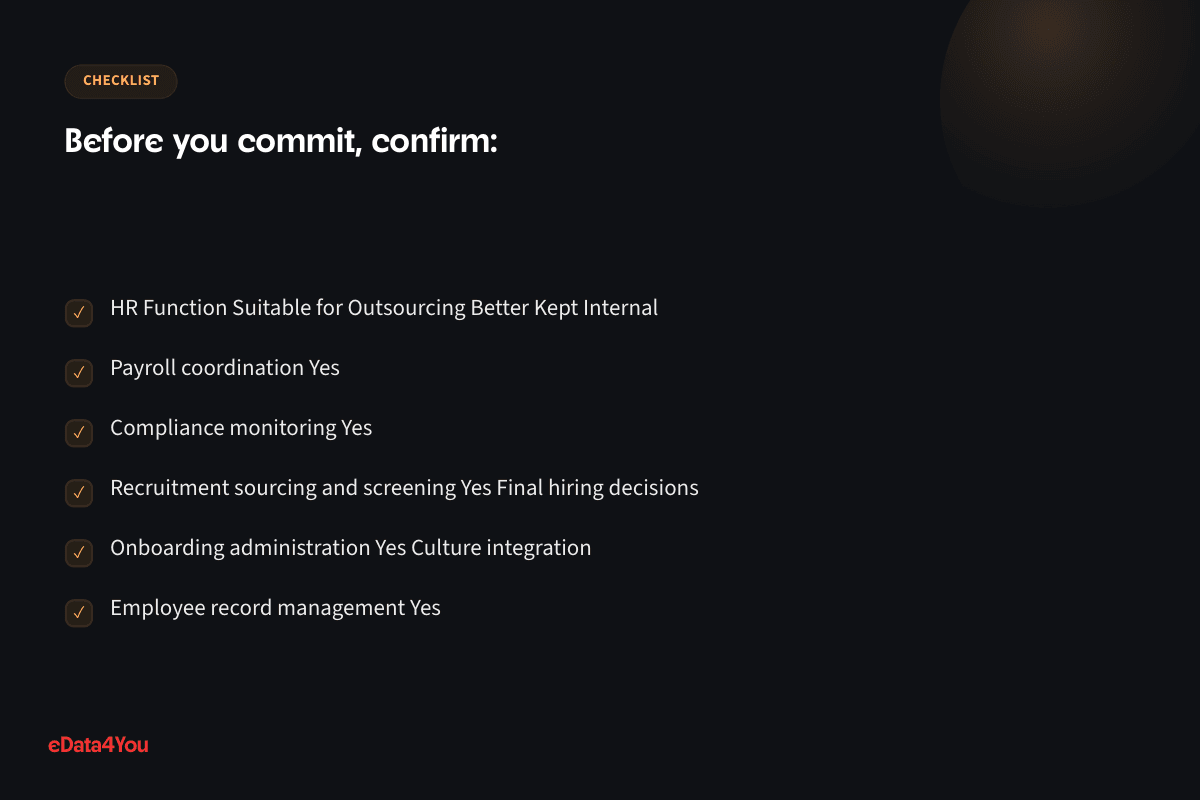
- Why Do Businesses Outsource HR Services?
- The Main Reasons Businesses Choose HR Outsourcing
- 1. Reducing Administrative Cost
- 2. Managing Compliance Without Specialist Hires
- 3. Improving Payroll Accuracy and Timeliness
- 4. Scaling Recruitment Without a Large Internal Team
- 5. Onboarding New Employees Consistently
- 6. Keeping Employee Records Accurate and Accessible
- What HR Functions Are Best Suited for Outsourcing?
- What Are the Risks of HR Outsourcing?
- How to Choose an HR Outsourcing Provider
- Is HR Outsourcing Right for Your Business?
- Frequently Asked Questions
- At what company size does HR outsourcing typically make sense?
- Which HR functions should stay in-house even when outsourcing?
- How do outsourced HR providers handle changing employment law?
- What should I check before trusting a provider with HR data?
- Will an outsourced HR provider respond as quickly as an internal team member?
- Conclusion
Key takeaways
- Businesses outsource HR services to reduce administrative cost, manage compliance more reliably, and provide employees with consistent HR support without building a…
- Growing businesses need to hire quickly without always having the internal capacity to manage high recruitment volumes.
- HR outsourcing introduces risks around data privacy, responsiveness, and cultural fit.
- Judgment-heavy work: final hiring decisions, performance ratings and feedback, culture integration, and disciplinary decisions.
- HR outsourcing works best as a deliberate split, not an all-or-nothing decision - administrative and compliance-heavy tasks move to a specialist provider, while culture,…
Why Do Businesses Outsource HR Services?
Businesses outsource HR services to reduce administrative cost, manage compliance more reliably, and provide employees with consistent HR support without building a large internal HR department. For small and mid-size businesses especially, outsourcing HR functions is often the most practical way to get professional-grade people operations without the overhead of a fully staffed HR team.
Human resources covers a wide range of activities: recruitment, onboarding, payroll coordination, benefits administration, compliance tracking, performance management, and employee record keeping. Most of these are necessary but do not directly contribute to revenue. Outsourcing them allows internal leaders to focus on business growth rather than administrative operations.
The Main Reasons Businesses Choose HR Outsourcing
01Reducing Administrative Cost
Building an in-house HR team requires salaries, benefits, software, training, and management time. For businesses with fewer than 200 employees, a full HR department rarely justifies its cost against the volume of HR work it handles.
Outsourced HR providers spread their infrastructure across many clients. You pay only for the services you use, whether that is payroll support, compliance monitoring, or recruitment coordination. For most businesses, this structure is significantly cheaper than hiring equivalent internal capability.
02Managing Compliance Without Specialist Hires
Employment law changes regularly. Minimum wage rules, leave entitlements, data protection requirements, and workplace safety obligations vary by country, state, and sector. Tracking these changes is a specialized job.
HR outsourcing providers monitor regulatory updates as part of their core service. They update policies, flag risks, and help businesses adjust their practices before violations occur. For companies operating across multiple geographies, this kind of ongoing compliance support is very difficult to replicate with a small internal team.
For your next planning session
Good guidance is worth keeping.
Save this guide and return when you’re ready to put it into practice.
03Improving Payroll Accuracy and Timeliness
Payroll errors create immediate problems. Employees paid late or incorrectly lose trust quickly, and repeated mistakes can create legal exposure. Payroll is also more complex than it appears: tax calculations, deductions, overtime rules, and statutory payments all vary and change over time.
Outsourced payroll coordination ensures calculations are handled by specialists using systems designed for accuracy and compliance. Errors are caught before payments go out rather than corrected after the fact.
04Scaling Recruitment Without a Large Internal Team
Growing businesses need to hire quickly without always having the internal capacity to manage high recruitment volumes. HR outsourcing providers support sourcing, screening, interview coordination, background checks, and offer management without requiring you to hire a dedicated recruiter during every growth phase.
Recruitment process outsourcing is particularly useful for project-based hiring, seasonal demand, or geographic expansion where internal teams lack the existing relationships or local market knowledge.
05Onboarding New Employees Consistently
Poor onboarding is one of the biggest contributors to early attrition. When new hires do not receive proper orientation, equipment, access, and documentation on time, they disengage quickly. Managing onboarding consistently across departments and locations is an operational challenge for any business growing faster than its HR capacity.
Outsourced HR providers use documented onboarding workflows that deliver a consistent experience regardless of which team the new hire joins or where they are based.
06Keeping Employee Records Accurate and Accessible
Employee records cover contracts, performance reviews, training completions, leave records, and disciplinary documentation. Maintaining these accurately across a growing workforce is time-consuming, and gaps create compliance risk during audits or disputes.
Outsourced HR providers maintain structured record systems with defined retention policies and audit trails. Records are accurate, accessible when needed, and managed in compliance with data protection requirements.
What HR Functions Are Best Suited for Outsourcing?
Not every HR function makes sense to outsource. The best candidates are tasks that are structured, process-driven, and do not require deep knowledge of your specific culture or leadership priorities.
HR Function Suitable for Outsourcing Better Kept Internal
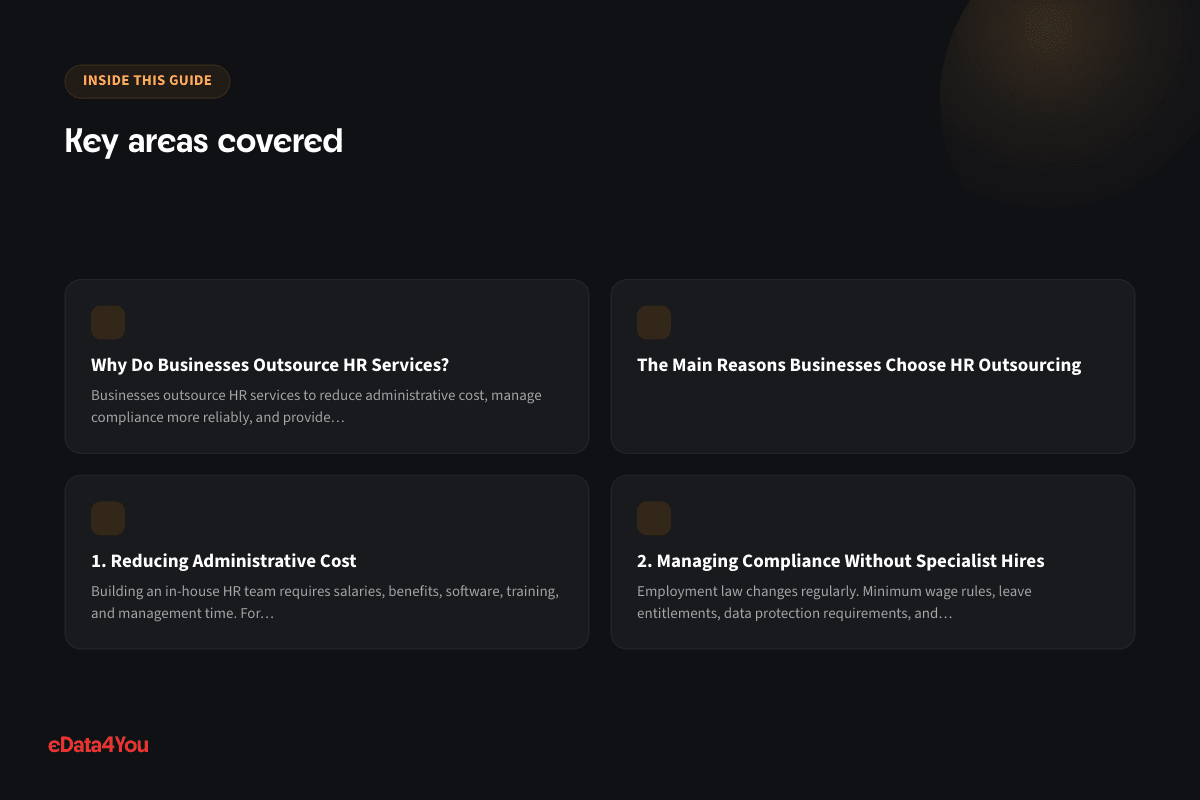
Payroll coordination Yes
Compliance monitoring Yes
Recruitment sourcing and screening Yes Final hiring decisions
Onboarding administration Yes Culture integration
Employee record management Yes
More resources
Understand the terms.
Follow the changes.
Clear definitions and marketplace updates, with context you can use in your next decision.
Benefits administration Yes
Performance review administration Partially Ratings and feedback
Culture and engagement Yes
Leadership development Yes
Disciplinary decisions Yes
The general principle: outsource the administration and keep the judgment in-house.
What Are the Risks of HR Outsourcing?
HR outsourcing introduces risks around data privacy, responsiveness, and cultural fit. Managing these starts with provider selection.
Data Privacy: HR data is sensitive. Contracts, salaries, health information, and performance records all require careful handling. Confirm that any provider you engage complies with relevant data protection regulations, signs a processing agreement, and has clear policies on data access and retention.
Cultural Disconnect: An outsourced provider does not know your business the way an internal team does. Keep judgment- heavy functions internal and limit outsourcing to process-driven work.
Your growth partner
Great work starts with a clear plan.
Dedicated offshore staff - trained on your systems, accountable to your SLAs.
One accountable team, from scope to reporting.
Support for this article
Remote Teams & Virtual Assistants
- Dedicated Virtual AssistantsA dedicated ecommerce VA handling inbox, listings and day-to-day admin - trained on your systems, not generic tasks.
- IT & Technical Help Desk SupportDedicated technical support staff for internal help-desk tickets, website issues and day-to-day system administration.
- Strategic Growth ServicesAn outside, data-led view of where your ecommerce growth is stuck - and a prioritised plan across channels, marketplaces and operations to unblock it.
From first conversation to delivery
Start with the real bottleneck.
We review your listings, storefront, campaigns or workflows to identify what needs attention. Bring examples of the work you want to improve.
Know the scope before work starts.
We agree priorities, scope and timelines before execution. You know what the team will handle and how the work will be organised.
Keep one team accountable.
The team that scoped the work handles delivery. Responsibility stays clear as tasks move from planning into execution.
See what changed and what comes next.
Regular reporting connects the work to progress and results. Review what has been done and decide what should happen next.
To get started, share your platform, current workload and target timeline.
Responsiveness: An outsourced provider handling multiple clients may not respond as quickly as an internal team member. Set clear response-time expectations in your contract and test them during an initial period before committing long-term.
How to Choose an HR Outsourcing Provider
When evaluating providers, look for experience with businesses of your size and in your industry, a clear scope of services with defined deliverables, a technology platform for record keeping and communication, a documented compliance monitoring process, strong data security practices, and references from clients who have used them for at least 12 months.
A provider who has worked with businesses similar to yours will require less onboarding time and will already understand the compliance landscape relevant to your operations.
Is HR Outsourcing Right for Your Business?
HR outsourcing makes the most sense for businesses that have enough employees to generate consistent HR workload but not enough to justify a full internal HR team. Most businesses between 10 and 200 employees find that outsourcing at least some HR functions reduces cost and improves consistency.
The clearest signal that outsourcing makes sense is when HR administration is taking significant time away from leaders who should be focused on business priorities, or when compliance gaps are creating risk that no one on the current team is equipped to manage.
eData4You provides remote operations support for businesses managing distributed teams, ecommerce operations, and back-office workflows. Our teams support HR administration, onboarding coordination, and process management as part of a broader outsourcing partnership. Request a free consultation to discuss your operational support requirements.
Frequently Asked Questions
At what company size does HR outsourcing typically make sense?
Most businesses between 10 and 200 employees find that outsourcing at least some HR functions reduces cost and improves consistency. Below that range, HR workload rarely justifies dedicated support; above it, an internal team usually becomes cost-effective.
Operations capacity
What could you hand off?
Adjust your workload and catalog size to explore a planning estimate of the time you could recover.
Time spent on your recurring operations tasks.
Number of products or variants in your catalog.
Estimated recoverable capacity
Per week
Per month
Monthly headline figures are rounded. This values time, rather than predicting a cash saving.
The assumptions behind the estimate
- Base recovery
- 60%of weekly operations time
- Catalog factor
- 1.00–1.40×1 + SKUs ÷ 2,000, capped at 1.40×
- Monthly conversion
- 4.33 weekstime valued at $35 per hour
Weekly hours × 60% × catalog factor × 4.33 = monthly capacity. Actual capacity depends on the work you can delegate.
Which HR functions should stay in-house even when outsourcing?
Judgment-heavy work: final hiring decisions, performance ratings and feedback, culture integration, and disciplinary decisions. The general principle is to outsource the administration and keep the judgment internal.
How do outsourced HR providers handle changing employment law?
Monitoring regulatory updates is part of their core service - they track changes to minimum wage rules, leave entitlements, and workplace safety obligations, then update policies and flag risks before violations occur, which is difficult for a small internal team to replicate across multiple jurisdictions.
What should I check before trusting a provider with HR data?
Confirm they comply with relevant data protection regulations, will sign a data processing agreement, and have clear policies on who can access records and how long they're retained. HR data includes salaries and health information, so this isn't optional due diligence.
Will an outsourced HR provider respond as quickly as an internal team member?
Not always, since they handle multiple clients simultaneously. Set clear response-time expectations in the contract and test them during an initial period before committing long-term, rather than assuming responsiveness will match an in-house hire.
Conclusion
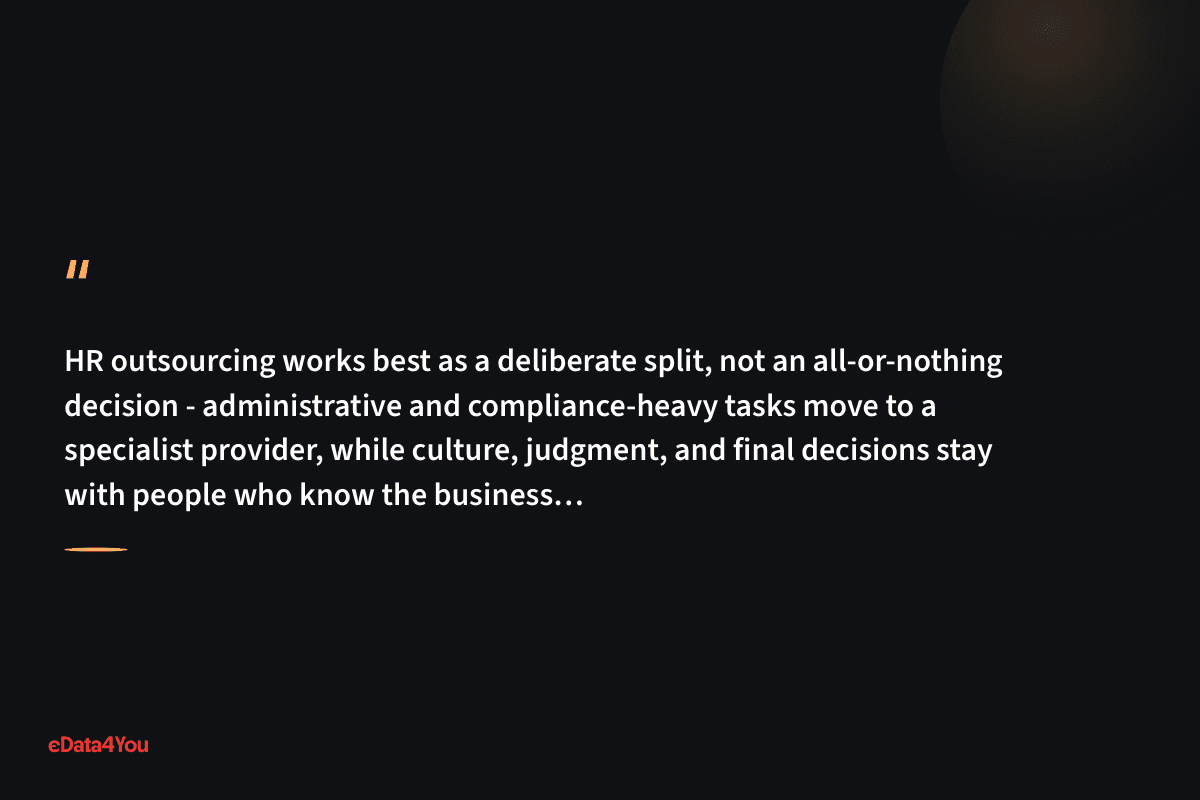
HR outsourcing works best as a deliberate split, not an all-or-nothing decision - administrative and compliance-heavy tasks move to a specialist provider, while culture, judgment, and final decisions stay with people who know the business. Businesses that draw that line clearly get the cost and compliance benefits without losing what makes their HR function actually theirs.

Reviewed by Amit Sharma, Founder & IT Head· Content reviewed Sep 2026
Explore eData4You
Find the right next step.
Check your fit, explore blog topics or find the service that supports your work.
Start with your industry, then check the platforms and technology that support your workload.
Blog topics
Choose a topic to explore recent guides on the work behind ecommerce.
Recent guides
Remote Teams & Virtual Assistants
Remote Teams & Virtual Assistants: 3 guides to explore.
Services
Start with services relevant to this guide, or explore the rest of our services.




Comments
Leave a comment