

On this page13 sectionsShowHide
- What a Listing Agency Actually Does All Day
- SEO That's Genuinely Different From Amazon or Google
- The Words You're Not Allowed to Use
- Fulfillment Details That Are Easy to Get Wrong
- What Agencies Cost, and What That Buys
- What to Actually Check Before Hiring One
- Frequently Asked Questions
- Can SEO alone fix a Walmart listing that isn't converting?
- Why does the same UPC get unpublished for a price parity violation?
- Is Walmart Fulfillment Services worth the fee structure?
- What's the actual link between Listing Quality Score and ad cost?
- What is the biggest technical risk facing Walmart sellers right now?
- Where This Is Headed
Key takeaways
- Listing agency work breaks down into a few distinct workstreams in practice, and most agencies end up doing all of them whether or not the client thinks they're hiring…
- Walmart Fulfillment Services has stricter intake rules than a lot of third-party logistics providers, and one of the easiest ways to lose margin is getting the packaging…
- The Triangle of Relevance weighs content, offer, and seller performance together - a perfectly optimized title can't compensate for an uncompetitive price or slow…
- For most sellers, yes - WFS items see a documented GMV boost from the 2-Day Delivery badge, and the fulfillment badge is itself a ranking factor.
- Walmart's rollout of in-store QR scanning - shelf codes that open the product detail page - is starting to turn that page into something closer to digital packaging than…
Walmart Marketplace stopped being a side channel a while ago. It's now home to roughly 200,000 active third-party sellers, up about 25% year over year, with 44,000 new sellers joining in just the first five months of 2025. Ninety-five percent of the 420 million products listed on Walmart.com come from third-party sellers - the platform has quietly become marketplace-first for most of its catalog. That growth is exactly why a casual, part-time approach to a Walmart listing doesn't hold up anymore. The "digital shelf" used to be mostly empty. It isn't now - which is also why full-service marketplace management has shifted from a nice-to-have to table stakes for anyone selling at real volume.
At the same time, the technical bar for staying visible has gone up. Item Spec 5.0 rewrote how product data has to be structured. Price parity enforcement got stricter. Walmart Fulfillment Services became a real ranking factor, beyond simply a shipping option. Between those three changes, a lot of sellers who used to manage their own Walmart listings started handing the work to agencies - not because they couldn't technically do it, but because keeping up with all three at once turned into a full-time job on its own.
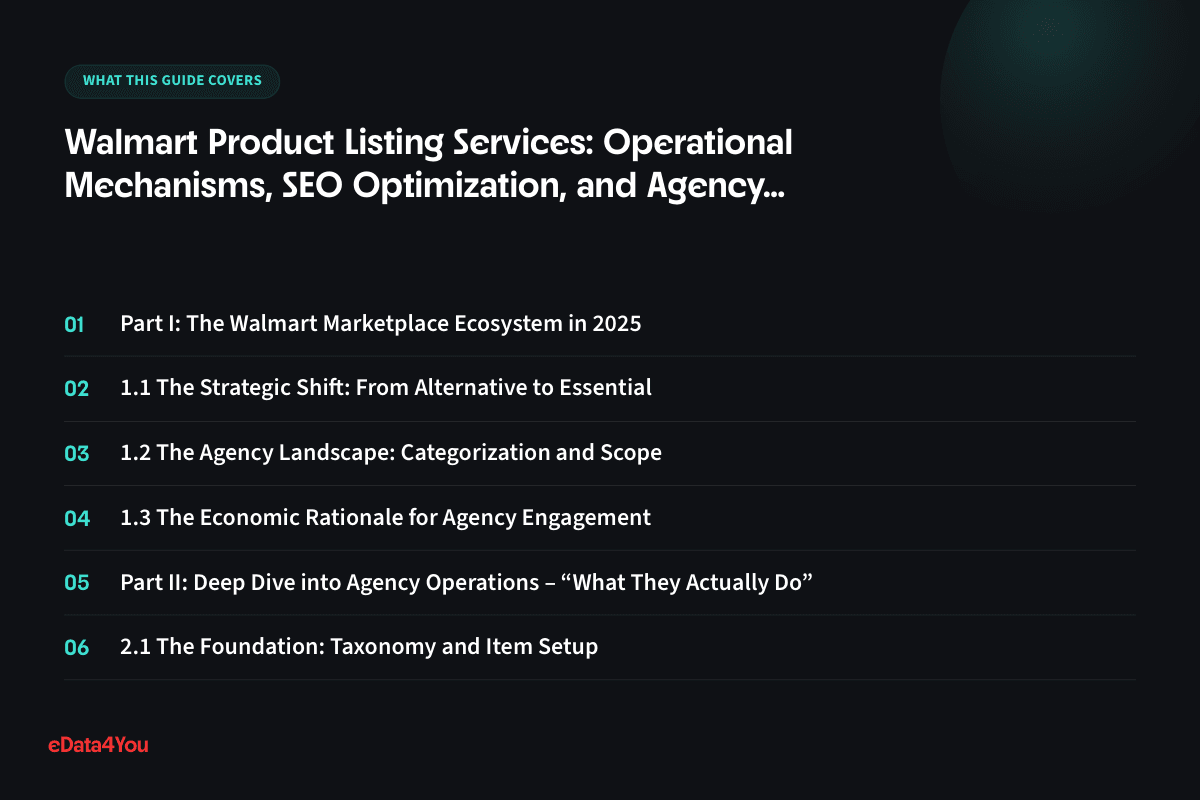
What a Listing Agency Actually Does All Day
Listing agency work breaks down into a few distinct workstreams in practice, and most agencies end up doing all of them whether or not the client thinks they're hiring for all of them.
Getting the taxonomy right comes before anything else, and it's really a catalog data problem before it's an SEO one. Where Amazon's category structure is fairly forgiving, Walmart's is rigid. A gaming headset filed under generic "Electronics" instead of Electronics > Audio > Headphones > Gaming Headsets doesn't just look messy - it loses access to attribute fields like "Mic Sensitivity" and "Platform Compatibility" that only exist at that deeper category level. And if a shopper filters by "Xbox Compatible" and that attribute isn't populated, the product simply doesn't show up, no matter how good the title is. A meaningful chunk of an agency's early work on a new account is just walking the catalog tree and making sure every SKU sits at the most specific node available.
For your next planning session
Good guidance is worth keeping.
Save this guide and return when you’re ready to put it into practice.
Migrating to Item Spec 5.0 was another big one. Walmart's August 2025 deadline for this wasn't optional, and it wasn't a simple copy-paste job either - the new spec cut generic attributes by roughly 60% while adding about 65% more specific ones. A field like "Fabric Content" might now need to split into "Material Composition" and "Material Percentage" separately. Miss the deadline with unmapped data and listings can freeze entirely, uneditable until it's fixed.
Keeping listings published is the daily grind, and it's mostly about the Unpublished Items dashboard. The single biggest cause of lost revenue is a price parity violation: Walmart's pricing bots scan competitor sites, and if the same UPC turns up cheaper on Amazon or elsewhere, the listing gets unpublished immediately to protect Walmart's low-price positioning. Agencies typically run algorithmic repricing tools that keep the Walmart price matched to the lowest tracked price automatically, and when the bot gets it wrong - matching a single unit to a multi-pack, for instance - someone has to file a manual override with screenshots and proof. Compliance flags work similarly: a skin cream using the word "cure" gets pulled, and fixing it means scrubbing that word from more than the description alone - the bullet points and even image alt text need it too, since all of it gets scanned.
Fulfillment planning matters too. Items fulfilled through WFS see a real GMV lift, largely from the 2-day delivery badge and the trust that comes with it, and the badge itself is a ranking signal. Agencies weigh that benefit against WFS's storage costs on a SKU-by-SKU basis - a heavy, fast-moving item is often cheaper through WFS than a third-party carrier, while a slow-moving, bulky item can rack up long-term storage fees that erase the ranking benefit.
SEO That's Genuinely Different From Amazon or Google
Walmart's search algorithm weighs three things roughly equally: how well the content matches the query, how competitive the offer is, and how reliable the seller's fulfillment has been. That last part matters more than most sellers expect - no amount of keyword work fixes a listing that's overpriced or ships slowly. SEO here is a multiplier on a decent offer, not a rescue plan for a bad one.
Titles follow a fairly rigid formula for a reason: brand, then the core product name, then key attributes like style or material, then size or count, then model number if relevant - something like "Dyson V15 Detect Cordless Vacuum Cleaner, Yellow/Nickel, HEPA Filtration, 3 Tools Included." Mobile matters more than it used to as well: titles truncate earlier on the app than on desktop, so the details a shopper actually needs to decide - size, key spec - have to land in the first 50-60 characters. "Premium Quality Organic Natural Peanut Butter with Honey and Sea Salt - 16oz Jar" buries the size at the end where it gets cut off; "Justin's Honey Peanut Butter, 16oz Jar - Organic, Gluten-Free, Natural Ingredients" puts brand, flavor, and size all in view immediately.
Attributes have quietly taken over the role backend keywords used to play. If someone searches "red dress" and a product's Color attribute is empty, it can get excluded from results even if "red" appears in the title. So a listing might map a variant literally named "Midnight" to Color: Blue in the structured data, while keeping "Midnight" as the customer-facing name - it shows up for broad searches while keeping its actual product name intact. The backend keyword field still has a job too, mostly for misspellings, Spanish-language terms given Walmart's large Hispanic customer base, and competitor-compatibility phrases ("fits iPhone," "compatible with Keurig") that would look cluttered sitting in the title itself.
Explore related concepts
Related term
FBA (Fulfillment by Amazon)
Definition of FBA (Fulfillment by Amazon)
Amazon stores, picks, packs, ships and handles returns for inventory a seller sends to its warehouses.
Example in practice
A seller ships a pallet of inventory to an Amazon fulfillment center; from that point, Amazon handles every order until the seller sends more stock.
Images matter more directly than people assume, since Walmart's Content Quality Score weighs them heavily: a pure white hero image, an infographic on key features, a lifestyle shot, a close-up on texture or material, and ideally a short demo video, all above 1,000px so the zoom function works properly.
The Words You're Not Allowed to Use
Walmart maintains a fairly aggressive list of terms that trigger automatic suppression. Promotional language like "best selling" or "free shipping" is banned outright in descriptions. Health-adjacent words - "antibacterial," "heals," "cures," "non-toxic" - trip compliance bots for pesticide or FDA-related review, even on products that have nothing to do with either. Competitor names like "Amazon" or "eBay" get flagged too. Agencies typically run copy through a sanitization pass before anything goes live, specifically to avoid a listing getting stuck in review limbo over a single word.
Fulfillment Details That Are Easy to Get Wrong
Walmart Fulfillment Services has stricter intake rules than a lot of third-party logistics providers, and one of the easiest ways to lose margin is getting the packaging wrong before it ever ships. Poly bags need to be at least 1.5 mil thick - noticeably thicker than the 1.0 mil standard for Amazon FBA - and if a seller ships the thinner bags, WFS can reject the shipment or charge a re-bagging fee per unit. On a low-cost item, that kind of unplanned prep fee can wipe out most of the margin in one shipment, which is why agencies spend real time making sure inbound shipments are compliant before they're sent, not after they're rejected.
What Agencies Cost, and What That Buys
Pricing in this space breaks into a few recognizable models. Full-service monthly retainers run roughly $1,500 to $5,000+ and cover everything - SEO, fulfillment strategy, customer service, the works. Advertising-only management is usually a percentage of ad spend, typically 10-25%, which scales with growth but also means the agency's incentive is to spend more, not necessarily spend efficiently. Project-based work - a one-time catalog migration or Item Spec 5.0 cleanup, say - runs roughly $50-150 per SKU with no ongoing monitoring included. Hybrid models combine a base fee with a percentage of sales, which tends to align incentives better but makes for a more complicated contract.
Business Analyzer
Know your numbers before you scale.
Understand margin, ad return and storefront performance using your own business inputs. Explore what the report checks.
Report outline
ProfitabilityWhere does your revenue go?
- Fees and marginWhere each dollar of revenue goes, and what's left.
- Marketplace fee comparisonWhat your revenue would cost in selling fees on each platform.
- Profit leaksCosts running above healthy levels at the numbers you entered.
Have this ready
Start with your selling channels, monthly revenue, return rate and goal. Add product cost and monthly team cost for a fuller margin picture.
Report outline
AdvertisingWhat does your ad return need to cover?
- Break-even ad returnThe ad return you need just to break even, against what you're getting.
- Ad spend in your cost mixSee how monthly ad spend affects the margin left after your entered costs.
- Revenue relative to ad spendCompare monthly revenue with monthly ad spend alongside the break-even threshold.
Have this ready
Bring your business figures and monthly ad spend. Add product cost as a percentage of price to calculate break-even ad return.
Report outline
Store performanceHow does your storefront perform?
- Mobile speedA live scan checks how your store performs on mobile.
- Google SEO checksSee the SEO checks included in your store scan.
- Product markupCheck for structured product data on your store or product page.
Have this ready
Add a store or product page URL alongside your business figures. The store scan runs after you unlock the full report.
Whether any of this is worth it comes down to the math for a specific business. For a seller doing $1 million a year on Walmart, a $3,000 monthly fee is about 3.6% of revenue - and it's often justified just by recovering a single month of price-parity-related suppression losses, plus the advertising efficiency gained from a stronger Listing Quality Score, plus not needing to hire a full-time in-house marketplace manager at $60-90k a year.
That LQS connection is worth calling out specifically, because it's not obvious: Walmart's ad auction derives a chunk of its relevance score from a listing's organic quality score. A seller with a strong LQS might pay $1.00 per click for a placement that costs a seller with a weak LQS $1.50 for the exact same spot. Fixing a missing attribute or a bad image does more than improve organic search - it directly lowers what you pay for ads on the same product.
What to Actually Check Before Hiring One
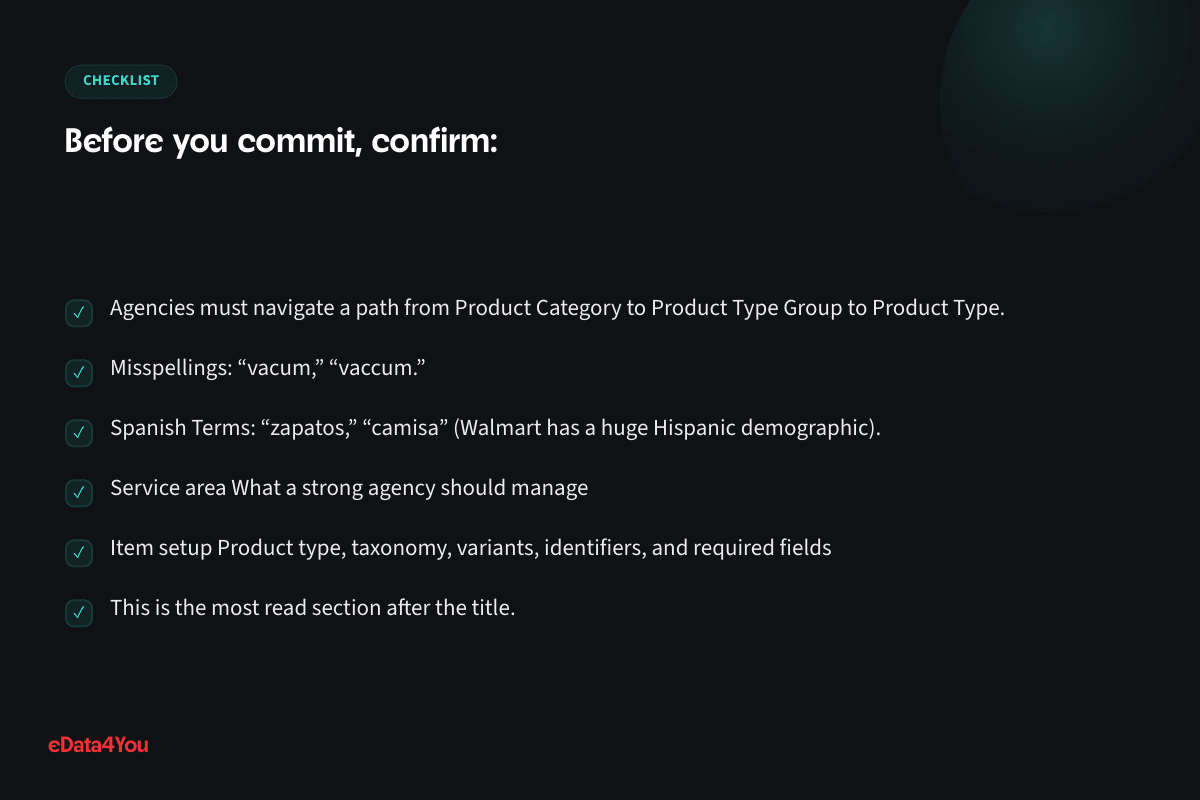
If you're evaluating whether an agency is doing real marketplace management or just editing copy, look for whether they're covering: item setup and taxonomy, title/attribute/backend-search SEO, a proper image and video stack, active suppression monitoring (price parity, compliance terms, unpublished items), a real fulfillment strategy rather than a default WFS-for-everything recommendation, and reporting that goes beyond traffic - Listing Quality Score, conversion rate, ad efficiency, and SKU-level issue tracking. An agency only doing the first two of those is a copywriter with a retainer, not a full listing service.
Your growth partner
Great work starts with a clear plan.
End-to-end operation of your marketplace storefronts - listings, ads, fulfillment and compliance.
One accountable team, from scope to reporting.
Support for this article
Marketplace Management
- Marketplace Account ManagementDay-to-day account handling, marketplace updates, issue tracking and operational coordination.
- Product Listing & Upload ServicesAccurate titles, descriptions, attributes, images, variants, specs and marketplace-ready product data.
- SEO ServicesTechnical SEO, content strategy and on-page optimization structured for how ecommerce actually ranks - measured by revenue, not vanity keyword positions.
From first conversation to delivery
Start with the real bottleneck.
We review your listings, storefront, campaigns or workflows to identify what needs attention. Bring examples of the work you want to improve.
Know the scope before work starts.
We agree priorities, scope and timelines before execution. You know what the team will handle and how the work will be organised.
Keep one team accountable.
The team that scoped the work handles delivery. Responsibility stays clear as tasks move from planning into execution.
See what changed and what comes next.
Regular reporting connects the work to progress and results. Review what has been done and decide what should happen next.
To get started, share your platform, current workload and target timeline.
Frequently Asked Questions
Can SEO alone fix a Walmart listing that isn't converting?
No. The Triangle of Relevance weighs content, offer, and seller performance together - a perfectly optimized title can't compensate for an uncompetitive price or slow shipping. SEO is a multiplier on a fundamentally sound offer, not a fix for one that isn't.
Why does the same UPC get unpublished for a price parity violation?
Walmart's pricing bots continuously scrape competitor sites, and if the same UPC is found cheaper elsewhere, the listing is unpublished immediately to protect Walmart's low-price positioning. This is the single most common cause of unplanned revenue loss on the platform.
Is Walmart Fulfillment Services worth the fee structure?
For most sellers, yes - WFS items see a documented GMV boost from the 2-Day Delivery badge, and the fulfillment badge is itself a ranking factor. The exception is slow-moving or bulky items, where long-term storage fees can outweigh the ranking benefit.
Operations capacity
What could you hand off?
Adjust your workload and catalog size to explore a planning estimate of the time you could recover.
Time spent on your recurring operations tasks.
Number of products or variants in your catalog.
Estimated recoverable capacity
Per week
Per month
Monthly headline figures are rounded. This values time, rather than predicting a cash saving.
The assumptions behind the estimate
- Base recovery
- 60%of weekly operations time
- Catalog factor
- 1.00–1.40×1 + SKUs ÷ 2,000, capped at 1.40×
- Monthly conversion
- 4.33 weekstime valued at $35 per hour
Weekly hours × 60% × catalog factor × 4.33 = monthly capacity. Actual capacity depends on the work you can delegate.
What's the actual link between Listing Quality Score and ad cost?
A direct one. Walmart's ad auction derives its relevance score largely from organic LQS, so a seller with a strong LQS can pay meaningfully less per click than one with a weak score competing for the same placement - fixing a listing before running ads lowers acquisition cost by design.
What is the biggest technical risk facing Walmart sellers right now?
Item Spec 5.0 migration. It restructures a large share of attribute fields, and listings that aren't properly mapped risk a "listing freeze" that makes them uneditable after the compliance deadline passes.
Where This Is Headed
Walmart's rollout of in-store QR scanning - shelf codes that open the product detail page - is starting to turn that page into something closer to digital packaging than a web listing. Agencies working on Walmart accounts are already writing content with that in mind, for someone standing in the aisle scanning a shelf tag as much as for someone scrolling on their phone at home.
The sellers doing well on Walmart right now aren't the ones with the cleverest titles. They're the ones treating catalog data, fulfillment, and search relevance as one connected system instead of three separate to-do lists - because on this platform, a mistake in any one of them shows up as lost revenue in all three. If that's more than your team has bandwidth for in-house, talk to us about managing it.

Reviewed by Seema, Listing Manager· Content reviewed Sep 2026
Explore eData4You
Find the right next step.
Check your fit, explore blog topics or find the service that supports your work.
Start with your industry, then check the platforms and technology that support your workload.
Blog topics
Choose a topic to explore recent guides on the work behind ecommerce.
Recent guides
Marketplace Management
Marketplace Management: 3 guides to explore.
Services
Start with services relevant to this guide, or explore the rest of our services.



Comments
Leave a comment