

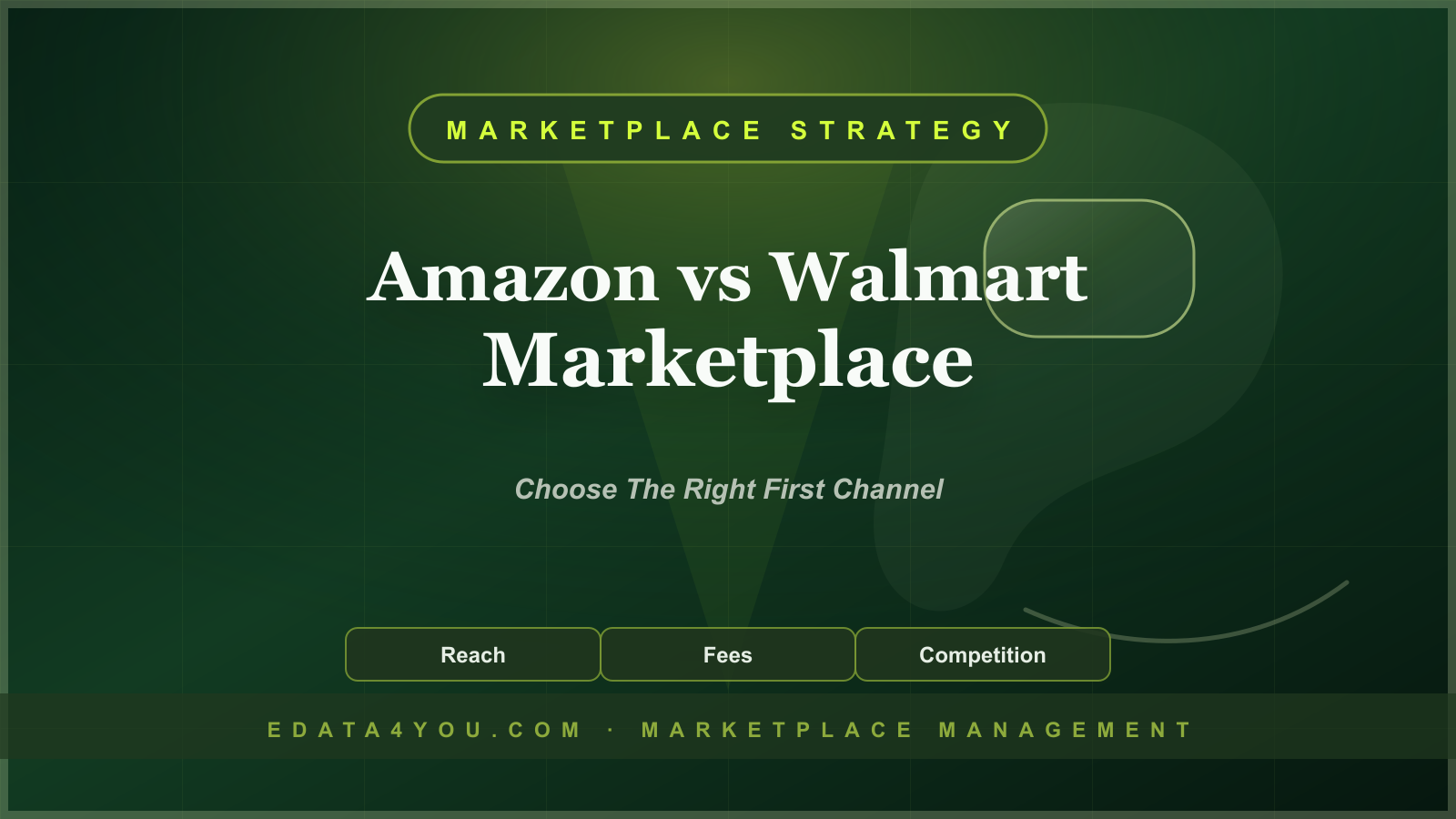
Quick answer
What you need to know
Amazon is the default because of its scale and infrastructure — but Walmart's lower seller density and rising traffic make it a compelling second channel for established Amazon sellers. The real question is whether to sell on both.
The Scale Difference
Referral Fees and Cost Structure
Competition Density
Premium reader tools
Turn insight into action
The brief, before you dive in
A practical snapshot of what this guide will help you understand and apply.
Key takeaways
- The Scale Difference: Amazon: 200M+ Prime members in the US.
- Referral Fees and Cost Structure: Both platforms charge referral fees as a percentage of the sale price.
- Competition Density: This is the most underappreciated difference between the two platforms.
- Product Fit by Category: Better fit on Amazon: Tech accessories, premium brands, books, tools, specialty products, premium health and beauty, international buyers.
Amazon is the default because of its scale and infrastructure — but Walmart's lower seller density and rising traffic make it a compelling second channel for established Amazon sellers. The real question is whether to sell on both.
Use the Amazon vs Walmart comparison tool to evaluate fees and positioning side by side. This guide explains the strategic context behind the numbers.
Need help applying this? Explore our Amazon Account Management.
The Scale Difference
Amazon: 200M+ Prime members in the US. Over 350M products listed. The default starting point for product discovery for most American online shoppers. Amazon controls approximately 40% of US ecommerce revenue.
Walmart Marketplace: 120M+ unique monthly visitors. 400M+ in-store customers annually across physical Walmart locations. Walmart's marketplace has grown from ~$1B to $15B+ in GMV over five years. Seller count has grown rapidly but remains far below Amazon's density.
Scale favors Amazon — there is no comparison on total addressable buyers. But scale also means far more competition for any given keyword or product category on Amazon vs. Walmart.
Referral Fees and Cost Structure
Both platforms charge referral fees as a percentage of the sale price. Typical ranges:
| Category | Amazon Referral | Walmart Referral |
|---|---|---|
| General merchandise | 15% | 15% |
| Electronics | 8% | 8–15% |
| Apparel | 17% | 15% |
| Grocery | 8% | 8% |
| Jewelry | 20% | 20% |
Amazon FBA fees are additional (fulfillment + storage). Walmart Fulfillment Services (WFS) fees are comparable to FBA but currently slightly lower for standard-size items.
Amazon's key cost advantage: More third-party logistics options, including FBA's scale efficiencies. Walmart's key cost advantage: No monthly seller subscription fee (Amazon charges $39.99/month for Professional). For low-volume sellers, this matters.
Competition Density
This is the most underappreciated difference between the two platforms.
On Amazon, most product categories have dozens to hundreds of established sellers competing for any given keyword. PPC costs are high. Ranking organically takes sustained sales velocity. The Buy Box rotates among sellers on identical ASINs.
On Walmart Marketplace, most categories have 5–20× fewer sellers per product category than Amazon. Many keywords in Walmart's search are not yet heavily contested. This lower competition density means:
- Lower CPC on Walmart's sponsored product advertising
- Easier organic ranking for competitive keywords
- Lower customer acquisition cost during Walmart's growth phase
The catch: Walmart's smaller buyer pool partially offsets the lower competition. But for categories where Walmart's demographics (value-focused, family households, essentials) align with the product, the conversion economics can be favorable.
Turn these recommendations into a working process with Amazon Account Management.
Product Fit by Category
Better fit on Amazon: Tech accessories, premium brands, books, tools, specialty products, premium health and beauty, international buyers.
Better fit on Walmart: Everyday essentials, grocery (Walmart is the US's largest grocer), household goods, baby and children's products, value-price-point items, products that benefit from Walmart's in-store brand recognition.
Neutral: Apparel, home goods, garden, sports — competitive on both platforms, with advantage going to whoever has the better listing and pricing strategy.
The Multi-Channel Case
Most established Amazon sellers who expand to Walmart report that Walmart adds 15–30% incremental revenue from their existing catalog with relatively low marginal operational cost — especially if they use WFS (which mirrors the FBA workflow) or an existing 3PL already connected to Walmart's API.
The argument against starting on both simultaneously: seller bandwidth is limited. A new marketplace requires new accounts, new ad campaigns, new pricing monitoring, new compliance management. Doing both poorly on launch is worse than mastering Amazon first and adding Walmart at 80% competency.
When to Start with Amazon
- You are launching a new product and need the broadest possible initial audience
- Your product is novel or needs discovery — Amazon's "Customers Also Bought" and search discovery is unmatched
- You want Prime eligibility (FBA) as a conversion driver from day one
- Your category is less developed on Walmart (tech, specialty tools, premium brands)
When Walmart Should Be Your Second Channel (Not First)
Walmart Marketplace works best as an expansion channel for sellers who have already proven their product on Amazon and want incremental revenue without starting a new customer discovery process from scratch. Your Amazon reviews, pricing knowledge, and catalog are directly transferable.
Walmart's application process is selective — they review business history, product quality, and seller metrics. Having an established Amazon track record strengthens the application.

Let's build something great together
A dedicated team of ecommerce, design, and data specialists - ready to scale your business across every marketplace.
Recent Posts
Latest on Social
Grow your sales on Amazon, Walmart & more
Our marketplace specialists handle listings, SEO, catalog & ads - end to end.
Talk to an Expert
Amit Sharma
Founder & IT Head | Project Management & IT Strategy Expert
Leave a Comment