Quick answer
What you need to know
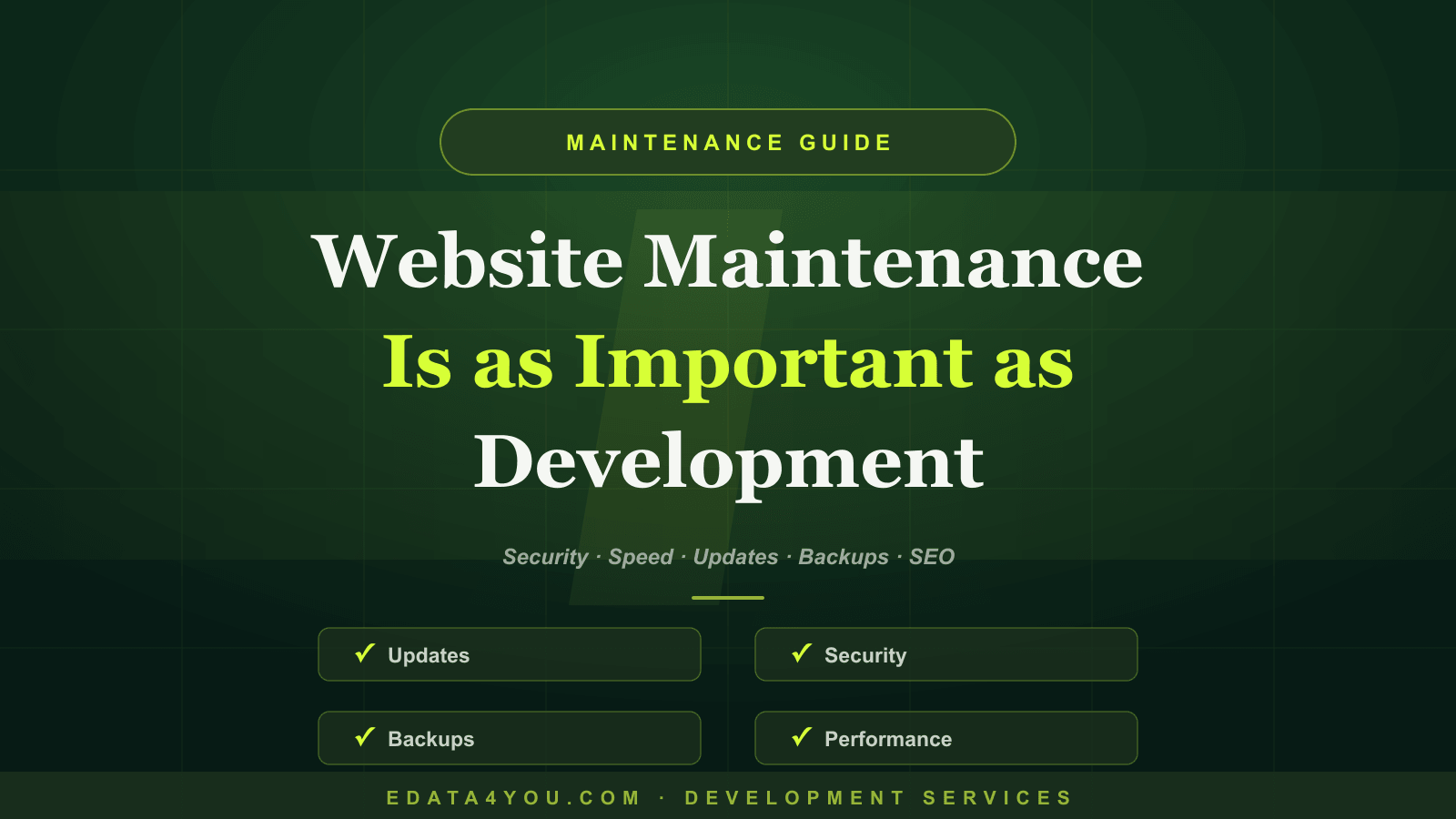
A complete guide to why website maintenance is as important as development, including security, updates, backups, performance, SEO, uptime, and support.
Who This Guide Is For
A Website Starts Aging the Day It Launches
What Website Maintenance Actually Includes
Premium reader tools
Turn insight into action
The brief, before you dive in
A practical snapshot of what this guide will help you understand and apply.
Key takeaways
- Who This Guide Is For: This guide is written for business owners, ecommerce teams, startup founders, operations managers, marketing teams, and decision-makers who need devel…
- A Website Starts Aging the Day It Launches: Browsers change, search engines update, frameworks evolve, plugins release patches, content becomes outdated, and user expectations rise.
- What Website Maintenance Actually Includes: Maintenance includes software updates, dependency checks, backups, security monitoring, uptime monitoring, form testing, broken link checks, content u…
- The Cost of Ignoring Maintenance: A broken contact form can waste paid traffic.
A complete guide to why website maintenance is as important as development, including security, updates, backups, performance, SEO, uptime, and support.
Businesses often invest heavily in a new website and then stop maintaining it. Over time, plugins, dependencies, content, forms, tracking, speed, security, and SEO health degrade. The site still exists, but it quietly stops performing.
This guide explains what website maintenance includes, why it protects revenue, and how to create a maintenance routine that prevents avoidable emergencies.
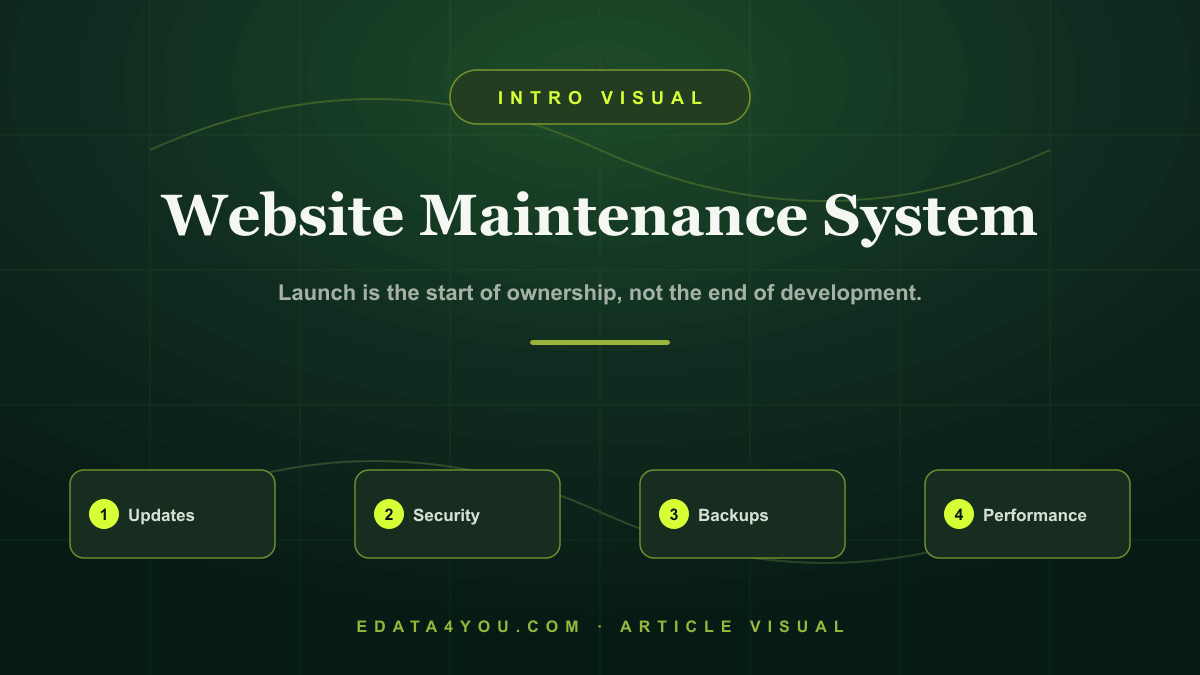
Launch is the start of ownership, not the end of development.
Need help applying this? Explore our Website Maintenance Services.
Who This Guide Is For
This guide is written for business owners, ecommerce teams, startup founders, operations managers, marketing teams, and decision-makers who need development work to solve real business problems. It is also useful for teams that are preparing to outsource development and want a clear framework before speaking with vendors.
The goal is not to make every reader a developer. The goal is to help you ask better questions, avoid expensive mistakes, and understand what a responsible implementation should include.
A Website Starts Aging the Day It Launches
Browsers change, search engines update, frameworks evolve, plugins release patches, content becomes outdated, and user expectations rise. A website that was healthy at launch can become slow, insecure, or inaccurate within months if nobody owns maintenance.
Maintenance is not just technical housekeeping. It protects lead generation, ecommerce revenue, customer trust, brand reputation, and SEO performance.
What Website Maintenance Actually Includes
Maintenance includes software updates, dependency checks, backups, security monitoring, uptime monitoring, form testing, broken link checks, content updates, analytics review, performance optimization, accessibility review, and technical SEO checks.
For ecommerce, maintenance also includes payment testing, checkout monitoring, product data updates, product feed checks, inventory sync review, coupon testing, marketplace integration checks, and order flow validation.
The Cost of Ignoring Maintenance
A broken contact form can waste paid traffic. A slow product page can lower conversion. An outdated plugin can create a security incident. Missing backups can turn a small bug into a major recovery problem.
Maintenance reduces surprise. It gives the business a controlled process for finding and fixing issues before customers do.
Maintenance and SEO
SEO health depends on ongoing care. Broken links, slow pages, outdated content, redirect problems, missing metadata, indexation errors, and layout shifts can reduce organic performance.
A monthly technical SEO and content maintenance review helps keep important pages healthy and useful.
Step-by-Step Implementation Framework
Use this framework before you approve design, development, migration, or integration work:
- Create a monthly maintenance checklist
- Schedule updates, backups, security scans, and form tests
- Monitor uptime, speed, analytics, and conversion actions
- Review content accuracy and SEO health
- Document issues, fixes, owners, and next review date
This framework reduces ambiguity. It also gives your internal team and development partner a shared language for scope, responsibility, and quality.
Practical Checklist
| Area | What to Check |
|---|---|
| Weekly | Backup confirmation, uptime review, form testing, and security scan |
| Monthly | Updates, speed review, broken links, analytics, and content fixes |
| Quarterly | SEO audit, accessibility check, conversion review, and dependency cleanup |
| Ecommerce | Checkout, payments, inventory sync, product data, feeds, and tracking |
| Emergency Plan | Rollback, restore, contacts, access, and escalation steps |
Use this checklist as a discovery tool before the project starts and as a QA tool before launch. If any row is unclear, the project needs more planning before implementation begins.
Turn these recommendations into a working process with Website Maintenance Services.
Ecommerce and AI Considerations
Even when the project is not an ecommerce website, ecommerce discipline is useful because it forces the team to think about data quality, conversion paths, speed, search visibility, integrations, and repeatable operations. For ecommerce businesses, these issues are even more important because small technical problems can affect product discovery, checkout, marketplace feeds, customer support, and revenue reporting.
AI adds another layer. Websites and apps increasingly connect with AI search, AI support, automated reporting, product recommendation systems, content generation, and workflow automation. These tools depend on clean structure. If pages, data fields, APIs, and content are poorly organized, AI features will produce unreliable results.
Plan for AI readiness by keeping data structured, permissions clear, logs available, and human review built into sensitive workflows. AI should improve decision-making and productivity, not create hidden quality problems.
Common Mistakes to Avoid
- Only updating after something breaks
- Skipping backups before changes
- Ignoring forms and checkout tests
- Letting content become outdated
- Not documenting who owns maintenance
Most of these mistakes happen because the project starts too quickly. A short planning phase with the right questions is cheaper than rebuilding after launch.
Budget, Timeline, and Ownership
A responsible development budget should include discovery, design, development, content, integrations, testing, launch support, and maintenance. If a quote only covers coding, it may miss the work required to make the project successful.
Timeline depends on complexity. A focused business website may take weeks. A custom ecommerce workflow, app, dashboard, or integration-heavy project may take longer because requirements, testing, and data mapping are more involved.
Ownership should be defined before launch. Decide who manages content, who monitors errors, who reviews analytics, who approves changes, who handles support, and who maintains documentation. Without ownership, even a well-built system can decay.
30-60-90 Day Roadmap
| Timeline | Focus | Outcome |
|---|---|---|
| First 30 Days | Discovery, requirements, content/data audit, workflow mapping, and technical planning | Clear scope and reduced risk before build |
| Days 31-60 | Design, development, integration setup, content preparation, and internal review | Working system ready for structured QA |
| Days 61-90 | Testing, launch, analytics review, training, support process, and optimization | Stable launch with measurable improvement plan |
The exact timeline may change, but the sequence should not. Discovery comes before build, QA comes before launch, and optimization comes after real usage data appears.
How eData4You Can Help
eData4You helps businesses plan, build, maintain, and support digital systems across websites, ecommerce operations, dashboards, APIs, app workflows, product data, and ongoing support. Our development work is connected with practical operations, so the final solution is easier to manage after launch.
Our team can support requirement planning, website development, ecommerce workflows, API integrations, dashboard development, product data operations, content updates, QA support, and maintenance. This is especially useful for businesses that need development connected with real back-office execution.
If your business needs development support, API integration, ecommerce workflows, website maintenance, dashboard planning, or AI-ready data operations, contact eData4You to discuss the project.
Frequently Asked Questions
How often should a website be maintained?
Business-critical websites should have weekly checks and monthly maintenance. Ecommerce sites often need more frequent monitoring.
Is website maintenance different from redesign?
Yes. Maintenance keeps the existing site healthy. Redesign changes structure, visual direction, content strategy, or user experience.
What is the biggest maintenance risk?
The biggest risk is lack of ownership. If nobody is responsible for checks, small issues can become expensive problems.
Final Thoughts
Good development is not only about launching a website or app. It is about building a system that stays useful, measurable, secure, and adaptable as the business grows.
Start with clear goals, document the workflow, choose technology deliberately, build with quality controls, and maintain the product after launch. That is how development becomes a business asset instead of a one-time expense.
Let's build something great together
A dedicated team of ecommerce, design, and data specialists - ready to scale your business across every marketplace.
Recent Posts
Latest on Social
Grow your sales on Amazon, Walmart & more
Our marketplace specialists handle listings, SEO, catalog & ads - end to end.
Talk to an Expert
Amit Sharma
Founder & IT Head | Project Management & IT Strategy Expert
Leave a Comment