Quick answer
What you need to know
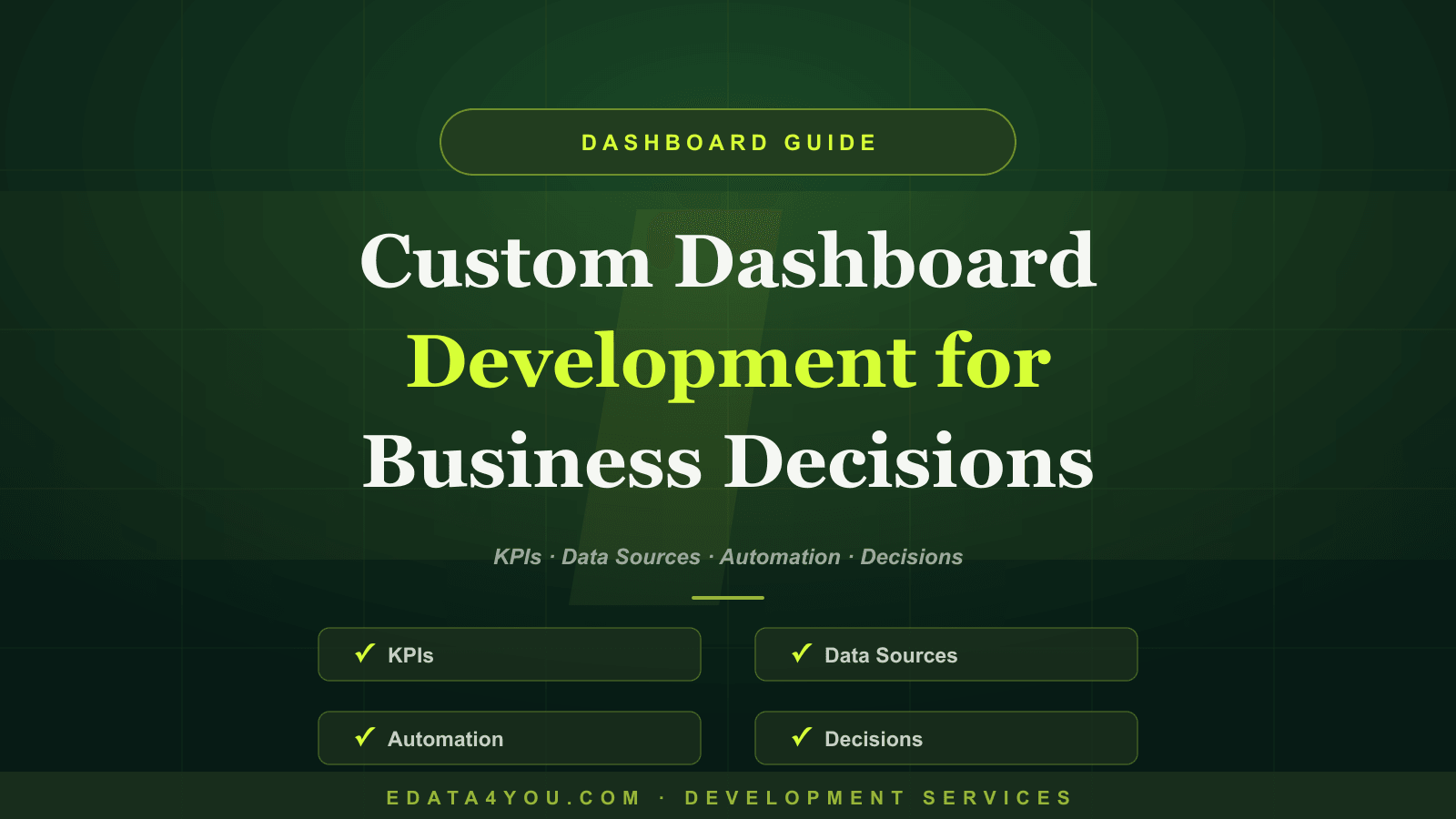
A complete guide to custom dashboard development for businesses that need better KPIs, integrations, automation, reporting, role-based views, and decision workflows.
Who This Guide Is For
Start With Decisions, Not Charts
Identify the Right KPIs
Premium reader tools
Turn insight into action
The brief, before you dive in
A practical snapshot of what this guide will help you understand and apply.
Key takeaways
- Who This Guide Is For: This guide is written for business owners, ecommerce teams, startup founders, operations managers, marketing teams, and decision-makers who need devel…
- Start With Decisions, Not Charts: A dashboard should answer business questions.
- Identify the Right KPIs: Good KPIs are tied to business outcomes.
- Connect Data Sources Carefully: Custom dashboards often need data from stores, marketplaces, CRMs, ad platforms, accounting tools, spreadsheets, support systems, and internal databas…
A complete guide to custom dashboard development for businesses that need better KPIs, integrations, automation, reporting, role-based views, and decision workflows.
Many businesses have data in CRMs, ecommerce platforms, ad accounts, support tools, spreadsheets, inventory systems, and finance software. The problem is not lack of data. The problem is that decision-makers cannot see the right data at the right time.
This guide explains how to plan custom dashboards that connect data sources, show meaningful KPIs, reduce manual reporting, and help teams take action faster.
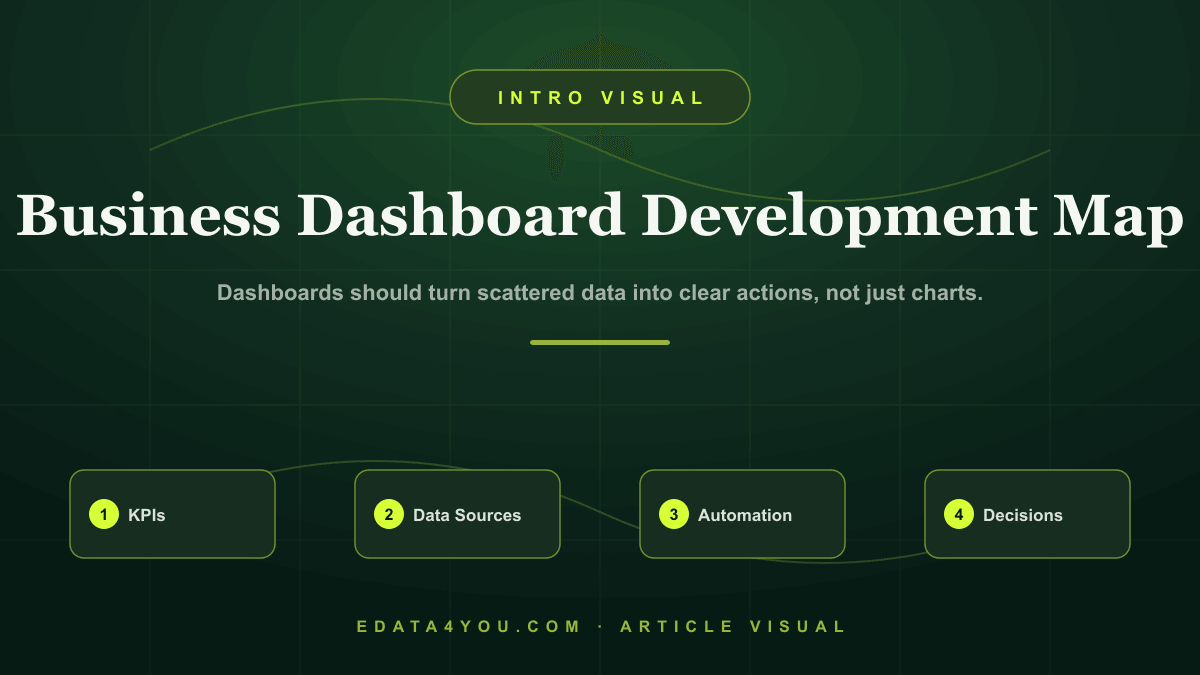
Dashboards should turn scattered data into clear actions, not just charts.
Need help applying this? Explore our Web Design & Development.
Who This Guide Is For
This guide is written for business owners, ecommerce teams, startup founders, operations managers, marketing teams, and decision-makers who need development work to solve real business problems. It is also useful for teams that are preparing to outsource development and want a clear framework before speaking with vendors.
The goal is not to make every reader a developer. The goal is to help you ask better questions, avoid expensive mistakes, and understand what a responsible implementation should include.
Start With Decisions, Not Charts
A dashboard should answer business questions. What needs attention today? Which products are underperforming? Which leads need follow-up? Which campaigns are wasting money? Which support issues are growing?
If a dashboard only displays charts without decision context, it becomes decoration. A useful dashboard connects metrics to owners, thresholds, and actions.
Identify the Right KPIs
Good KPIs are tied to business outcomes. Ecommerce teams may track revenue, margin, conversion rate, average order value, inventory risk, return rate, ad spend, and product performance. Sales teams may track leads, pipeline, follow-ups, close rate, and revenue forecast.
Avoid vanity metrics that do not change decisions. A dashboard should make it easier to act, not harder to focus.
Connect Data Sources Carefully
Custom dashboards often need data from stores, marketplaces, CRMs, ad platforms, accounting tools, spreadsheets, support systems, and internal databases.
Before development, define each data source, refresh frequency, owner, format, authentication method, and data quality risk. Dirty data produces misleading dashboards.
Design for Roles and Actions
Executives, managers, sales teams, operations teams, and clients do not need the same view. Role-based dashboards reduce clutter and protect sensitive data.
Include filters, alerts, export options, drill-downs, and notes where they support real workflows.
Step-by-Step Implementation Framework
Use this framework before you approve design, development, migration, or integration work:
- Define the decisions the dashboard must support
- Choose KPIs and remove vanity metrics
- Map data sources, ownership, refresh rules, and quality checks
- Design role-based views and action states
- Launch with monitoring, feedback, and iteration
This framework reduces ambiguity. It also gives your internal team and development partner a shared language for scope, responsibility, and quality.
Practical Checklist
| Area | What to Check |
|---|---|
| Users | Who uses the dashboard and what decisions do they make? |
| KPIs | Which metrics change action, budget, staffing, or priority? |
| Sources | Which systems provide data and how often should they refresh? |
| Quality | How will duplicates, missing fields, stale data, and errors be flagged? |
| Actions | What should users do when a metric crosses a threshold? |
Use this checklist as a discovery tool before the project starts and as a QA tool before launch. If any row is unclear, the project needs more planning before implementation begins.
Turn these recommendations into a working process with Web Design & Development.
Ecommerce and AI Considerations
Even when the project is not an ecommerce website, ecommerce discipline is useful because it forces the team to think about data quality, conversion paths, speed, search visibility, integrations, and repeatable operations. For ecommerce businesses, these issues are even more important because small technical problems can affect product discovery, checkout, marketplace feeds, customer support, and revenue reporting.
AI adds another layer. Websites and apps increasingly connect with AI search, AI support, automated reporting, product recommendation systems, content generation, and workflow automation. These tools depend on clean structure. If pages, data fields, APIs, and content are poorly organized, AI features will produce unreliable results.
Plan for AI readiness by keeping data structured, permissions clear, logs available, and human review built into sensitive workflows. AI should improve decision-making and productivity, not create hidden quality problems.
Common Mistakes to Avoid
- Starting with chart design before defining decisions
- Connecting dirty data without cleanup
- Showing every metric to every user
- Skipping permissions and access control
- Not assigning ownership for dashboard accuracy
Most of these mistakes happen because the project starts too quickly. A short planning phase with the right questions is cheaper than rebuilding after launch.
Budget, Timeline, and Ownership
A responsible development budget should include discovery, design, development, content, integrations, testing, launch support, and maintenance. If a quote only covers coding, it may miss the work required to make the project successful.
Timeline depends on complexity. A focused business website may take weeks. A custom ecommerce workflow, app, dashboard, or integration-heavy project may take longer because requirements, testing, and data mapping are more involved.
Ownership should be defined before launch. Decide who manages content, who monitors errors, who reviews analytics, who approves changes, who handles support, and who maintains documentation. Without ownership, even a well-built system can decay.
30-60-90 Day Roadmap
| Timeline | Focus | Outcome |
|---|---|---|
| First 30 Days | Discovery, requirements, content/data audit, workflow mapping, and technical planning | Clear scope and reduced risk before build |
| Days 31-60 | Design, development, integration setup, content preparation, and internal review | Working system ready for structured QA |
| Days 61-90 | Testing, launch, analytics review, training, support process, and optimization | Stable launch with measurable improvement plan |
The exact timeline may change, but the sequence should not. Discovery comes before build, QA comes before launch, and optimization comes after real usage data appears.
How eData4You Can Help
eData4You helps businesses plan, build, maintain, and support digital systems across websites, ecommerce operations, dashboards, APIs, app workflows, product data, and ongoing support. Our development work is connected with practical operations, so the final solution is easier to manage after launch.
Our team can support requirement planning, website development, ecommerce workflows, API integrations, dashboard development, product data operations, content updates, QA support, and maintenance. This is especially useful for businesses that need development connected with real back-office execution.
If your business needs development support, API integration, ecommerce workflows, website maintenance, dashboard planning, or AI-ready data operations, contact eData4You to discuss the project.
Frequently Asked Questions
What is custom dashboard development?
It is the design and development of dashboards tailored to a business’s KPIs, data sources, user roles, workflows, and decision needs.
Why not use a generic reporting tool?
Generic tools can work, but custom dashboards are better when business rules, data sources, permissions, or workflows are specific.
Can dashboards use AI?
Yes. AI can support summaries, anomaly detection, forecasting, natural-language queries, and recommended actions when the underlying data is clean.
Final Thoughts
Good development is not only about launching a website or app. It is about building a system that stays useful, measurable, secure, and adaptable as the business grows.
Start with clear goals, document the workflow, choose technology deliberately, build with quality controls, and maintain the product after launch. That is how development becomes a business asset instead of a one-time expense.
Let's build something great together
A dedicated team of ecommerce, design, and data specialists - ready to scale your business across every marketplace.
Recent Posts
Latest on Social
Grow your sales on Amazon, Walmart & more
Our marketplace specialists handle listings, SEO, catalog & ads - end to end.
Talk to an Expert
Amit Sharma
Founder & IT Head | Project Management & IT Strategy Expert



Leave a Comment