

Quick answer
What you need to know
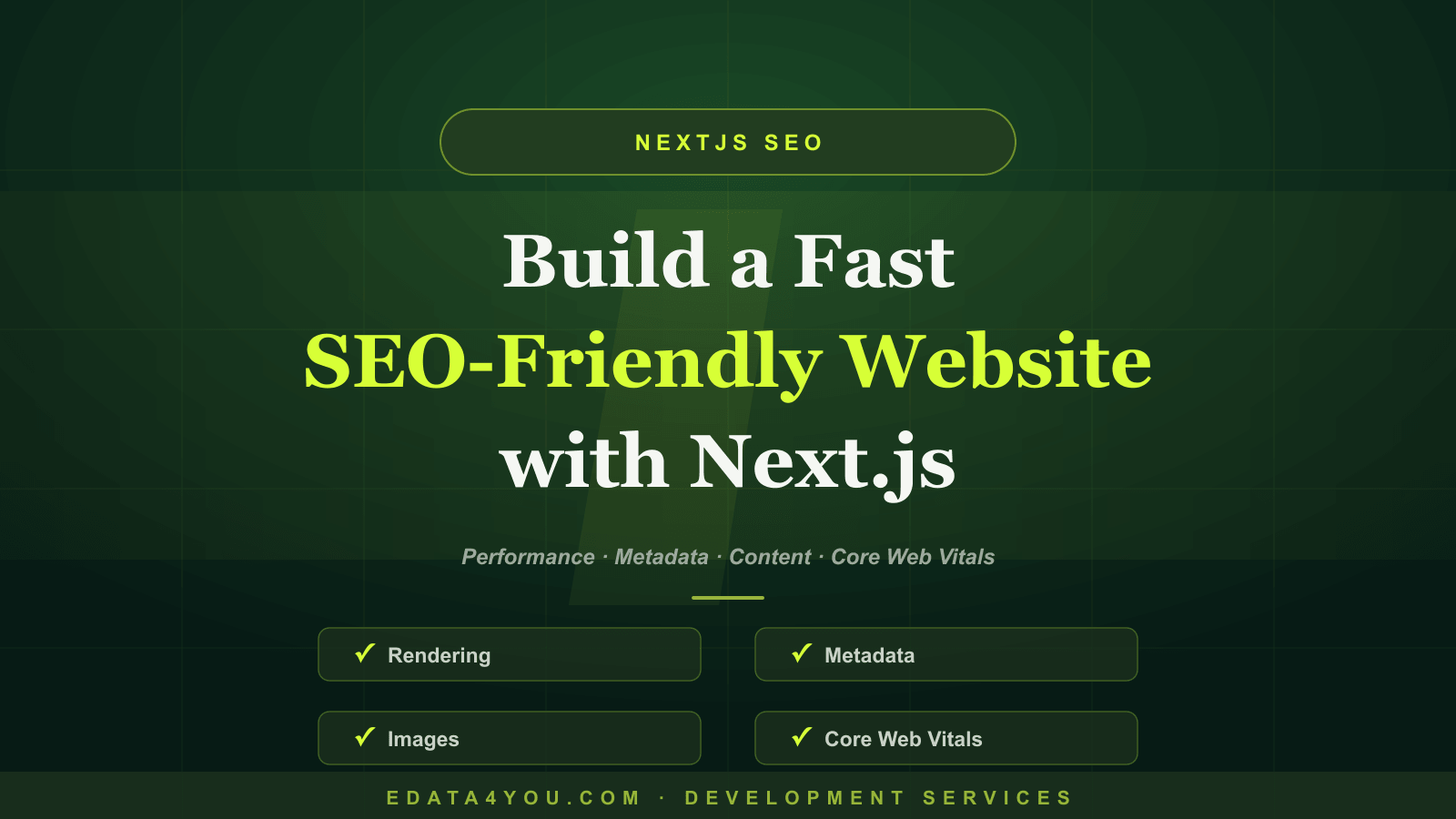
A complete guide to building a fast, SEO-friendly business website with Next.js using content architecture, rendering strategy, metadata, image optimization, and Core Web Vitals.
Who This Guide Is For
Why Next.js Is Strong for Business Websites
Plan the Website Architecture First
Premium reader tools
Turn insight into action
The brief, before you dive in
A practical snapshot of what this guide will help you understand and apply.
Key takeaways
- Who This Guide Is For: This guide is written for business owners, ecommerce teams, startup founders, operations managers, marketing teams, and decision-makers who need devel…
- Why Next.js Is Strong for Business Websites: Next.js gives development teams control over rendering, routing, metadata, image optimization, caching, and page structure.
- Plan the Website Architecture First: Before writing components, map the site structure.
- Build for Performance From the Start: Performance should not be an after-launch cleanup task.
A complete guide to building a fast, SEO-friendly business website with Next.js using content architecture, rendering strategy, metadata, image optimization, and Core Web Vitals.
Many business websites look modern but perform poorly in search because they are slow, thin, hard to crawl, missing metadata, or built without a scalable content structure. Next.js can solve these issues, but only if the project is planned correctly.
This guide explains how to use Next.js for a business website that is fast, crawlable, easy to expand, and ready for SEO, analytics, and future AI-assisted content operations.
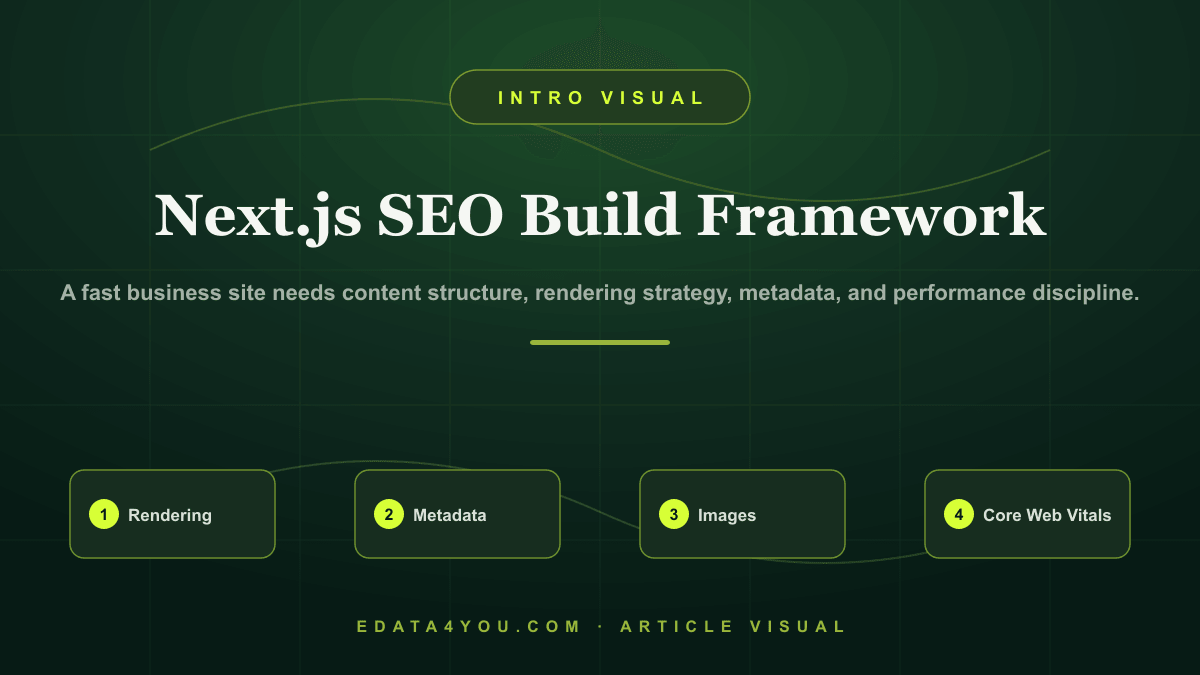
A fast business site needs content structure, rendering strategy, metadata, and performance discipline.
Need help applying this? Explore our Web Design & Development.
Who This Guide Is For
This guide is written for business owners, ecommerce teams, startup founders, operations managers, marketing teams, and decision-makers who need development work to solve real business problems. It is also useful for teams that are preparing to outsource development and want a clear framework before speaking with vendors.
The goal is not to make every reader a developer. The goal is to help you ask better questions, avoid expensive mistakes, and understand what a responsible implementation should include.
Why Next.js Is Strong for Business Websites
Next.js gives development teams control over rendering, routing, metadata, image optimization, caching, and page structure. That control is valuable for business websites where SEO, speed, and content expansion matter.
A Next.js site can be statically generated for fast service pages, server-rendered for dynamic content, or built as a hybrid system. This flexibility helps teams create pages that are both user-friendly and search-friendly.
However, Next.js does not automatically make a website rank. The result depends on architecture, content quality, internal linking, performance, accessibility, and technical SEO execution.
Plan the Website Architecture First
Before writing components, map the site structure. Define core service pages, industry pages, location pages, blog categories, case studies, pricing pages, comparison pages, and conversion paths.
Each important page should target a clear search intent. For example, a page about ecommerce development should not also try to rank for website maintenance, API integration, and SEO services at the same time. Focused pages perform better and are easier for users to understand.
A strong content architecture also helps AI search systems and answer engines understand what your business does.
Build for Performance From the Start
Performance should not be an after-launch cleanup task. Use optimized images, stable layout dimensions, careful font loading, limited client-side JavaScript, and caching strategies from the beginning.
Choose static rendering for pages that rarely change. Use server rendering when content depends on live data. Avoid turning every component into a client component when it does not need browser interactivity.
Core Web Vitals should be checked on real templates: homepage, service page, blog post, category page, landing page, and contact flow.
Step-by-Step Implementation Framework
Use this framework before you approve design, development, migration, or integration work:
- Create the SEO page map and URL structure
- Choose rendering mode for each page type
- Define metadata, schema, internal links, and image rules
- Build reusable templates for services, posts, and landing pages
- Measure Core Web Vitals before and after launch
This framework reduces ambiguity. It also gives your internal team and development partner a shared language for scope, responsibility, and quality.
Practical Checklist
| Area | What to Check |
|---|---|
| Rendering | Static, server, or hybrid based on content freshness and SEO needs |
| Metadata | Unique title, description, canonical, OG image, and structured page intent |
| Images | Correct dimensions, compression, alt text, lazy loading, and stable layout |
| Content | Useful headings, internal links, FAQs, schema-friendly details, and CTAs |
| Performance | Reduced JavaScript, caching, CDN, font optimization, and monitoring |
Use this checklist as a discovery tool before the project starts and as a QA tool before launch. If any row is unclear, the project needs more planning before implementation begins.
Turn these recommendations into a working process with Web Design & Development.
Ecommerce and AI Considerations
Even when the project is not an ecommerce website, ecommerce discipline is useful because it forces the team to think about data quality, conversion paths, speed, search visibility, integrations, and repeatable operations. For ecommerce businesses, these issues are even more important because small technical problems can affect product discovery, checkout, marketplace feeds, customer support, and revenue reporting.
AI adds another layer. Websites and apps increasingly connect with AI search, AI support, automated reporting, product recommendation systems, content generation, and workflow automation. These tools depend on clean structure. If pages, data fields, APIs, and content are poorly organized, AI features will produce unreliable results.
Plan for AI readiness by keeping data structured, permissions clear, logs available, and human review built into sensitive workflows. AI should improve decision-making and productivity, not create hidden quality problems.
Common Mistakes to Avoid
- Building every page as a client-heavy application
- Ignoring metadata templates until launch week
- Uploading oversized images
- Using generic service page copy
- Skipping redirects, sitemap, and analytics checks
Most of these mistakes happen because the project starts too quickly. A short planning phase with the right questions is cheaper than rebuilding after launch.
Budget, Timeline, and Ownership
A responsible development budget should include discovery, design, development, content, integrations, testing, launch support, and maintenance. If a quote only covers coding, it may miss the work required to make the project successful.
Timeline depends on complexity. A focused business website may take weeks. A custom ecommerce workflow, app, dashboard, or integration-heavy project may take longer because requirements, testing, and data mapping are more involved.
Ownership should be defined before launch. Decide who manages content, who monitors errors, who reviews analytics, who approves changes, who handles support, and who maintains documentation. Without ownership, even a well-built system can decay.
30-60-90 Day Roadmap
| Timeline | Focus | Outcome |
|---|---|---|
| First 30 Days | Discovery, requirements, content/data audit, workflow mapping, and technical planning | Clear scope and reduced risk before build |
| Days 31-60 | Design, development, integration setup, content preparation, and internal review | Working system ready for structured QA |
| Days 61-90 | Testing, launch, analytics review, training, support process, and optimization | Stable launch with measurable improvement plan |
The exact timeline may change, but the sequence should not. Discovery comes before build, QA comes before launch, and optimization comes after real usage data appears.
How eData4You Can Help
eData4You helps businesses plan, build, maintain, and support digital systems across websites, ecommerce operations, dashboards, APIs, app workflows, product data, and ongoing support. Our development work is connected with practical operations, so the final solution is easier to manage after launch.
Our team can support requirement planning, website development, ecommerce workflows, API integrations, dashboard development, product data operations, content updates, QA support, and maintenance. This is especially useful for businesses that need development connected with real back-office execution.
If your business needs development support, API integration, ecommerce workflows, website maintenance, dashboard planning, or AI-ready data operations, contact eData4You to discuss the project.
Frequently Asked Questions
Is Next.js good for SEO?
Yes, when implemented properly. It supports fast rendering, crawlable content, metadata, routing, and image optimization.
Does Next.js automatically improve rankings?
No. Rankings still require useful content, technical SEO, page speed, authority, and a good user experience.
Can Next.js support ecommerce websites?
Yes. Next.js is often used for headless ecommerce storefronts, product content hubs, high-performance landing pages, and custom checkout-adjacent experiences.
Final Thoughts
Good development is not only about launching a website or app. It is about building a system that stays useful, measurable, secure, and adaptable as the business grows.
Start with clear goals, document the workflow, choose technology deliberately, build with quality controls, and maintain the product after launch. That is how development becomes a business asset instead of a one-time expense.
Let's build something great together
A dedicated team of ecommerce, design, and data specialists - ready to scale your business across every marketplace.
Recent Posts
Latest on Social
Grow your sales on Amazon, Walmart & more
Our marketplace specialists handle listings, SEO, catalog & ads - end to end.
Talk to an Expert
Amit Sharma
Founder & IT Head | Project Management & IT Strategy Expert

Leave a Comment