Quick answer
What you need to know
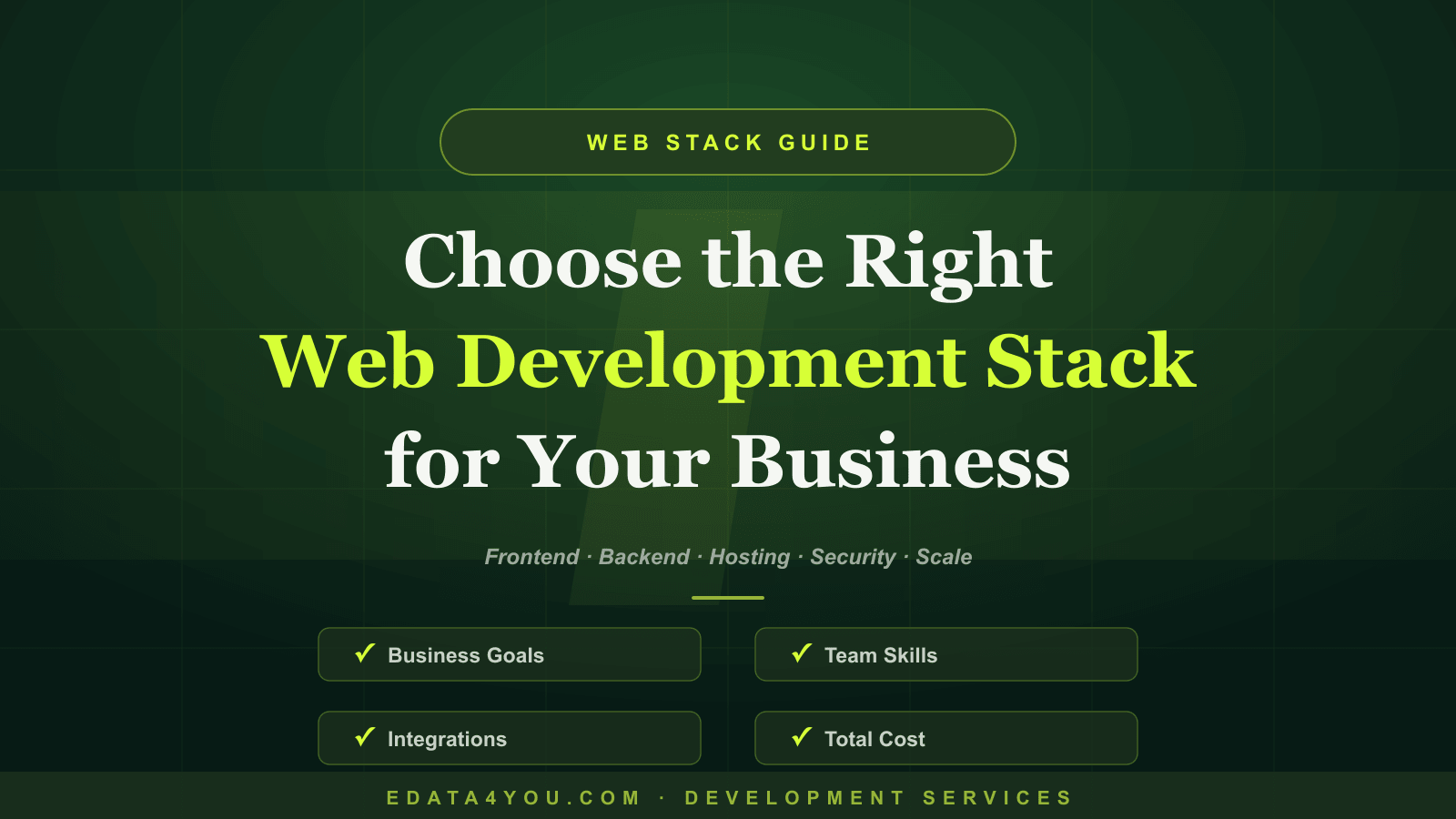
A complete guide to choosing the right web development stack for business websites, ecommerce platforms, SaaS products, portals, and custom applications.
Who This Guide Is For
Start With the Business Model, Not the Framework
Map the Core Workflows Before Choosing Technology
Premium reader tools
Turn insight into action
The brief, before you dive in
A practical snapshot of what this guide will help you understand and apply.
Key takeaways
- Who This Guide Is For: This guide is written for business owners, ecommerce teams, startup founders, operations managers, marketing teams, and decision-makers who need devel…
- Start With the Business Model, Not the Framework: The right stack depends on what the business needs the website or application to do.
- Map the Core Workflows Before Choosing Technology: Create a workflow map for customers, staff, and administrators.
- Compare Frontend, Backend, Database, and Hosting Together: Do not evaluate one layer in isolation.
A complete guide to choosing the right web development stack for business websites, ecommerce platforms, SaaS products, portals, and custom applications.
Businesses often choose a stack because a developer likes it, a competitor uses it, or a platform looks popular. That creates trouble later when the website needs integrations, faster pages, product data workflows, custom dashboards, or AI features that the original architecture was not designed to support.
This guide gives you a practical stack selection process so you can make a decision that supports revenue, operations, SEO, security, maintainability, and future growth.
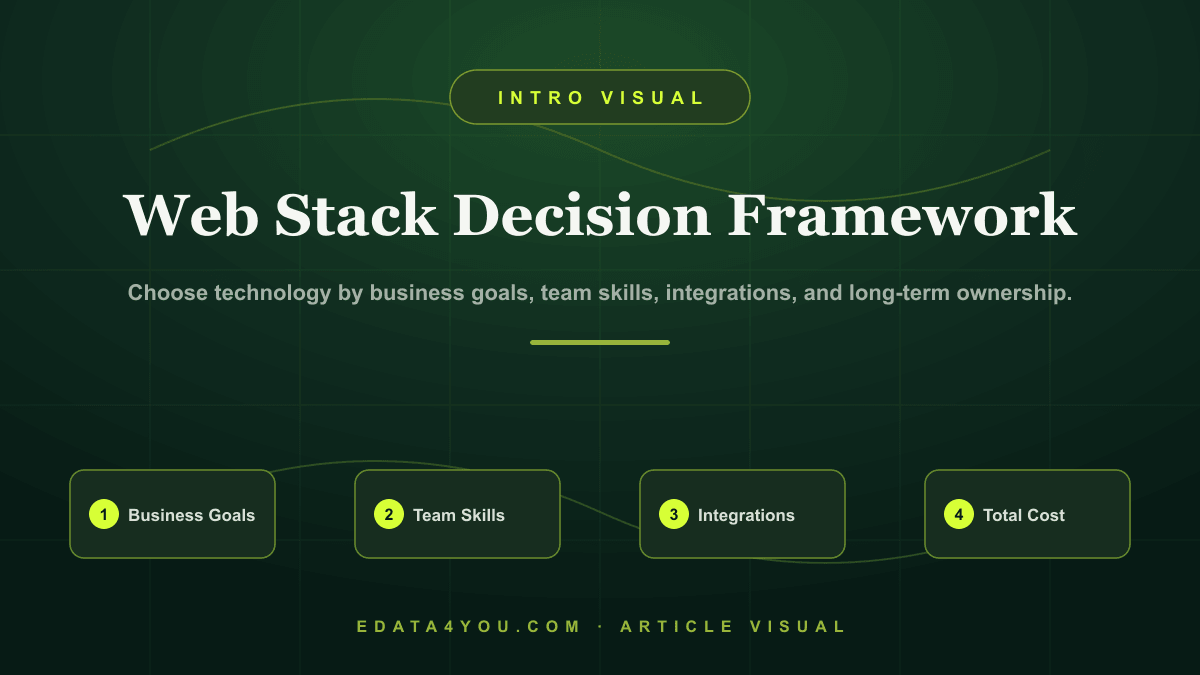
Choose technology by business goals, user workflows, integrations, team skills, and long-term ownership.
Need help applying this? Explore our Web Design & Development.
Who This Guide Is For
This guide is written for business owners, ecommerce teams, startup founders, operations managers, marketing teams, and decision-makers who need development work to solve real business problems. It is also useful for teams that are preparing to outsource development and want a clear framework before speaking with vendors.
The goal is not to make every reader a developer. The goal is to help you ask better questions, avoid expensive mistakes, and understand what a responsible implementation should include.
Start With the Business Model, Not the Framework
The right stack depends on what the business needs the website or application to do. A local service website, ecommerce storefront, booking platform, customer portal, internal dashboard, SaaS product, and marketplace all have different technical requirements.
Before comparing React, Next.js, Laravel, Django, Shopify, WordPress, Node.js, or serverless platforms, write down the business model. Ask what users need to accomplish, what data must move between systems, what the internal team must manage, and what success looks like after launch.
For an ecommerce business, the stack must support product catalog structure, search, filtering, checkout flow, payment gateways, inventory data, order processing, analytics, and SEO. For a service business, the stack may need lead forms, CRM integration, booking workflows, case studies, local SEO pages, and fast content publishing.
This step prevents a common mistake: choosing a tool that is excellent in general but weak for your specific operating model.
Map the Core Workflows Before Choosing Technology
Create a workflow map for customers, staff, and administrators. Customer workflows include browsing, searching, submitting forms, booking appointments, paying, logging in, downloading documents, or checking order status. Staff workflows include updating content, managing leads, uploading products, reviewing reports, handling tickets, or approving requests.
The stack should make these workflows easy to build and maintain. If product managers need to update content daily, a strong CMS matters. If inventory updates every hour, API reliability matters. If SEO is central to acquisition, rendering strategy and page speed matter. If users log in and access private data, authentication and permissions matter.
A stack decision without workflow mapping usually leads to expensive rework.
Compare Frontend, Backend, Database, and Hosting Together
Do not evaluate one layer in isolation. A fast frontend is less useful if the backend cannot serve data reliably. A flexible database is less useful if the admin interface is impossible for the team to use. Cheap hosting is not cheap if downtime or slow pages hurt conversions.
Frontend choices affect speed, accessibility, interface quality, SEO, and developer experience. Backend choices affect business logic, integrations, security, user roles, and automation. Database choices affect reporting, search, product relationships, and data quality. Hosting choices affect deployment, uptime, logging, image delivery, and monitoring.
A practical stack review should compare complete combinations rather than isolated tools.
Step-by-Step Implementation Framework
Use this framework before you approve design, development, migration, or integration work:
- Define the business outcome and user journeys
- List required integrations and data flows
- Choose rendering strategy for SEO and performance
- Select backend and database based on workflows
- Document ownership, maintenance, and security requirements
This framework reduces ambiguity. It also gives your internal team and development partner a shared language for scope, responsibility, and quality.
Practical Checklist
| Area | What to Check |
|---|---|
| Frontend | Does it support fast pages, accessibility, SEO, and the user experience you need? |
| Backend | Can it handle business logic, APIs, permissions, and automation? |
| Database | Can it model products, customers, orders, reports, or content cleanly? |
| Hosting | Does it provide reliability, CDN, monitoring, logs, and deployment control? |
| Team | Can your team or vendor maintain it confidently for years? |
Use this checklist as a discovery tool before the project starts and as a QA tool before launch. If any row is unclear, the project needs more planning before implementation begins.
Turn these recommendations into a working process with Web Design & Development.
Ecommerce and AI Considerations
Even when the project is not an ecommerce website, ecommerce discipline is useful because it forces the team to think about data quality, conversion paths, speed, search visibility, integrations, and repeatable operations. For ecommerce businesses, these issues are even more important because small technical problems can affect product discovery, checkout, marketplace feeds, customer support, and revenue reporting.
AI adds another layer. Websites and apps increasingly connect with AI search, AI support, automated reporting, product recommendation systems, content generation, and workflow automation. These tools depend on clean structure. If pages, data fields, APIs, and content are poorly organized, AI features will produce unreliable results.
Plan for AI readiness by keeping data structured, permissions clear, logs available, and human review built into sensitive workflows. AI should improve decision-making and productivity, not create hidden quality problems.
Common Mistakes to Avoid
- Choosing a stack before defining workflows
- Ignoring admin and maintenance needs
- Treating hosting as an afterthought
- Choosing tools with limited hiring availability
- Ignoring future AI, automation, and reporting requirements
Most of these mistakes happen because the project starts too quickly. A short planning phase with the right questions is cheaper than rebuilding after launch.
Budget, Timeline, and Ownership
A responsible development budget should include discovery, design, development, content, integrations, testing, launch support, and maintenance. If a quote only covers coding, it may miss the work required to make the project successful.
Timeline depends on complexity. A focused business website may take weeks. A custom ecommerce workflow, app, dashboard, or integration-heavy project may take longer because requirements, testing, and data mapping are more involved.
Ownership should be defined before launch. Decide who manages content, who monitors errors, who reviews analytics, who approves changes, who handles support, and who maintains documentation. Without ownership, even a well-built system can decay.
30-60-90 Day Roadmap
| Timeline | Focus | Outcome |
|---|---|---|
| First 30 Days | Discovery, requirements, content/data audit, workflow mapping, and technical planning | Clear scope and reduced risk before build |
| Days 31-60 | Design, development, integration setup, content preparation, and internal review | Working system ready for structured QA |
| Days 61-90 | Testing, launch, analytics review, training, support process, and optimization | Stable launch with measurable improvement plan |
The exact timeline may change, but the sequence should not. Discovery comes before build, QA comes before launch, and optimization comes after real usage data appears.
How eData4You Can Help
eData4You helps businesses plan, build, maintain, and support digital systems across websites, ecommerce operations, dashboards, APIs, app workflows, product data, and ongoing support. Our development work is connected with practical operations, so the final solution is easier to manage after launch.
Our team can support requirement planning, website development, ecommerce workflows, API integrations, dashboard development, product data operations, content updates, QA support, and maintenance. This is especially useful for businesses that need development connected with real back-office execution.
If your business needs development support, API integration, ecommerce workflows, website maintenance, dashboard planning, or AI-ready data operations, contact eData4You to discuss the project.
Frequently Asked Questions
What is the best web development stack for business websites?
The best stack is the one that fits the business model, workflow complexity, budget, internal skills, performance goals, integrations, and long-term ownership plan.
Is Next.js a good choice for business websites?
Yes, Next.js is strong for SEO-friendly, fast, content-rich, and application-style websites when implemented with good architecture and maintenance practices.
Should small businesses use custom development?
Small businesses should use custom development when templates or website builders cannot support their workflows, integrations, performance needs, or growth plan.
Final Thoughts
Good development is not only about launching a website or app. It is about building a system that stays useful, measurable, secure, and adaptable as the business grows.
Start with clear goals, document the workflow, choose technology deliberately, build with quality controls, and maintain the product after launch. That is how development becomes a business asset instead of a one-time expense.
Let's build something great together
A dedicated team of ecommerce, design, and data specialists - ready to scale your business across every marketplace.
Recent Posts
Latest on Social
Grow your sales on Amazon, Walmart & more
Our marketplace specialists handle listings, SEO, catalog & ads - end to end.
Talk to an Expert
Amit Sharma
Founder & IT Head | Project Management & IT Strategy Expert
Leave a Comment